

In this article11 sections
- Grammy Album of the Year Winners by Year: How This Guide Works
- 1950s–1960s: Soundtracks, Standards, and the British Invasion
- 1970s–1980s: Singer-Songwriters, Blockbusters, and Global Pop
- 1990s–2000s: Unplugged Sets, Hip-Hop Breakthroughs, and Indie Surprises
- 2010s–2020s: Taylor Swift's Record Run and New Barriers Fall
- Compact Grammy Album of the Year Winners by Year: 2016–2026
- Notable Records, Firsts, and Upsets
- Full Grammy Album of the Year Winners by Year: 1959–2026
- How Album of the Year Voting Works
- Using This List for Research and Debate
- Explore More Awards Coverage
Grammy Album of the Year winners by year is the definitive reference every music fan needs during awards season — a chronological roll call of every album crowned the Recording Academy’s top prize from the inaugural 1959 ceremony through the 68th Annual Grammy Awards in February 2026. Album of the Year remains the Grammys’ marquee category: the one envelope producers, labels, and audiences watch most closely when the Crypto.com Arena lights dim and presenters reach for the card. Whether you need decade-by-decade narrative highlights, a compact list of recent champions, or the upsets and firsts that define Grammy history, this evergreen hub organizes the full Grammy Album of the Year winners by year with Recording Academy-verified facts and links to our latest ceremony coverage.
USA Celebs built this guide for readers who want more than trivia cards. We trace how the category evolved from Henry Mancini’s The Music from Peter Gunn through Bad Bunny’s DeBÍ TiRAR MáS FOToS at the 68th Grammys, flag milestone firsts from Judy Garland to Lauryn Hill and OutKast, explain why certain years produced legendary upsets, and note records without duplicating red-carpet fashion analysis. For current-season context, see our Grammy winners 2026 complete list, Taylor Swift Grammy wins full history, Beyoncé Grammy wins record explained, and most Grammy awards won by an artist leaderboard for total trophy counts beyond Album of the Year alone.
Grammy Album of the Year Winners by Year: How This Guide Works
The Grammy Album of the Year winners by year below follows official Recording Academy ceremony years — the year the trophy was presented, not always the calendar year the album was released. Eligibility windows have shifted over the decades, but historians cite ceremony year when building a Grammy Album of the Year winners by year list. We organize content three ways: decade highlights for readers who want narrative context, a compact 2016–2026 table for quick lookups, and a full year-by-year table covering all 68 winners through 2026.
All titles reflect competitive Album of the Year winners as listed in the Grammy Awards official archives. The category has honored full-length albums since the first ceremony; until the 1960s, comedy albums and soundtracks competed alongside pop and jazz releases, which explains early champions like Bob Newhart and Vaughn Meader on the Grammy Album of the Year winners by year roll call.
1950s–1960s: Soundtracks, Standards, and the British Invasion
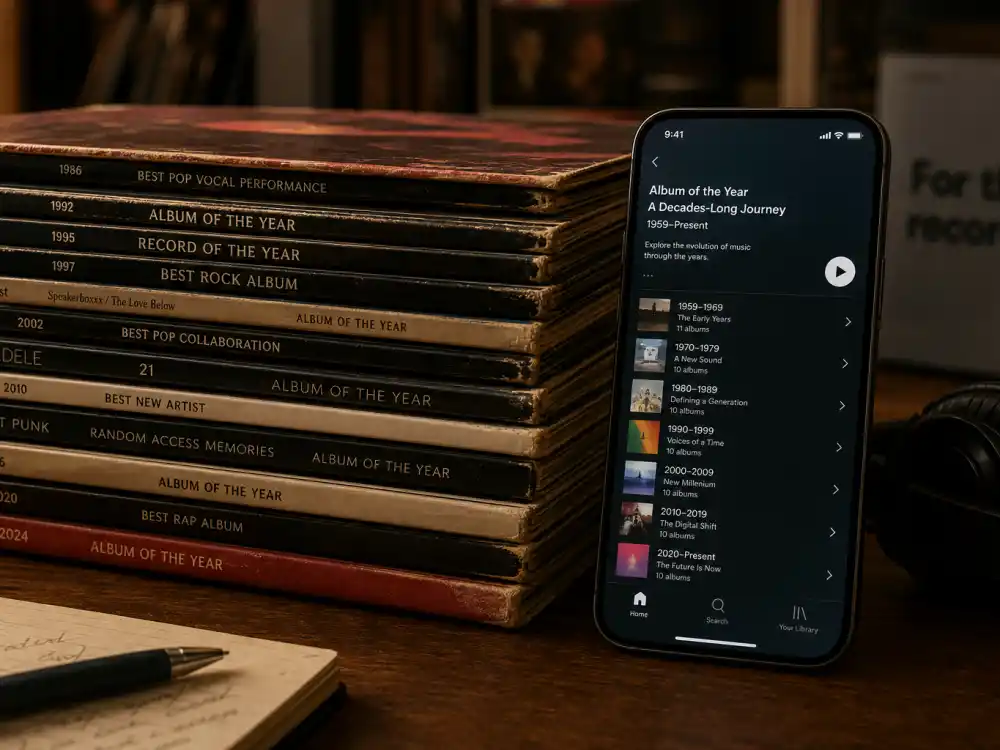
The Grammy Album of the Year winners by year begins with Henry Mancini at the 1st Grammy Awards in 1959 for The Music from Peter Gunn — a television soundtrack that beat Frank Sinatra, Ella Fitzgerald, and Van Cliburn in the inaugural field. The early Grammy Album of the Year winners by year list skewed toward adult-contemporary polish: Sinatra’s Come Dance with Me! (1960), Bob Newhart’s comedy landmark The Button-Down Mind of Bob Newhart (1961), and Vaughn Meader’s political satire The First Family (1963).
Judy Garland won in 1962 for Judy at Carnegie Hall — widely cited as the first solo female artist to claim Album of the Year, a milestone every Grammy Album of the Year winners by year guide must highlight. Barbra Streisand followed with The Barbra Streisand Album (1964). Stan Getz and João Gilberto’s Getz/Gilberto (1965) brought bossa nova to the top prize. Sinatra collected two more wins — September of My Years (1966) and A Man and His Music (1967) — giving him three Album of the Year trophies, tied for the pre-Taylor Swift record.
The Beatles’ Sgt. Pepper’s Lonely Hearts Club Band (1968) signaled rock’s arrival at the center of the Grammy Album of the Year winners by year canon. Glen Campbell’s By the Time I Get to Phoenix (1969) closed the decade with country-pop crossover appeal before the 1970s widened the field further.
1970s–1980s: Singer-Songwriters, Blockbusters, and Global Pop
The Grammy Album of the Year winners by year in the 1970s reads like a classic-rock and soul syllabus. Blood, Sweat & Tears (1970), Simon & Garfunkel’s Bridge over Troubled Water (1971), and Carole King’s Tapestry (1972) anchored the singer-songwriter era. Stevie Wonder won three times in four years — Innervisions (1974), Fulfillingness’ First Finale (1975), and Songs in the Key of Life (1977) — a run that still defines multi-win excellence on any Grammy Album of the Year winners by year chart.
Paul Simon claimed his first solo win with Still Crazy After All These Years (1976); he added Graceland (1987) after the Simon & Garfunkel victory, finishing with three Album of the Year trophies when counting Bridge over Troubled Water. Fleetwood Mac’s Rumours (1978) and the Saturday Night Fever soundtrack (1979) reflected blockbuster commercial dominance.
The 1980s mixed yacht-rock polish with MTV-era spectacle. Billy Joel’s 52nd Street (1980), Christopher Cross’s self-titled debut (1981), and John Lennon & Yoko Ono’s Double Fantasy (1982) opened the decade. Michael Jackson‘s Thriller (1984) remains the best-selling album ever to win Album of the Year. Lionel Richie, Phil Collins, and George Michael followed before U2’s The Joshua Tree (1988) closed the decade as a global rock landmark on the Grammy Album of the Year winners by year timeline.
1990s–2000s: Unplugged Sets, Hip-Hop Breakthroughs, and Indie Surprises
The Grammy Album of the Year winners by year in the 1990s featured veteran comebacks and generational shifts. Quincy Jones’s Back on the Block (1991), Eric Clapton’s Unplugged (1993), Whitney Houston’s The Bodyguard soundtrack (1994), and Tony Bennett’s MTV Unplugged (1995) rewarded established stars. Alanis Morissette’s Jagged Little Pill (1996) and Celine Dion’s Falling into You (1997) dominated mid-decade ballots before Bob Dylan’s Time Out of Mind (1998) gave the legend a late-career capstone.
Lauryn Hill‘s The Miseducation of Lauryn Hill (1999) became a landmark — the first hip-hop-influenced album by a solo female artist to win Album of the Year, reshaping what the Grammy Album of the Year winners by year list could represent. Santana’s Supernatural (2000) and Steely Dan’s Two Against Nature (2001) followed before the O Brother, Where Art Thou? soundtrack (2002) proved Americana could claim the top prize.
OutKast‘s Speakerboxxx/The Love Below (2004) is widely reported as the first rap album to win Album of the Year — a barrier Lauryn Hill’s hybrid masterwork had approached five years earlier. Ray Charles’s Genius Loves Company (2005), U2’s How to Dismantle an Atomic Bomb (2006), and the Dixie Chicks’ Taking the Long Way (2007) reflected voter appetite for legacy and statement albums. Herbie Hancock’s River: The Joni Letters (2008) — a jazz tribute — and Robert Plant & Alison Krauss’s Raising Sand (2009) closed the decade with genre-expanding victories that still spark debate on any Grammy Album of the Year winners by year retrospective.
2010s–2020s: Taylor Swift’s Record Run and New Barriers Fall
Recent chapters of the Grammy Album of the Year winners by year reflect streaming dominance, expanded Academy membership, and culture-war ballot dynamics. Taylor Swift’s Fearless (2010) made her the youngest solo artist to win at the time. Arcade Fire’s The Suburbs (2011) upset expectations. Adele won twice with 21 (2012) and 25 (2017). Daft Punk’s Random Access Memories (2014) brought electronic music to the podium before Beck‘s Morning Phase (2015) shocked viewers by beating Beyoncé’s BEYONCÉ — one of the most argued upsets in Grammy Album of the Year winners by year history.
Swift won again with 1989 (2016), Folklore (2021), and Midnights (2024) — giving her four Album of the Year victories, the all-time record among solo artists on the Grammy Album of the Year winners by year chart. Billie Eilish’s When We All Fall Asleep, Where Do We Go? (2020) made her the youngest solo winner. Jon Batiste’s We Are (2022), Harry Styles’s Harry’s House (2023), and Beyoncé’s Cowboy Carter (2025) — her first Album of the Year win after decades of nominations — extended the modern roll call.
At the 68th Annual Grammy Awards on February 1, 2026, Bad Bunny‘s DeBÍ TiRAR MáS FOToS claimed Album of the Year — consistent with our Grammy winners 2026 complete list — becoming the first primarily Spanish-language album to win the top prize and capping the current Grammy Album of the Year winners by year reference.
Compact Grammy Album of the Year Winners by Year: 2016–2026
For quick reference, here is the Grammy Album of the Year winners by year for the most recent decade-plus of ceremonies:
- 2016 ceremony (58th Grammys): Taylor Swift — 1989
- 2017 ceremony (59th Grammys): Adele — 25
- 2018 ceremony (60th Grammys): Bruno Mars — 24K Magic
- 2019 ceremony (61st Grammys): Kacey Musgraves — Golden Hour
- 2020 ceremony (62nd Grammys): Billie Eilish — When We All Fall Asleep, Where Do We Go?
- 2021 ceremony (63rd Grammys): Taylor Swift — Folklore
- 2022 ceremony (64th Grammys): Jon Batiste — We Are
- 2023 ceremony (65th Grammys): Harry Styles — Harry’s House
- 2024 ceremony (66th Grammys): Taylor Swift — Midnights
- 2025 ceremony (67th Grammys): Beyoncé — Cowboy Carter
- 2026 ceremony (68th Grammys): Bad Bunny — DeBÍ TiRAR MáS FOToS
Notable Records, Firsts, and Upsets
Several milestones stand out on any Grammy Album of the Year winners by year reference:
- Most Album of the Year wins (artist): Taylor Swift — four (Fearless 2010, 1989 2016, Folklore 2021, Midnights 2024). See our Taylor Swift Grammy wins full history.
- Three-time winners: Stevie Wonder (Innervisions, Fulfillingness’ First Finale, Songs in the Key of Life); Frank Sinatra (Come Dance with Me!, September of My Years, A Man and His Music); Paul Simon (Bridge over Troubled Water with Simon & Garfunkel, Still Crazy After All These Years, Graceland).
- First solo female winner: Judy Garland — Judy at Carnegie Hall (1962).
- Hip-hop milestones: Lauryn Hill (1999) — first hip-hop-influenced album by a solo female artist; OutKast (2004) — widely cited as first rap album to win.
- First primarily Spanish-language winner: Bad Bunny — DeBÍ TiRAR MáS FOToS (2026).
- Legendary upsets: Beck over Beyoncé (2015); Herbie Hancock’s jazz tribute over Amy Winehouse (2008); Steely Dan over Eminem and Radiohead (2001). The 2014 ceremony — when Macklemore & Ryan Lewis won Best New Artist over Kendrick Lamar while Kendrick’s good kid, m.A.A.d city lost Album of the Year — fueled years of debate fans still cite when reviewing the Grammy Album of the Year winners by year timeline.
Full Grammy Album of the Year Winners by Year: 1959–2026
The table below is the Grammy Album of the Year winners by year in ceremony order. Cross-check Grammy.com if you need producer credits or eligibility-year details.
| Ceremony Year | Album of the Year Winner | Artist |
|---|---|---|
| 1959 | The Music from Peter Gunn | Henry Mancini |
| 1960 | Come Dance with Me! | Frank Sinatra |
| 1961 | The Button-Down Mind of Bob Newhart | Bob Newhart |
| 1962 | Judy at Carnegie Hall | Judy Garland |
| 1963 | The First Family | Vaughn Meader |
| 1964 | The Barbra Streisand Album | Barbra Streisand |
| 1965 | Getz/Gilberto | Stan Getz & João Gilberto |
| 1966 | September of My Years | Frank Sinatra |
| 1967 | A Man and His Music | Frank Sinatra |
| 1968 | Sgt. Pepper’s Lonely Hearts Club Band | The Beatles |
| 1969 | By the Time I Get to Phoenix | Glen Campbell |
| 1970 | Blood, Sweat & Tears | Blood, Sweat & Tears |
| 1971 | Bridge over Troubled Water | Simon & Garfunkel |
| 1972 | Tapestry | Carole King |
| 1973 | The Concert for Bangladesh | Various Artists |
| 1974 | Innervisions | Stevie Wonder |
| 1975 | Fulfillingness’ First Finale | Stevie Wonder |
| 1976 | Still Crazy After All These Years | Paul Simon |
| 1977 | Songs in the Key of Life | Stevie Wonder |
| 1978 | Rumours | Fleetwood Mac |
| 1979 | Saturday Night Fever | Various Artists |
| 1980 | 52nd Street | Billy Joel |
| 1981 | Christopher Cross | Christopher Cross |
| 1982 | Double Fantasy | John Lennon & Yoko Ono |
| 1983 | Toto IV | Toto |
| 1984 | Thriller | Michael Jackson |
| 1985 | Can’t Slow Down | Lionel Richie |
| 1986 | No Jacket Required | Phil Collins |
| 1987 | Graceland | Paul Simon |
| 1988 | The Joshua Tree | U2 |
| 1989 | Faith | George Michael |
| 1990 | Nick of Time | Bonnie Raitt |
| 1991 | Back on the Block | Quincy Jones |
| 1992 | Unforgettable… with Love | Natalie Cole |
| 1993 | Unplugged | Eric Clapton |
| 1994 | The Bodyguard (Soundtrack) | Whitney Houston |
| 1995 | MTV Unplugged | Tony Bennett |
| 1996 | Jagged Little Pill | Alanis Morissette |
| 1997 | Falling into You | Celine Dion |
| 1998 | Time Out of Mind | Bob Dylan |
| 1999 | The Miseducation of Lauryn Hill | Lauryn Hill |
| 2000 | Supernatural | Santana |
| 2001 | Two Against Nature | Steely Dan |
| 2002 | O Brother, Where Art Thou? (Soundtrack) | Various Artists |
| 2003 | Come Away with Me | Norah Jones |
| 2004 | Speakerboxxx/The Love Below | OutKast |
| 2005 | Genius Loves Company | Ray Charles & Various Artists |
| 2006 | How to Dismantle an Atomic Bomb | U2 |
| 2007 | Taking the Long Way | Dixie Chicks |
| 2008 | River: The Joni Letters | Herbie Hancock |
| 2009 | Raising Sand | Robert Plant & Alison Krauss |
| 2010 | Fearless | Taylor Swift |
| 2011 | The Suburbs | Arcade Fire |
| 2012 | 21 | Adele |
| 2013 | Babel | Mumford & Sons |
| 2014 | Random Access Memories | Daft Punk |
| 2015 | Morning Phase | Beck |
| 2016 | 1989 | Taylor Swift |
| 2017 | 25 | Adele |
| 2018 | 24K Magic | Bruno Mars |
| 2019 | Golden Hour | Kacey Musgraves |
| 2020 | When We All Fall Asleep, Where Do We Go? | Billie Eilish |
| 2021 | Folklore | Taylor Swift |
| 2022 | We Are | Jon Batiste |
| 2023 | Harry’s House | Harry Styles |
| 2024 | Midnights | Taylor Swift |
| 2025 | Cowboy Carter | Beyoncé |
| 2026 | DeBÍ TiRAR MáS FOToS | Bad Bunny |
Note: Ceremony years label when the prize was presented. When in doubt, cross-check our Grammy winners 2026 complete list and Grammy.com for the latest updates to the Grammy Album of the Year winners by year reference. For a sibling format covering film’s top prize, see our Oscar best picture winners by year complete list.
How Album of the Year Voting Works
Understanding the Grammy Album of the Year winners by year list requires knowing how winners are chosen. Recording Academy members across all genres may vote in Album of the Year — unlike craft categories where specialists dominate. Voters consider an album’s overall artistic achievement, production, and cultural impact rather than single-track performance alone. Campaign strategists chase cross-genre respect because the math rewards albums that appeal beyond one lane — which reportedly helped Jon Batiste’s We Are in 2022 and Herbie Hancock’s River: The Joni Letters in 2008.
Eligibility windows and membership demographics have shifted over the decades, which partly explains why the Grammy Album of the Year winners by year list mixes soundtracks, comedy albums, and rock blockbusters in the early years while recent champions skew toward streaming-era pop, rap, and global releases. Expanded voter pools since the 2010s have accelerated genre diversity on the roll call.
Using This List for Research and Debate
The Grammy Album of the Year winners by year reference is a living document. New ceremonies add titles, records fall, and retrospective criticism revisits older victories — whether Beck beating Beyoncé reflects voter preference for understated craft or generational bias underrates visual albums. USA Celebs treats the Recording Academy’s official record as the baseline while noting cultural context around controversial years.
For deeper dives, explore our Grammy winners 2026 complete list for the latest ceremony recap, Taylor Swift Grammy wins full history for her record four Album of the Year trophies, Beyoncé Grammy wins record explained for her long road to Cowboy Carter, and most Grammy awards won by an artist for total career hauls beyond this category. Visit our Awards archive for ceremony history, snubs, and records coverage.
Explore More Awards Coverage
- Read the Grammy winners 2026 complete list from the 68th Annual Grammy Awards.
- See Taylor Swift Grammy wins full history for her four Album of the Year victories.
- Browse Oscar best picture winners by year complete list for film’s equivalent chronological reference.
- Visit our Awards section for nominees, snubs, and ceremony moments.