

In this article12 sections
- What Is an Oscar Statue Made Of Today: Bronze and 24-Karat Gold
- Original Materials: Britannia Metal and Early Gold Plate
- World War II Plaster Oscars and the Exchange Program
- Dimensions, Weight, and Design Symbolism
- Who Makes Oscars Today: Polich Tallix and the R.S. Owens Era
- How an Oscar Is Manufactured Step by Step
- The $1 Resale Rule and Academy Ownership Claims
- Famous Lost, Sold, and Stolen Statuettes
- Why It Is Called "Oscar": The Margaret Herrick Legend
- How Modern Oscars Compare to Other Awards Trophies
- Care, Tarnish, and Repair for Winners
- Explore More Awards Coverage
What is an Oscar statue made of — the question sounds simple until you trace nearly a century of metallurgy, wartime rationing, foundry contracts, and Academy rules governing the most famous trophy in entertainment. Today’s Academy Award of Merit statuette is a solid bronze core electroplated in 24-karat gold, standing 13.5 inches tall and weighing roughly 8.5 pounds. It is not solid gold — never was — though early editions used different base alloys before the modern bronze standard settled in. During World War II, winners reportedly received painted plaster substitutes later exchanged for metal versions. The knight-on-a-film-reel design was sketched by MGM art director Cedric Gibbons and sculpted by artist George Stanley, with five spokes on the reel representing the Academy’s original branches. Since 2016, Polich Tallix Fine Art Foundry in Walden, New York, has cast each statuette by hand after decades with R.S. Owens in Chicago. Below we break down materials, manufacturing, dimensions, resale law, famous lost trophies, and why Hollywood calls it “Oscar.”
Pair this materials guide with our how are Oscar winners chosen voting explained breakdown, most Oscars won by an actor all time record list, and who has won the most Oscars ever historical tally. This is awards history and craft — not red-carpet outfit analysis.
What Is an Oscar Statue Made Of Today: Bronze and 24-Karat Gold
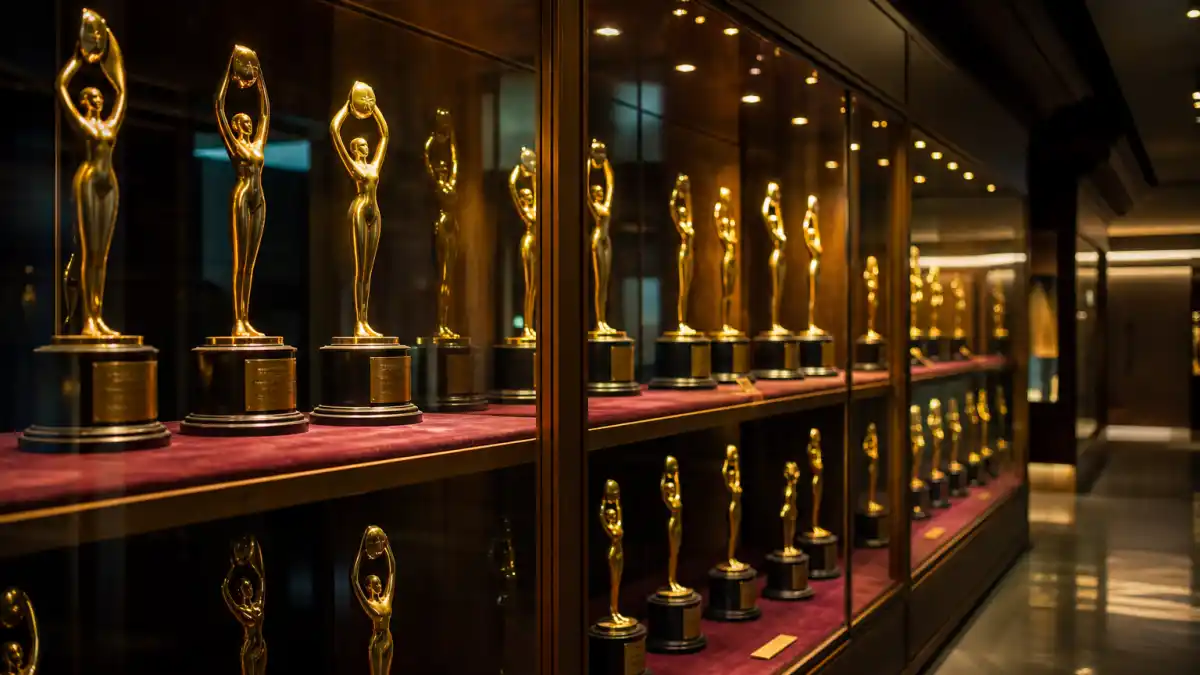
The Academy of Motion Picture Arts and Sciences publishes official specifications through its press office and museum materials. Per those accounts and foundry documentation, the modern Oscar is cast in solid bronze, then finished with a 24-karat gold plating layer applied through electroplating. The core gives the statuette heft and structural integrity; the gold delivers the signature warm mirror shine viewers recognize on television. It is not a hollow shell filled with lead, nor a zinc toy dipped in paint — though knockoff replicas sold online often are.
Understanding what is an Oscar statue made of requires separating appearance from composition. Gold plating is microns thick. The bulk of the weight is bronze — an alloy historically combining copper and tin with trace metals depending on the batch. If you scratched through the finish (please do not), you would expose dull copper-toned metal beneath the glitter. The Academy and Polich Tallix treat each statuette as a precision art object, not costume jewelry, which is why production reportedly takes about three months from mold to shipment for each year’s winner batch.
Original Materials: Britannia Metal and Early Gold Plate
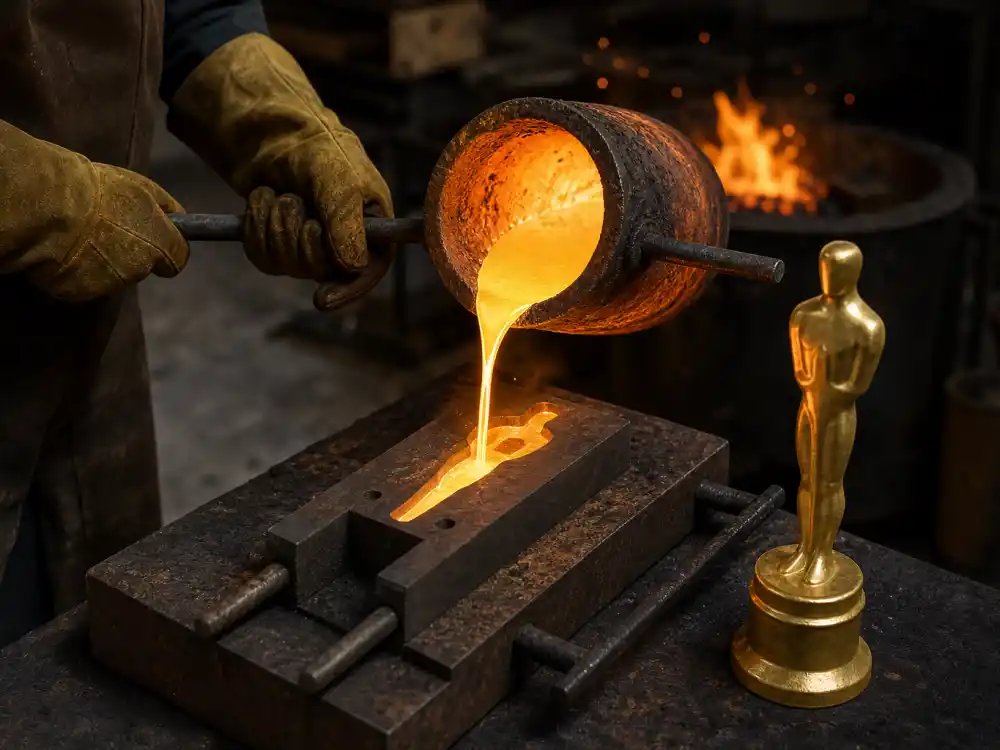
The first Academy Awards ceremony took place in 1929, honoring films released in 1927 and 1928. Early statuettes were manufactured by Chicago-based R.S. Owens & Company, which held the contract for most of the 20th century. Those earliest trophies reportedly used britannia metal — a pewter-like alloy rich in tin with antimony and copper — plated in gold. Britannia metal is softer than bronze, easier to cast in fine detail, and was a common choice for decorative awards and tableware in the 1920s.
Over subsequent decades the Academy refined specifications as manufacturing improved. The transition toward a bronze core with heavier gold electroplate reflected both durability concerns (winners handle, kiss, and drop statuettes on live television) and evolving foundry capabilities. Exact alloy recipes for every historical year are not always published; USA Celebs labels pre-1980s metallurgical minutiae as reportedly documented in trade press and Owens company histories unless confirmed in Academy publications.
World War II Plaster Oscars and the Exchange Program
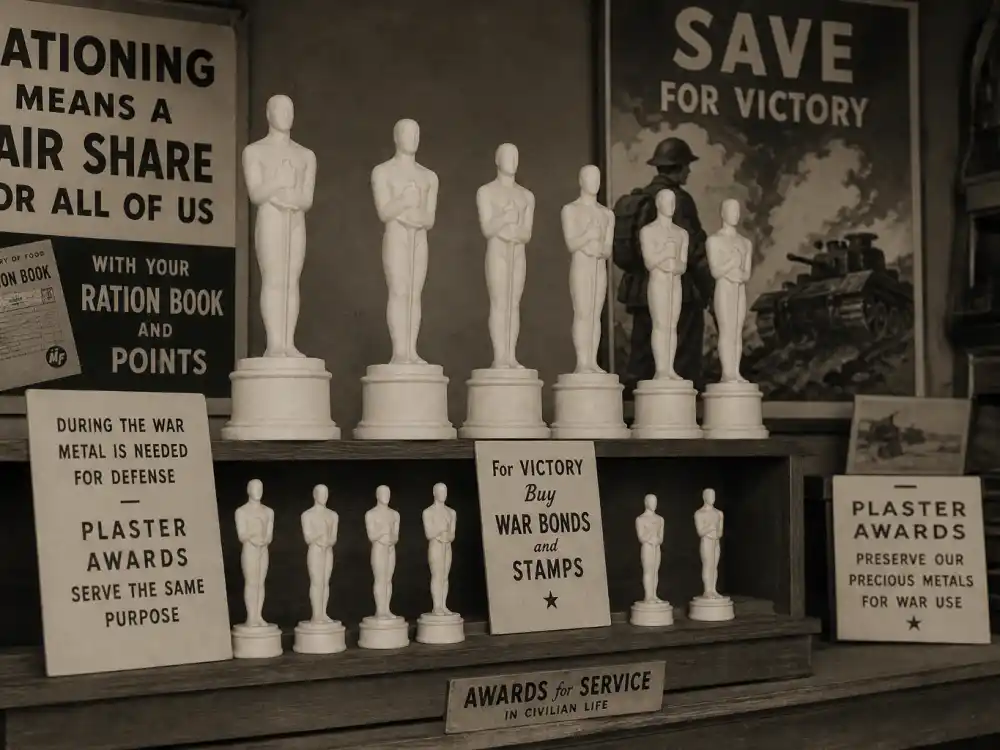
Metal rationing during World War II forced a famous compromise in what is an Oscar statue made of for a brief window. For three ceremony years — 1942, 1943, and 1944 (honoring films from 1941 through 1943) — winners received plaster statuettes painted gold rather than metal trophies. The Academy pledged that recipients could exchange the stand-ins for traditional metal versions after the war ended. Most winners reportedly did swap; those plaster editions that survived became collector curiosities fetching steep prices at auction decades later.
The plaster era matters because it proves the Oscar is as much an institution as an object. Even when the country could not spare bronze for vanity prizes, the Academy continued honoring filmmakers — substituting material without canceling ritual. When metal supply returned, the exchange program restored parity for winners who had accepted painted plaster on stage. Collectors today hunt those wartime stand-ins precisely because they break the “solid metal” assumption casual fans hold about what is an Oscar statue made of.
Dimensions, Weight, and Design Symbolism
Official Academy references cite the statuette at 13.5 inches (34.3 cm) tall and approximately 8.5 pounds (3.85 kg). The figure depicts a stylized knight standing on a reel of film with five spokes — a design credited to Cedric Gibbons, the influential MGM production designer who reportedly sketched the concept for the Academy’s 1928 board meeting. Los Angeles sculptor George Stanley carved the three-dimensional model from which molds were made. The knight holds a crusader’s sword; the film reel base anchors the trophy in cinema rather than theater or television — a distinction that mattered when the Academy was young.
Those five reel spokes originally represented the Academy’s five founding branches: Actors, Writers, Directors, Producers, and Technicians. As membership branches multiplied past five, the design stayed frozen — a vintage logo frozen in metal. For students of what is an Oscar statue made of, the dimensions are not arbitrary: the height fits comfortably in a winner’s hands for the podium lift, while the weight reads as substantial without being unwieldy for elderly honorees.
Who Makes Oscars Today: Polich Tallix and the R.S. Owens Era
For roughly eight decades, R.S. Owens in Chicago manufactured Oscars — a family business whose name became synonymous with the trophy even though the public rarely saw the factory. In 2016, the Academy announced a return to hand-crafted production at Polich Tallix Fine Art Foundry in Walden, New York, about 65 miles north of Manhattan. Polich Tallix, founded by sculptor Dick Polich, had long produced monumental art installations and limited-edition sculptures for galleries; the Oscar contract elevated a boutique foundry into awards-show headlines.
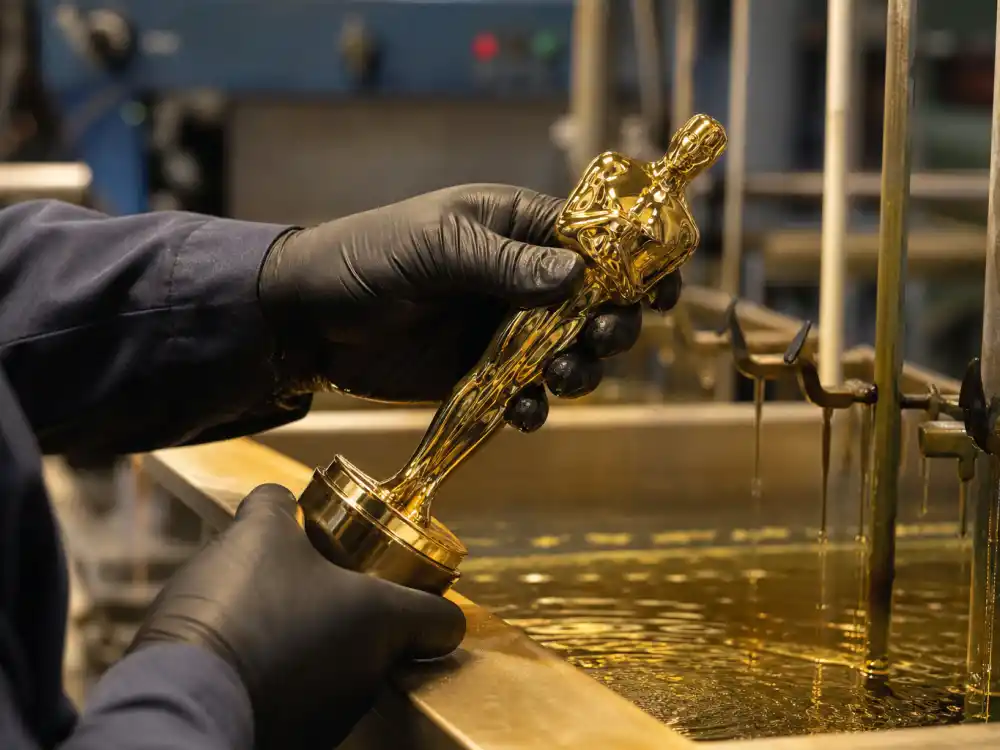
The shift reportedly involved reverting to lost-wax bronze casting with more manual finishing than late-period Owens automation. Each statuette passes through molding, casting, deburring, polishing, and electroplating before a black nickel plate is applied to the base and a lacquer coat protects the gold. Production timelines cited in press coverage run roughly 10 weeks per batch, with the foundry making fewer than 60 statuettes annually — enough for winners plus a small reserve for ties and late additions. Understanding what is an Oscar statue made of in 2026 means understanding a Hudson Valley workshop more than a Chicago assembly line.
How an Oscar Is Manufactured Step by Step
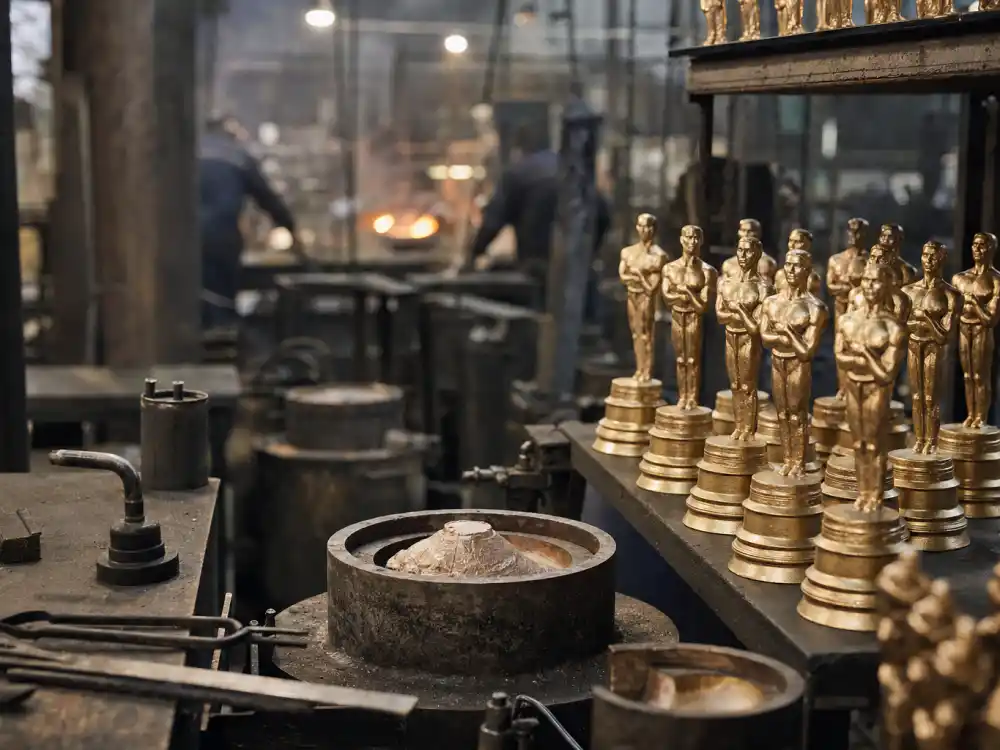
Though the Academy does not publish a factory tour video for every step, Polich Tallix and AMPAS press materials describe a consistent pipeline:
- Sculpture and mold: The original George Stanley sculpture remains the design source. Modern production uses molds derived from that form, with periodic refurbishment to preserve crisp detail in the knight’s features and reel spokes.
- Lost-wax casting: Technicians create wax positives, coat them in ceramic shell, burn out the wax, and pour molten bronze into the void. Each cast is individual — no mass plastic injection.
- Finishing: Artisans grind seam lines, chase surface detail, and polish the bronze before plating.
- Gold electroplate: The statuette is submerged in a solution where electric current deposits 24-karat gold onto the bronze surface. Thickness is controlled to balance shine and durability.
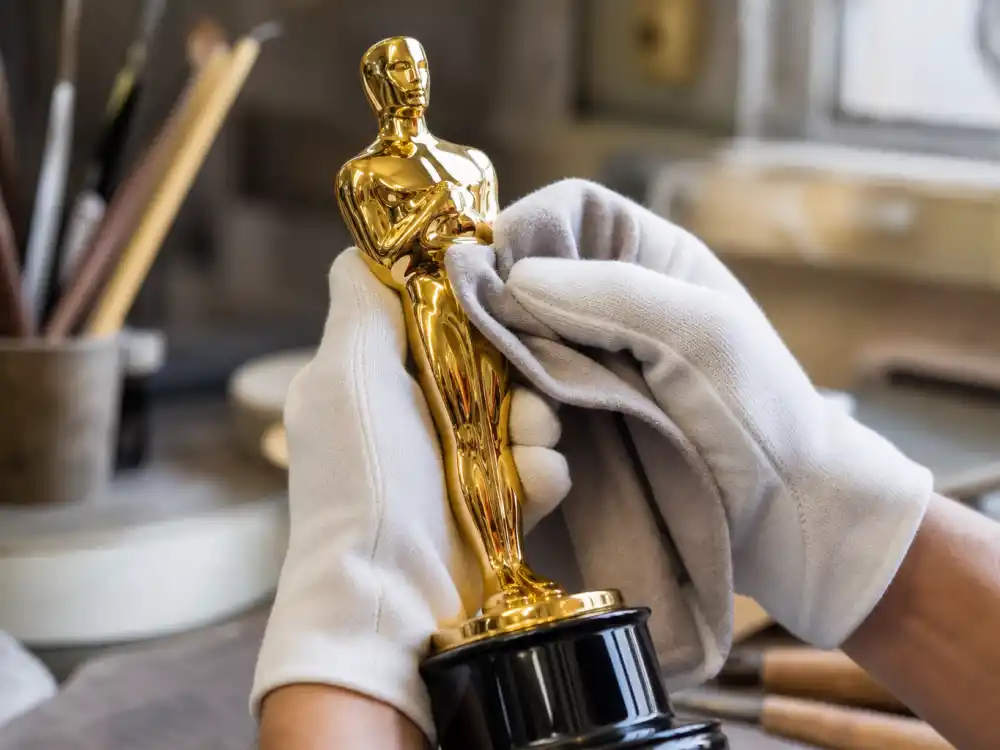
- Base treatment: The film-reel base receives black nickel plating for contrast, then the entire piece is lacquered to slow tarnish from handling.
- Quality control: Each trophy is inspected for pits, plating uniformity, and weight before shipment to the Academy.
That pipeline explains why what is an Oscar statue made of is as much process as metal. A single flaw in plating or a bubble in casting can scrap an entire unit — costly for a trophy with no retail SKU.
The $1 Resale Rule and Academy Ownership Claims
Winners do not own Oscars the way they own a wristwatch. Since 1951, the Academy has required recipients to sign an agreement granting the organization a right of first refusal before any sale. If a winner (or heir) wishes to sell, they must offer the statuette back to the Academy for $1 before selling elsewhere. The rule exists to keep Oscars off open markets where they could be treated as commodities rather than symbols of achievement — and to discourage theft.
Courts have generally upheld the agreements as binding contracts signed at receipt. High-profile sales that bypassed the rule — or predated it — generated headlines. When pre-1951 trophies or disputed estates surface at auction, prices can reach six or seven figures, fueled by collector obsession with what is an Oscar statue made of materially and mythologically. The $1 clause is less about the Academy hoarding trophies than controlling brand integrity: a shelf of Oscars at Sotheby’s would commoditize the icon.
Famous Lost, Sold, and Stolen Statuettes
Orson Welles’s 1941 Best Original Screenplay Oscar for Citizen Kane reportedly surfaced at auction decades after being believed lost, selling for roughly $861,000 in 2011 after legal disputes between heirs and the Academy. That sale predated modern enforcement nuances but illustrated collector appetite. More recently, heirs of cinematographer Robert Surtees reportedly sold his Oscars after his death, prompting Academy legal attention under the resale agreement.
Theft stories circulate too: UPS reportedly lost a shipment of replacement statuettes in 2000 before recovery; warehouses and storage units occasionally yield abandoned trophies whose provenance requires investigation. USA Celebs attributes contested anecdotes as reportedly covered in trade press unless documented in court filings. Each saga reinforces that what is an Oscar statue made of metallurgically is bronze and gold — but what it is worth culturally is far higher.
Why It Is Called “Oscar”: The Margaret Herrick Legend
The trademark name “Oscar” was officially adopted by the Academy in 1939, though nicknames appeared earlier. The most repeated origin story — treated as legend rather than proven fact — credits Margaret Herrick, the Academy’s longtime librarian and later executive director. Herrick allegedly remarked that the statuette resembled her Uncle Oscar when she first saw it in the 1930s. Columnist Sidney Skolsky reportedly popularized the nickname in print, cementing “Oscar” in public vocabulary before the Academy formalized it.
Alternative theories name other staffers or actors as first users; the Academy itself presents the Herrick tale in museum programming while acknowledging competing anecdotes. For etymology purists, the official trophy name remains Academy Award of Merit. “Oscar” is affectionate shorthand — like calling the Stanley Cup “Lord Stanley” — that obscures the industrial reality of what is an Oscar statue made of behind the glamour.
How Modern Oscars Compare to Other Awards Trophies
The Emmy uses a winged woman holding an atom — copper, nickel, and gold alloys depending on era. The Grammy is gilt bronze “gramophone” miniatures. The Tony is a medallion on a pedestal. Only the Oscar combines a human figure, precious-metal plating, and a single foundry contract so tightly controlled that unauthorized reproductions trigger legal letters. Fans comparing what is an Oscar statue made of to a Super Bowl ring or World Series trophy should note: sports championships issue rings to teams; Hollywood issues one statuette per competitive category winner (plus potential duplicates for co-winners).
The Oscar’s gold flash reads uniquely on camera — a deliberate contrast against black tuxedos and red velvet drapes. Broadcast lighting in the Dolby Theatre is tuned knowing millions of pixels will reflect off that plating. Material science serves television optics.
Care, Tarnish, and Repair for Winners
Gold plating can dull from fingerprint oils, champagne splashes, and decades on mantels. The Academy historically offered replating services for winners who shipped damaged trophies back — a maintenance perk reinforcing institutional custody. Collectors recommend soft cloth storage away from humidity; harsh cleaners strip lacquer. Because what is an Oscar statue made of includes a protective lacquer coat, aggressive polishing by amateurs can do more harm than good.
Winners who lose statuettes in moves may petition the Academy for replacements — reportedly at a fee covering materials and labor, not the symbolic $1 buyback price. Replacement trophies are marked internally so they cannot be sold as original ceremony pieces without disclosure.
Explore More Awards Coverage
- Learn how are Oscar winners chosen voting explained — branches, ballots, and envelopes.
- See most Oscars won by an actor all time for the acting record book.
- Read who has won the most Oscars ever across all categories.
- Visit our Awards archive for ceremony history, records, and explainers.