

In this article11 sections
- Mike Tyson Tattoo Collection Guide: Full Body Inventory
- Face Tattoo: Tribal Warrior Ink by S. Victor Whitmill
- Prison Era: Mao Zedong and Arthur Ashe Bicep Portraits
- Che Guevara: Abdomen Revolutionary Portrait
- Tiger Forearm and Monica Turner Portrait
- Exodus Chest Memorial: 2023 Daughter Portrait
- Collection Timeline: How Tyson's Ink Evolved
- What Mike Tyson Has and Has Not Said About His Tattoos
- Most Asked Pieces: Quick Collection Reference
- How to Use This Tattoo Collection Guide
- Explore More on USA Celebs
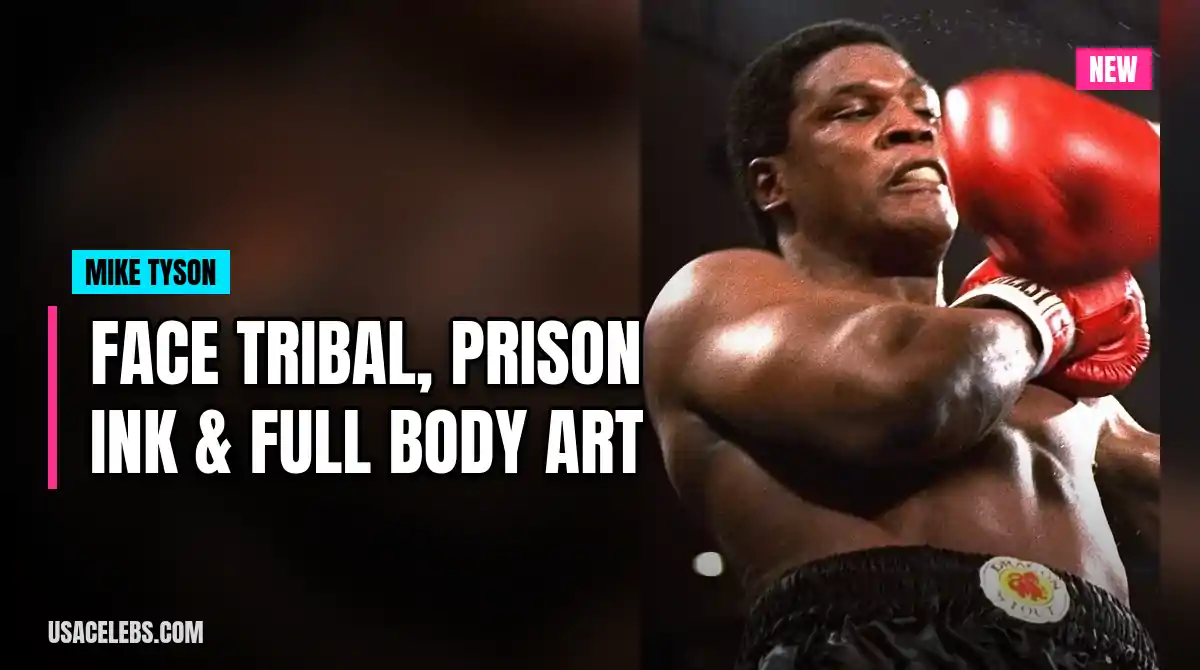
Mike Tyson tattoo collection guide readers arrive wanting a mapped inventory — not a fight recap or bio-stat page — but a catalog of what ink sits where on the former heavyweight champion’s body, when each piece appeared across his prison, comeback, and memorial eras, and what credible outlets attribute as meaning. Tyson carries at least seven documented tattoos spanning a 2003 Māori-inspired tribal face design by S. Victor Whitmill, prison-era portraits of Mao Zedong and Arthur Ashe, a Che Guevara abdomen piece, a tiger forearm, an ex-wife Monica Turner portrait, and a 2023 chest tribute to late daughter Exodus. Outlets including Wikipedia’s dedicated Tyson tattoos page, USA Today, Sporting News, and Yahoo Sports catalog both the iconic face ink and the lesser-discussed body portraits.
Unlike stars who accumulate dozens of scattered decorative pieces, Tyson’s catalog functions as autobiography on skin — prison anger channeled into revolutionary portraits, a warrior-face statement before his final professional victory, and a late memorial portrait honoring family tragedy. What matters for fans searching Mike Tyson tattoo collection guide is the through-line: each tattoo cluster ties to a documented life chapter rather than random shop ink, with some meanings widely quoted from Tyson himself and others only partially explained on record. USA Celebs does not invent symbolism — when a meaning is unconfirmed, we label it as reported or unverified fan interpretation.
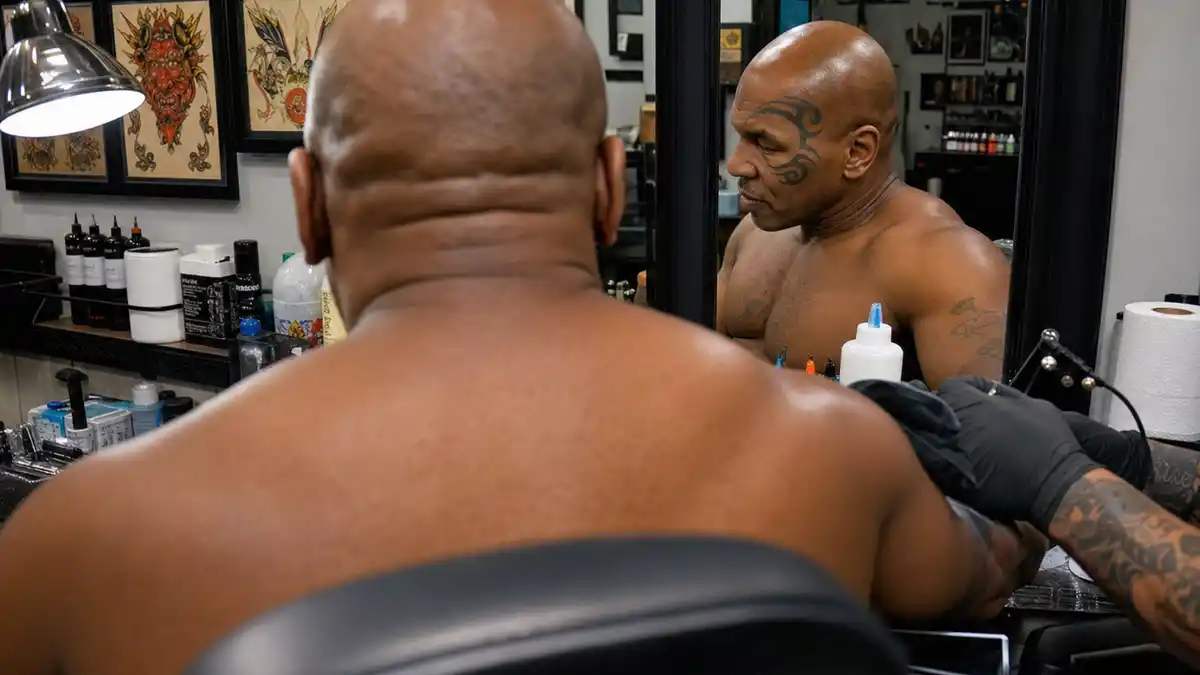
Mike Tyson Tattoo Collection Guide: Full Body Inventory
At the center of every Mike Tyson tattoo collection guide conversation is scope: Wikipedia and sports press catalog at least seven distinct documented pieces across face, arms, abdomen, chest, and forearms — with fight footage, documentaries, and red-carpet photography filling gaps Tyson rarely addresses in dedicated tattoo interviews. The face tribal design alone became one of the most recognizable tattoos in North America, amplified by The Hangover franchise and Tyson’s own public persona.
The through-line in sourced coverage is intentional symbolism rather than impulsive acquisition. Tyson inked Mao and Ashe portraits during his 1992–1995 prison sentence, added Che Guevara on his abdomen by 1999, received the Whitmill tribal face tattoo in 2003 before beating Clifford Etienne, and commissioned the Exodus chest portrait in 2023. Fans searching Mike Tyson tattoo collection guide usually want a categorized map — face versus arm versus chest, confirmed Tyson quotes versus reported context — before diving into individual pieces. That inventory structure is what this guide provides.
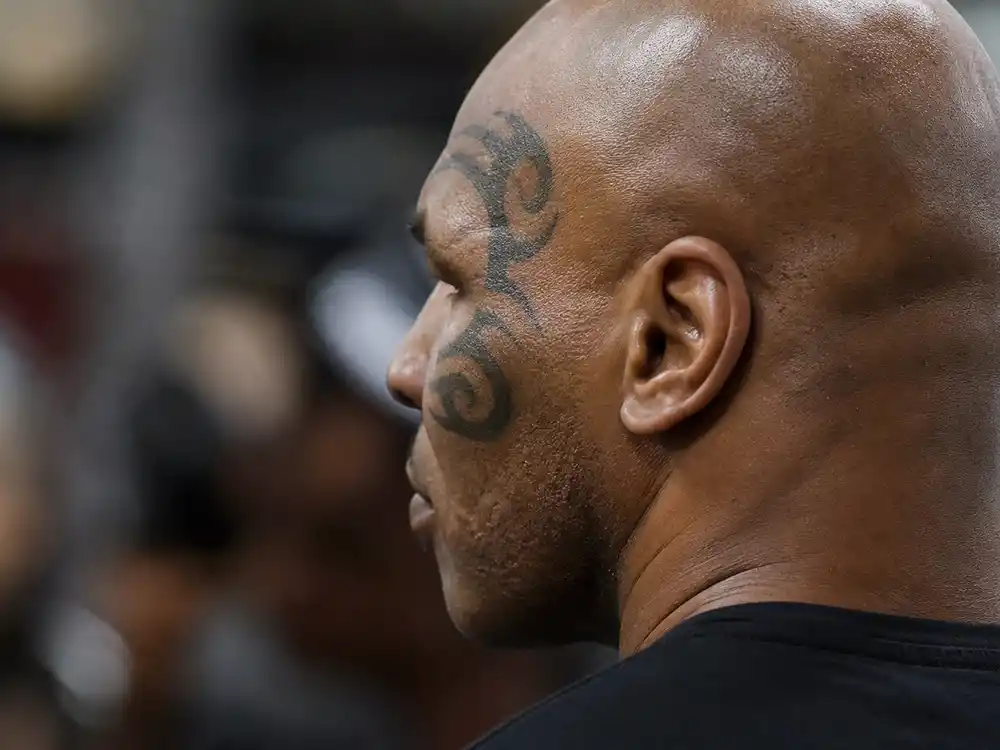
Face Tattoo: Tribal Warrior Ink by S. Victor Whitmill
Among the most photographed entries in the Mike Tyson tattoo collection guide, the left-side face hosts monochrome spiral tribal shapes above and below his left eye — inked in Las Vegas shortly before his March 2003 fight with Clifford Etienne.
- Artist: S. Victor Whitmill of Paradox-Studio of Dermagraphics in Las Vegas designed and applied the tattoo per Wikipedia and USA Today reporting.
- Design origin: Whitmill proposed a tribal pattern inspired by tā moko, a Māori tattoo style — not based on any specific moko but created directly on Tyson’s face.
- Tyson’s stated meaning: Tyson told Sporting News and Yahoo Sports he associated the design with Māori warriors and has called it his “warrior tattoo” in interviews and the 2008 documentary Tyson.
- Hearts rejected: Tyson originally wanted small hearts on his face; Whitmill refused and worked several days on the tribal alternative per multiple outlet accounts.
- Cultural context: Māori activists criticized the tattoo as cultural appropriation; the design later became central to Whitmill’s 2011 copyright suit against Warner Bros. over The Hangover Part II.
- Meaning status: Warrior-tribe framing comes from Tyson’s own words; deeper Māori genealogical meaning is not claimed by Tyson on record — treat appropriation debate as reported cultural commentary.
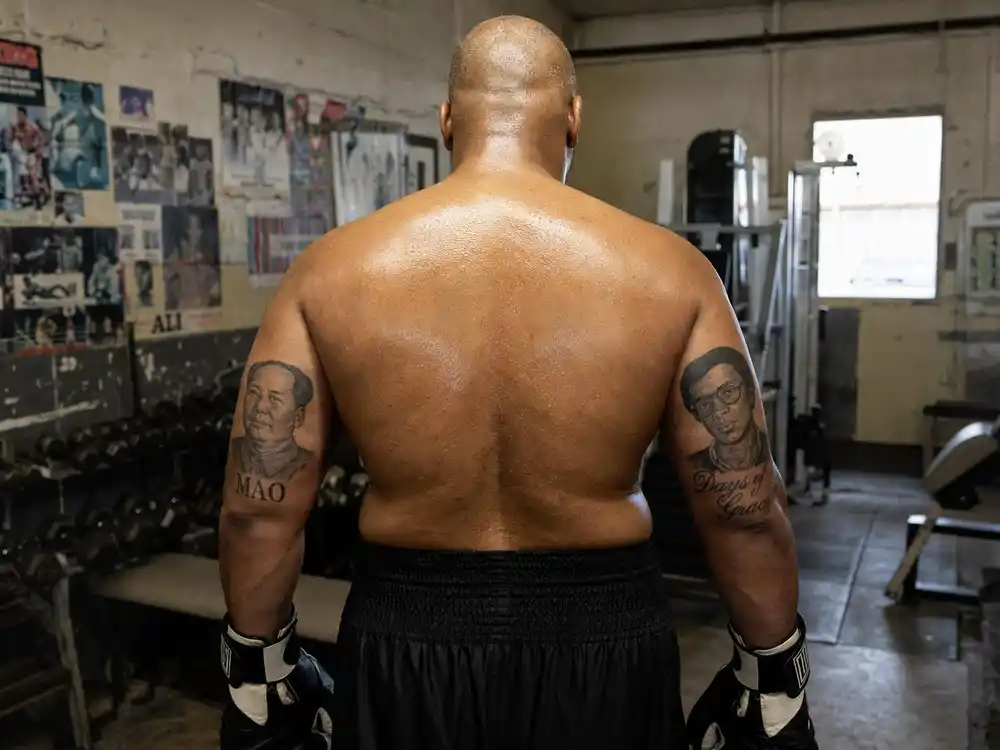
Prison Era: Mao Zedong and Arthur Ashe Bicep Portraits
Tyson acquired two contrasting bicep portraits during his Indiana prison sentence — revolutionary authority meets quiet athletic grace.
- Mao Zedong (right bicep): Wikipedia documents a Mao portrait captioned with “MAO” in all-caps on Tyson’s right arm, inked while he read Mao’s works in prison from 1992–1995.
- Arthur Ashe (left bicep): Spike Lee sent Tyson Ashe’s memoir Days of Grace; Tyson got a portrait beneath “Days of Grace” script on his left bicep per Wikipedia and Sporting News.
- Reported contrast: Biographer Gerald Early and The New York Times framed the pairing as symbolizing Tyson’s “newfound self-control” alongside his “fits of rage” — alternate icons on opposite arms.
- Tyson’s prison quote: In the 2008 documentary, Tyson said: “When I was in prison, I was so angry at society. I put a tattoo of Mao on me. I put a tattoo of Che on me, because I just had no faith in our government.”
- Meaning status: Prison anger and reading-influenced tribute framing are Tyson-sourced; scholarly interpretations of the Mao-Ashe contrast are reported analysis, not direct Tyson tattoo interviews.
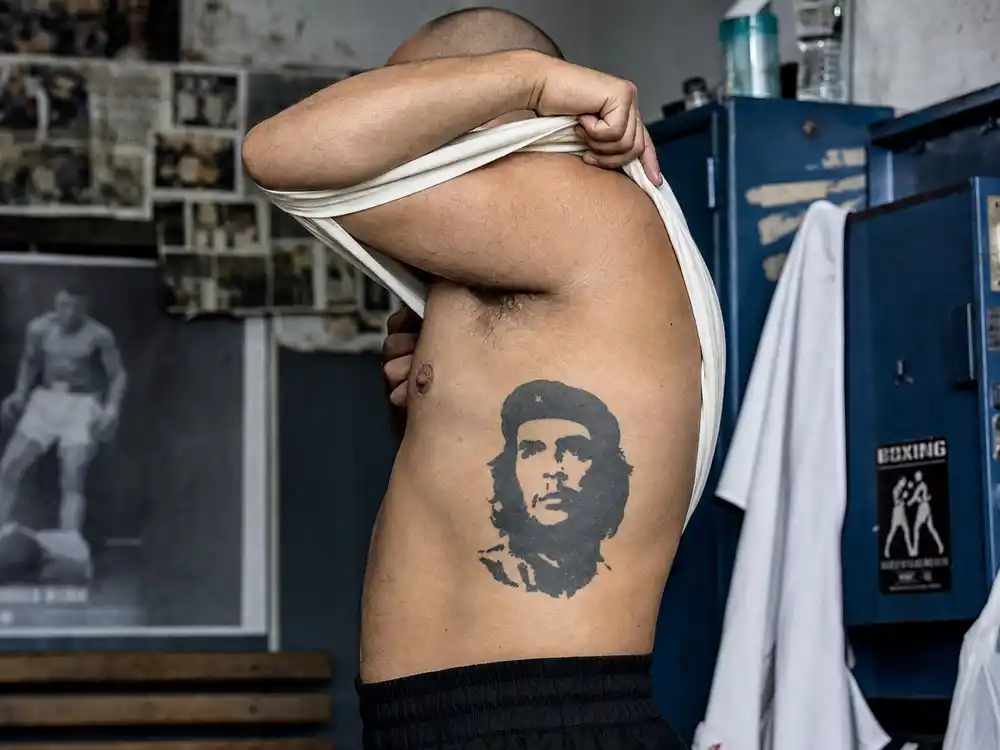
Che Guevara: Abdomen Revolutionary Portrait
Tyson’s left-side abdomen carries a Che Guevara portrait derived from Alberto Korda’s iconic Guerrillero Heroico photograph.
- Placement: Wikipedia places the Guevara tattoo on the left side of Tyson’s abdomen; USA Today and Sporting News describe it among his stomach and ribcage ink.
- Reported context: Tyson chose Guevara alongside Mao to reflect anger at society and government during his prison years per Wikipedia sourcing.
- Tyson’s 1999 quote: An Associated Press account quotes Tyson describing Guevara as “someone who had so much but sacrificed it all for the benefit of other people.”
- Timing note: A January 1999 AP article described the Guevara tattoo as new at that time, though Wikipedia notes dating ambiguity alongside the tiger piece.
- Meaning status: Sacrifice-for-others framing is Tyson-sourced from 1999; treat any broader Marxist ideology reading as reported commentary unless Tyson confirms in a primary source.
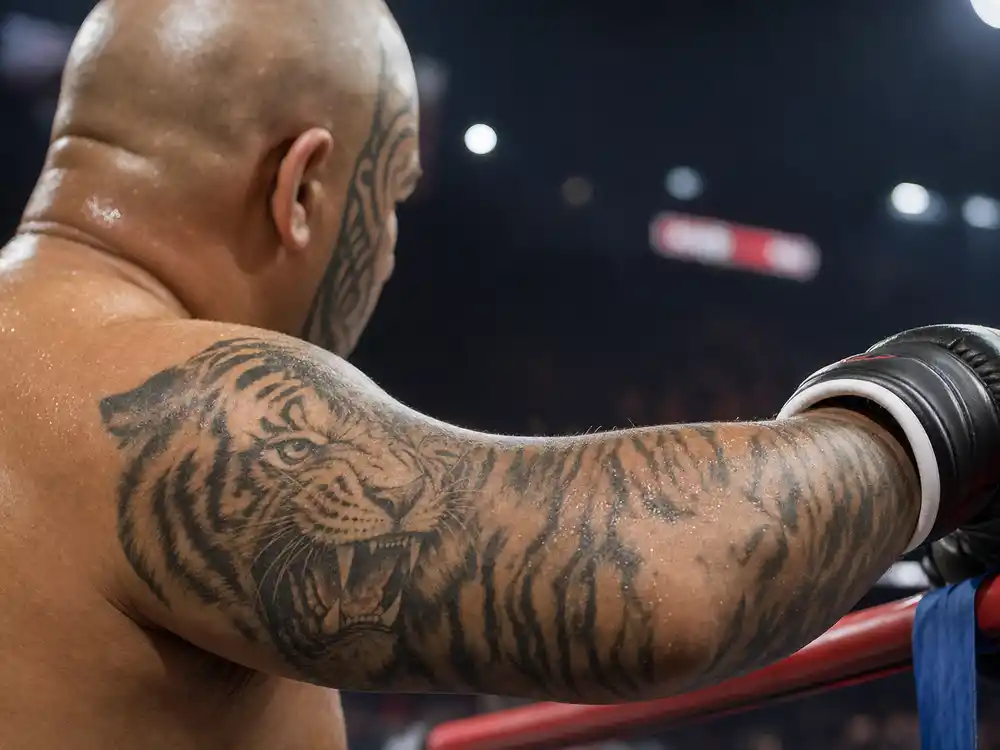
Tiger Forearm and Monica Turner Portrait
Tyson’s forearms host two personal pieces that received less sustained press than his face ink but remain documented in the collection.
- Tiger (right forearm): Wikipedia catalogs a tiger tattoo on Tyson’s right forearm; the Los Angeles Times in May 1997 described tiger and Turner tattoos as new at that time.
- Monica Turner (left forearm): A portrait of ex-wife Monica Turner appears on his left forearm, dating to August 1995 at the latest per Wikipedia.
- Reported tiger symbolism: NextLuxury and entertainment outlets speculate the tiger represents strength, wisdom, and freedom — treat animal symbolism as reported fan/outlet interpretation unless Tyson confirms directly.
- Meaning status: Turner portrait is a straightforward relationship tribute by placement logic; tiger meaning beyond general strength associations is largely unconfirmed on record.
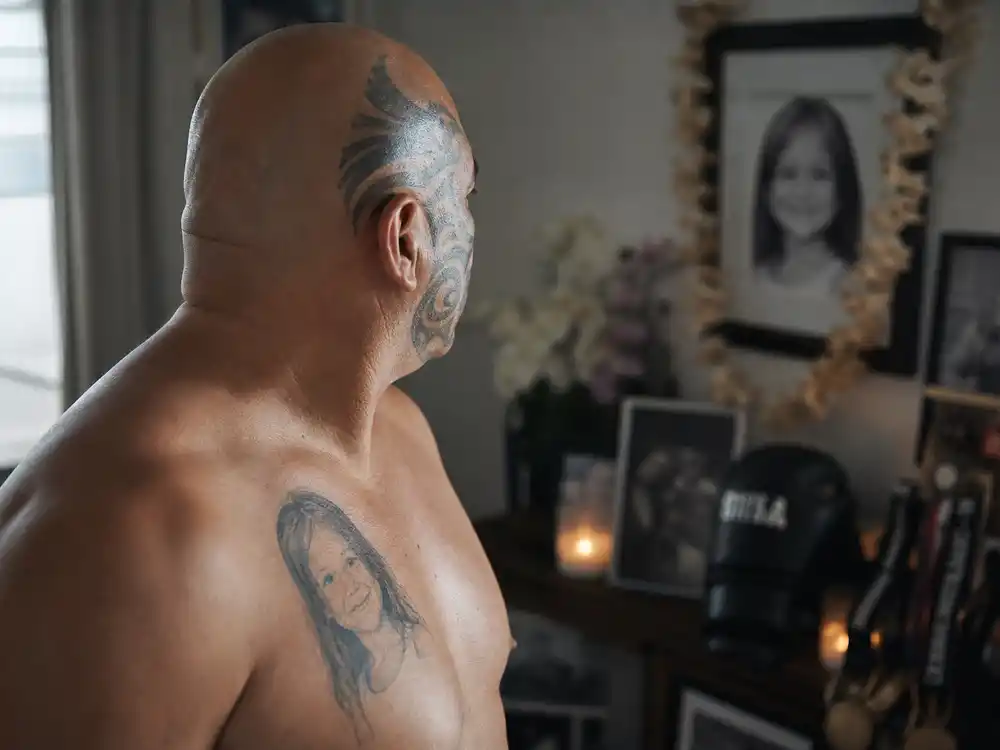
Exodus Chest Memorial: 2023 Daughter Portrait
Tyson’s most recent widely noted addition honors his late daughter Exodus, who died in 2009 at age four.
- Placement: Wikipedia documents a portrait of Exodus on Tyson’s left breast, inked in 2023.
- Reported context: USA Today and Yahoo Sports identify the chest tattoo as a portrait of Exodus — among the most emotionally sourced entries in Tyson’s catalog.
- Visibility: Shirtless training and exhibition footage made the memorial piece readable in profile and over-shoulder frames during Tyson’s 2024 Jake Paul exhibition buildup.
- Meaning status: Memorial intent is straightforward and widely reported; treat as visually confirmed family tribute without speculative symbolism beyond grief and remembrance.
Collection Timeline: How Tyson’s Ink Evolved
Understanding the Mike Tyson tattoo collection guide requires a rough chronology:
- Prison era (1992–1995): Mao Zedong right bicep and Arthur Ashe left bicep portraits during Indiana incarceration per Wikipedia.
- Mid-1990s: Monica Turner left forearm portrait by August 1995; tiger right forearm documented by May 1997.
- Late 1990s: Che Guevara abdomen portrait described as new in January 1999 AP reporting.
- 2003 face tattoo: Whitmill tribal warrior ink before Clifford Etienne fight — Tyson’s 50th and final professional victory.
- 2009 tragedy: Daughter Exodus dies; memorial chest portrait follows years later in 2023.
- 2011 copyright fight: Whitmill sues Warner Bros. over The Hangover Part II face-tattoo replication — settlement without trial.
- 2024 exhibition era: Full collection visible during Jake Paul buildup — face tribal plus body portraits in weigh-in footage.
What Mike Tyson Has and Has Not Said About His Tattoos
Recurring themes from Wikipedia, USA Today, Sporting News, and Yahoo Sports coverage:
- Tyson has given direct quotes on the face tattoo (warrior identity, rejected hearts, Whitmill collaboration) and prison-era revolutionary portraits (anger at government, Guevara sacrifice).
- Arthur Ashe tribute connects to Spike Lee sending Days of Grace and Tyson’s respect for Ashe’s nonconfrontational excellence — reported biographical context.
- Tiger and Monica Turner forearm pieces carry less on-record Tyson explanation — meaning attribution relies on placement logic and outlet speculation.
- Exodus chest portrait functions as straightforward memorial ink with reported grief context rather than symbolic mystery.
- Māori cultural appropriation criticism and Whitmill copyright litigation add legal and cultural layers beyond personal meaning — reported debate, not Tyson tattoo philosophy.
Those sourced layers anchor credible portions of the Mike Tyson tattoo collection guide map. Anything beyond them — unverified numerology for tiger ink, fan theories linking Che Guevara to specific fight moments, speculation about Turner portrait removal — stays labeled as fan theory unless Tyson confirms it in a reputable outlet.
Most Asked Pieces: Quick Collection Reference
- Tribal face tattoo: Whitmill 2003 warrior ink — Tyson-sourced meaning, Māori-inspired design.
- Mao right bicep: Prison-era revolutionary portrait — Tyson documentary quote confirmed.
- Arthur Ashe left bicep: Days of Grace tribute — Spike Lee memoir connection reported.
- Che Guevara abdomen: Guerrillero Heroico derivative — Tyson 1999 sacrifice quote sourced.
- Tiger forearm: 1997-era personal ink — animal symbolism largely unconfirmed.
- Monica Turner portrait: Left forearm ex-wife tribute — placement documented.
- Exodus chest: 2023 daughter memorial — USA Today and Yahoo Sports reported.
- Hangover copyright: Whitmill v. Warner Bros. 2011 — legal context, not personal meaning.
How to Use This Tattoo Collection Guide
The Mike Tyson tattoo collection guide ecosystem includes outdated galleries mixing fight-night screengrabs with mislabeled pieces and speculation about symbols Tyson never addressed. Prioritize Wikipedia’s dedicated tattoos page, USA Today, Sporting News, and the 2008 Tyson documentary for primary-context quotes. USA Celebs synthesizes those layers for a free reference — not to replace primary sources.
Remember: tattoo meaning can be private. A revolutionary portrait that looks ideological to outsiders may carry a prison-era emotional reference only Tyson fully understands. Unconfirmed does not mean false; it means we will not present guesswork as fact.
Explore More on USA Celebs
- Browse our Celebrities archive for more tattoo and body-art reference pages.
- Pair this ink inventory with Tyson’s exhibition weigh-in footage when you want visible confirmation beyond our summary.
Disclaimer: This article is for informational and entertainment reference only. Tattoo meanings attributed to Mike Tyson are sourced from publicly reported interviews and sports press; unconfirmed symbols are labeled as such. USA Celebs does not provide tattoo, medical, or removal advice.