

In this article7 sections
- Jeff Bezos net worth 2026 on Forbes' dated prints
- Amazon after the MacKenzie transfer and years of sales
- Blue Origin's private mark versus the listed stub
- The Washington Post as a reported $250 million civic line
- Cash from sales, Expeditions, and Prometheus
- Third in July, fourth on the March list
- What this fortune is not
Jeff Bezos net worth 2026 is still an Amazon equity fortune after the 2019 split and years of sales — plus private rockets, a newspaper, and cash from those sales. Forbes’ 2026 World’s Billionaires list, using March 1 prices, placed him fourth at an estimated $224 billion. The magazine’s August 1 roundup, after a July in which Amazon climbed 14 percent, put him third at an estimated $278 billion. The real-time profile on August 28 showed approximately $273.2 billion, still third. Those prints look like different men. They are the same 8 percent of Amazon, according to Forbes, after he transferred a quarter of a then-16 percent stake to MacKenzie Scott in 2019 and sold more than $49 billion of shares since the 1997 IPO.
This page is the current total: what named outlets say he is worth now, what that fortune is made of, and why a divorce, stock sales, and a rocket company he long funded himself sit inside the same 12-figure figure. It is not an income mix. For the peer gap against the man who now sits first, see how much is Elon Musk worth. For the composition of that larger fortune, see Elon Musk net worth 2026. For the rank among living fortunes rather than the inventory, see how much Jeff Bezos is worth.
Jeff Bezos net worth 2026 on Forbes’ dated prints
Forbes is the primary public source for this fortune, and it publishes two related products. Forbes’ yearly World’s Billionaires ranking freezes Bezos’s Amazon stub on one pricing day. The 2026 edition, Forbes wrote, marked prices and currencies as of March 1 and found a record 3,428 billionaires whose fortunes summed to an estimated $20.1 trillion — the day Bezos printed fourth at an estimated $224 billion. On that snapshot he was fourth at an estimated $224 billion, behind Musk at an estimated $839 billion, Larry Page at an estimated $257 billion, and Sergey Brin at an estimated $237 billion. He had been third on the 2023, 2024, and 2025 annual lists. The 2025 print sat at an estimated $215 billion. The 2022 print, when Musk first took the annual top, sat at an estimated $177 billion. He was first on the annual list from 2018 through 2021, including an estimated $177 billion in 2021, an estimated $113 billion in 2020, an estimated $131 billion in 2019, and an estimated $112 billion in 2018.
Forbes’ live tracker then reprices Bezos’s remaining Amazon shares as the session moves. By August 1, 2026, Forbes put him at an estimated $278 billion, third, after a July gain the magazine put at an estimated $29 billion. By August 28 the profile showed approximately $273.2 billion. On an Amazon-driven 12-figure column, a swing of a few billion between August 1’s estimated $278 billion and late August’s approximately $273.2 billion is noise, not a new Bezos. What is not rounding is the distance from first. Musk’s estimated $839 billion March print was nearly four times Bezos. The late-August pair was approximately $866.3 billion versus approximately $273.2 billion.
A 2026 claim that pins Bezos to a private-bank exact dollar, rather than the dated Forbes cluster, is a guess. The public read of Jeff Bezos net worth 2026 is the dated Forbes cluster — an estimated $224 billion in March, an estimated $278 billion on August 1, approximately $273.2 billion in late August — plus the acknowledgment that Bloomberg and other professional lists can sit nearby because they mark Blue Origin on different calendars.
Amazon after the MacKenzie transfer and years of sales
Amazon created the fortune. It is still most of the fortune. It is no longer the whole holding he held when the company went public. Forbes’ 2026 profile is blunt: he stepped down as chief executive in 2021 and remains executive chairman, and he owns 8 percent of the company. In 2019, after 25 years of marriage, he transferred a quarter of his then-16 percent Amazon stake to MacKenzie Scott. She received 4 percent. He kept 12 percent. He has since sold and given away more of the stub. The 8 percent that remains is still the largest individual holding, according to Forbes, and it is still the daily driver of the 2026 total.
Sales are a timeline of the fortune, not gossip. Forbes calculates that since Amazon’s 1997 IPO he has sold more than $49 billion worth of his stock. Those sales funded living costs, Blue Origin, philanthropy, and diversification through Bezos Expeditions. They also reduced the personal column. Selling more than $49 billion of Amazon stock since the 1997 IPO, as Forbes calculates, converted part of Bezos’s listing into cash without giving Amazon away. He is a founder who turned some of the listing into cash and left a concentrated holding. People who write that he is worth approximately $273.2 billion “because he owns Amazon” are describing 1997 with a 2026 number pasted on top. The current mark is his slice.
MacKenzie Scott’s separate fortune is the other half of the 2019 arithmetic. Forbes’ March 2026 list placed her 84th at an estimated $28.6 billion. The magazine’s August profile of her philanthropy described a woman who received that 4 percent stake and has since given away approximately $26 billion over seven years, with Yield Giving as the public ledger. Her March print is not another Bezos total. It is what left his column in 2019 and then left hers as gifts. Adding the two 2026 Forbes numbers together and calling the sum “the Amazon fortune” would count a split that already happened twice.
Blue Origin’s private mark versus the listed stub
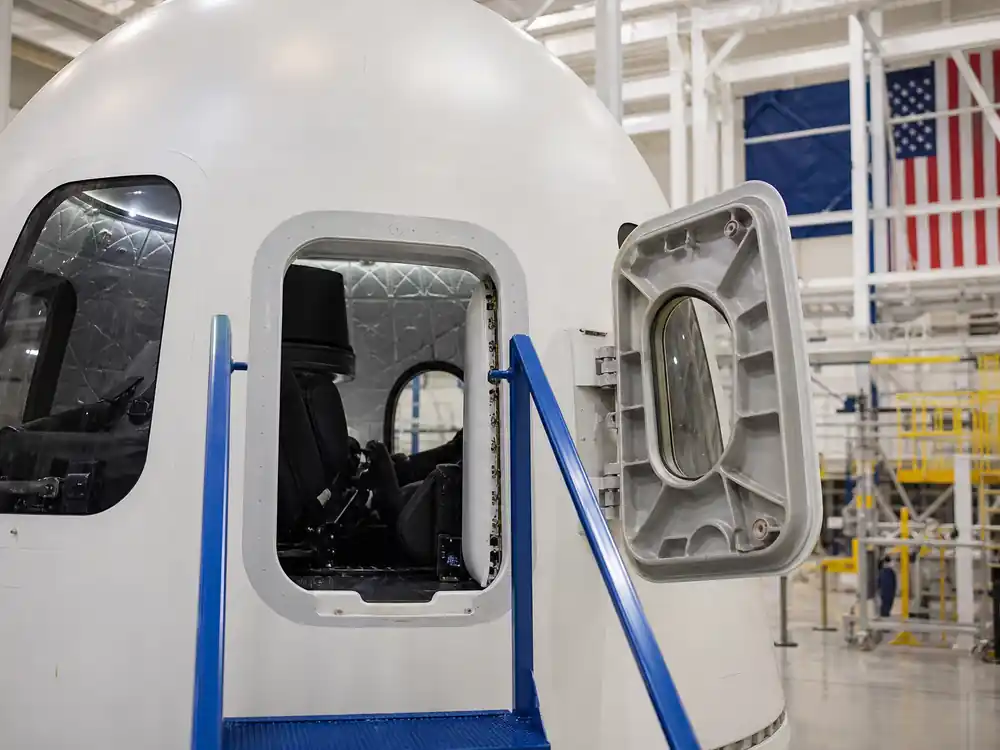
Blue Origin is the named private engine, and it is not another Amazon. Forbes says he founded the aerospace company and has funded it with billions of dollars; he flew on one of its rockets in 2021, the same month he left Amazon’s chief-executive role. For most of the company’s life there was no outside round to mark. In July 2026 that changed. Forbes, citing the first outside raise, described a round seeking approximately $10 billion at a pre-money valuation of about $130 billion. The New York Times had reported the same figures. Coatue Management was named as a lead participant in recaps. Forbes also noted that Bezos planned to put additional personal capital into the round.
A company Forbes described at a pre-money valuation of about $130 billion is large. An 8 percent Amazon stub on a listed giant the market treats in the trillions is larger. Jeff Bezos net worth 2026 still lives or dies on AMZN first. Blue Origin can reprice the private slice if the round closes at the reported mark. It will not, on any sourced figure, overtake the listed holding. Treat a headline that says he is “now a rocket billionaire instead of an Amazon billionaire” as a mix-up of engines.
He has said for years that he sold on the order of $1 billion of Amazon stock annually to fund the rocket company, a figure Forbes-adjacent recaps have repeated. Recent years ran hotter. The 2026 round is the first time outside investors were invited to share that bill. Dilution, if the round closes, trims a 100 percent founder story. It does not erase the personal capital already in the company.
The Washington Post as a reported $250 million civic line
He bought The Washington Post in 2013 for a reported $250 million. Forbes lists the paper among his assets. It is one of the most visible non-Amazon holdings and one of the smallest in dollar terms next to an estimated $224 billion March print. Jeff Bezos net worth 2026 does not move when a newsroom is restructured. It moves when Amazon’s stock moves. The Post is a civic and reputational line. It is not the engine.
That distinction matters because 2026 coverage of the paper’s staff cuts and strategy is loud, and the wealth figure is quiet. Owning a newspaper can consume management time and invite political heat. It does not, on any sourced appraisal, look like Blue Origin’s reported $130 billion mark or like the Amazon stub. Counting the Post as a hidden nine-figure swing in the personal total would overstate a 2013 check.
Media ownership is still part of the composition. It sits beside Bezos Expeditions’ named bets — Forbes has mentioned Airbnb and Workday among them — as diversification, not as a replacement for Amazon. Any article that lists “exact” valuations for those venture stakes without a filing is speculating.
Cash from sales, Expeditions, and Prometheus
Stock sales create cash. Cash buys rockets, houses, and new companies. Forbes’ August 1 recap said that in a May interview he unveiled scant details of an AI startup called Prometheus, an “artificial general engineer” aimed at helping design physical objects, and that he is co-CEO — his first operational role since leaving Amazon’s chief-executive job. The company announced a funding round at an estimated $41 billion valuation in June. Forbes said it had not yet been able to verify his stake or how much he had personally invested. The 2026 fortune should not bake in a Promethean line that the magazine will not mark.
Real estate is a use of money. Secondary roundups have described a large Miami-area footprint after he moved his residence to Florida, plus older Seattle holdings and a West Texas ranch tied to Blue Origin. Purchase prices are not current appraisals, and they do not tell you whether debt sits against the properties. Together they are a visible slice of a 12-figure fortune, not the bulk of it. A Miami or Seattle close in the tens of millions does not drop tens of millions of spendable cash onto Bezos’s Amazon-heavy total.
Philanthropy is an outflow, not a Gates-scale operating plan. Forbes records a 2020 Bezos pledge to put $10 billion into climate work by 2030 via the Bezos Earth Fund, with $2 billion granted to date. In a 2022 CNN interview, Forbes notes, he said he plans to give away the majority of his wealth in his lifetime without disclosing a 2045-style close date. Those sentences describe intent. They do not describe a fortune already reduced by more than $59 billion of foundation gifts, according to Forbes. The 2026 total is still a score that Amazon can inflate.

Third in July, fourth on the March list
Rank is a relative number. On the March 2026 annual list he sat fourth at an estimated $224 billion. Page at an estimated $257 billion and Brin at an estimated $237 billion — the Alphabet pair — sat ahead. Musk at an estimated $839 billion sat in another band. In July, Forbes said, Amazon’s 14 percent climb added an estimated $29 billion and moved him back to third, overtaking Brin, who sat at an estimated $269 billion on August 1. Page remained second at an estimated $292 billion. Third is historically ordinary for Bezos in the mid-2020s and historically extraordinary for almost anyone else.
He was the world’s richest person on Forbes’ annual list from 2018 through 2021. Gates had held that annual top for most of the prior two decades. The 2018 overtake, Forbes has written, owed partly to Gates having donated tens of billions of stock. Bezos’ 2026 fourth-place annual finish owes to Musk’s SpaceX-and-Tesla fortune and to the Alphabet pair’s AI rerating, not to Amazon disappearing. The company still compounds. His slice is smaller than it was in 2018, when Forbes put him first at an estimated $112 billion on a much smaller Amazon.
Among living fortunes the useful neighbors are Ellison at an estimated $190 billion in March and Arnault at an estimated $171 billion — still below Bezos — and Page and Brin just above. Among givers, MacKenzie Scott’s speed is the contrast inside the family of the 2019 split. Forbes has credited her with giving faster in recent years than most billionaires, including, in one 2026 recap, more in a single year than several tech founders have given in a lifetime. Speed and remaining personal wealth are different leaderboards. His estimated $224 billion March print is compatible with her estimated $28.6 billion and with her approximately $26 billion already given, because the 4 percent left his column seven years ago.
What this fortune is not
It is not Amazon’s market capitalization. Forbes estimates an 8 percent personal stake. People who write that he is worth approximately $273.2 billion because “he owns Amazon” are describing a founder myth with a 2026 number pasted on top. The current mark is his slice, minus debts a tracker is willing to subtract, plus Blue Origin, the Post, Expeditions, and cash from sales.
It is not Elon Musk’s 2026 fortune. Musk’s March print of an estimated $839 billion is a control stake in a newly public rocket company plus Tesla. Bezos’ Blue Origin is a private mark on a company he long funded alone. They compete for NASA contracts. NASA bids can overlap; Musk’s March estimated $839 billion and Bezos’s estimated $224 billion do not sit on the same personal-wealth rung. The older public-company holding is the story here. Framing it as a failed first-place story, without the 2019 split and the sales Forbes puts above $49 billion, is getting the fork backwards.
It is not a Gates spend-down. Forbes estimates Gates’ remaining Microsoft stake at less than 1 percent after 2022 gifts and puts the 2026 personal fortune at about an estimated $108 billion to $109.7 billion after more than $59 billion donated. Bezos has pledged a majority gift without a dated close. The Earth Fund’s $10 billion climate pledge, with $2 billion granted so far according to Forbes, is real and still small next to the Amazon stub. The usable total, then, is a technology equity fortune dated to the print you are holding: an estimated $224 billion in March, an estimated $278 billion on August 1, approximately $273.2 billion on August 28. The composition is Amazon, rockets, a newspaper, and time. The paycheck is not. For how the cash year actually works, see how Jeff Bezos makes money.