

In this article7 sections
- How Elton John makes money when Boxscore is not take-home
- The estimated $80 million touring year, then the trucks parked
- Two Caesars residencies as weekend engines
- Recorded-music royalties on a catalog he still holds
- Publishing: a 1992 advance of about $39 million that was not a sale
- Film and theatre as thickeners, not a studio slate
- After 2023: the mix without a stadium calendar
How Elton John makes money is a keep-versus-gross problem that Boxscore headlines keep getting wrong. Celebrity Net Worth says a touring year could easily make upward of an estimated $80 million, a claim that sits next to Forbes’ estimated $84 million pretax for 2019, fifth among musicians that year, in the middle of Farewell Yellow Brick Road. Those are artist-side flow numbers. Billboard’s reported $939.1 million farewell gross is what fans paid. This article follows the revenue streams: touring keep, catalog royalties, publishing, and residencies. It is not Celebrity Net Worth’s estimated $650 million fortune, and it does not treat the farewell as extra household wealth stacked on that print.
The mix is lumpy, and the shape has changed. A year with a stadium cycle does not look like a year of Colosseum weekends, and neither looks like 2026, after he ended full-scale touring in 2023. Streaming and publishing keep working when the trucks are parked. Residencies were the second live engine when he was not circling the planet. For the fortune those streams built, see Elton John net worth 2026. For the British ranking of that fortune, see how much Elton John is worth.
How Elton John makes money when Boxscore is not take-home
Forbes’ musician lists are pretax and do not deduct managers, agents, or lawyers. Billboard prints what fans paid. The Sunday Times tries to mark identifiable wealth. For Elton, the pay question is what he keeps after a night, not what Billboard prints as the house take. Anyone who treats Elton’s Boxscore as a household deposit will inflate every stadium and Colosseum chapter. Readers who treat a career reported box office of about $1.98 billion, according to Billboard, as a household total will overstate the lifetime chapter.
Rocket Entertainment is the corporate wrapper for a lot of the music side. In 2018, Universal Music Group and Rocket announced a long-term partnership covering recorded music, publishing administration, merchandise, brand management, and licensing. Terms were not disclosed. David Furnish, speaking to Music Business Worldwide, later called selling the song catalog unthinkable because it would mean giving up control of the art. Participation in future exploitation is the point of that pact, not a public W-2 for an unpublished cash figure.
That same gap is why Farewell Yellow Brick Road’s ticket total and Elton’s personal year are different figures. Billboard’s reported $939.1 million for Farewell Yellow Brick Road is a venue-side tally. Forbes’ estimated $84 million pretax for 2019 is one attempt at an artist-side year. Celebrity Net Worth’s upward-of-an-estimated-$80 million touring-year line is another. Road income is the keep after production, promoter cuts, and tax, not the headline gross. The core wealth page already used that Boxscore as the hook for the 2026 fortune. This page keeps it in its lane: the top of a funnel, not the deposit.
The estimated $80 million touring year, then the trucks parked
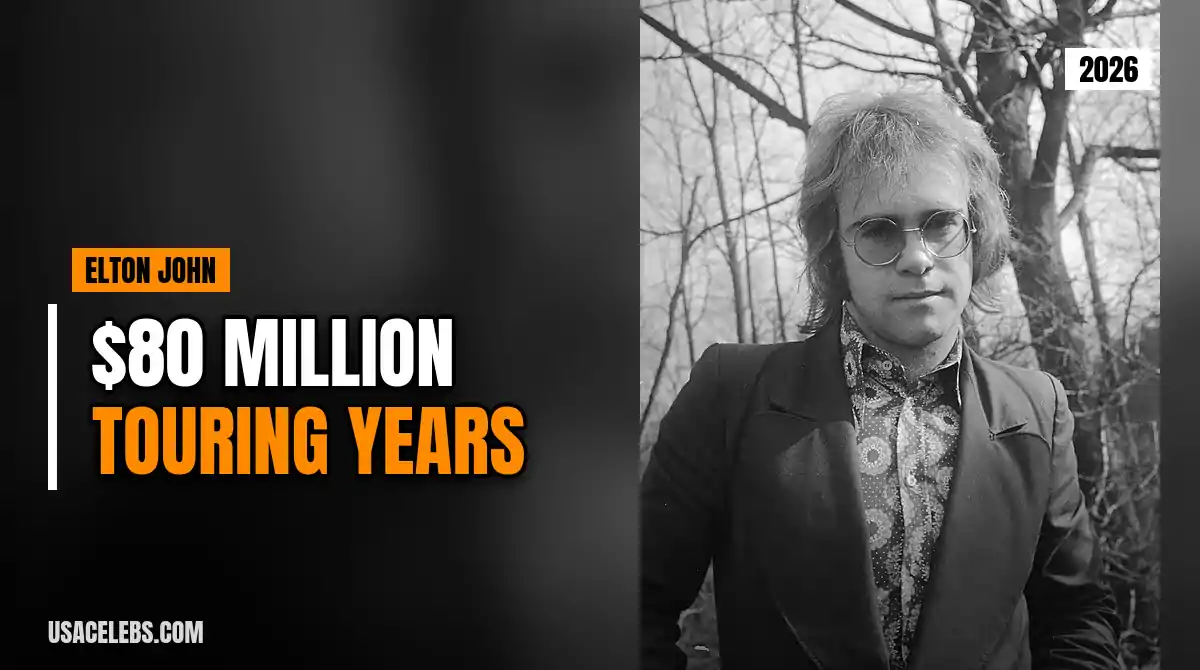
The 2019 pay year is the cleanest public picture of how Elton John makes money when a farewell calendar is fully booked. Forbes estimated $84 million pretax, fifth among musicians that year. Celebrity Net Worth says a touring year could easily make upward of an estimated $80 million. Those two named figures sit next to each other as a check. They are still pretax flow. They are not the estimated $650 million fortune, and they are not a slice of Billboard’s reported $939.1 million ticket tally dropped into a personal account.
Billboard Boxscore, wrapping the run after the July 8, 2023, finale in Stockholm, reported about $939.1 million and 6 million tickets across 330 shows, excluding Glastonbury as a festival date. Billboard split that farewell wrap as roughly $567.7 million and 3.5 million tickets in North America, roughly $218 million and 1.5 million tickets in Europe, and roughly $134 million and 889,000 tickets in Oceania. Five years of that Boxscore do not add about $939.1 million to the household. Production, promoter cuts, tax, and the fact that Celebrity Net Worth already had him at roughly $500 million by 2020 all sit in between.
He ended full-scale touring in 2023. Road income in 2026 is therefore not another farewell cycle. Selected one-off appearances and a later studio album are catalog thickeners. They are not a stadium occupation. Scarcity can still price a date. Volume is what compounded the live savings that are already inside the residual. Until Billboard wraps another cycle that is not on the public plan, treat the estimated $84 million 2019 pretax year as the touring-keep photograph, not as a 2026 salary.

Two Caesars residencies as weekend engines
Las Vegas is a different live machine from a farewell stadium. Elton’s home was the Colosseum at Caesars Palace, not a later Park MGM theater run associated with other pop residencies. On Billboard’s all-time residency ranking, Elton’s Red Piano (2004 to 2009) is a reported $166.4 million from 247 Colosseum nights and about 982,000 tickets, while The Million Dollar Piano (2011 to 2018) is a reported $131.2 million from 189 nights and about 777,000 tickets. Together those two Caesars stands add up to about $297.6 million in Elton ticket receipts over 14 years of weekend dates.
Both Caesars Boxscores are what the Colosseum collected, not Elton’s after-cost paycheck. Celebrity Net Worth groups the two stands as 450 shows and roughly 1.8 million attendees between 2004 and 2018, and has used about $500,000 a night as a working Las Vegas rate. How Elton John makes money from a Colosseum weekend is a high-margin live business built on a deep catalog: tickets, then a residency rate, then tax. The about $500,000-a-night working figure is Celebrity Net Worth’s estimate of artist-side color. It is not a W-2, and it is not the 2026 fortune.
Elton walked away from Caesars in 2018 once Farewell Yellow Brick Road was already on the books. The residencies were the second engine that kept cash compounding when he was not circling the planet every year. A residency decade does not look like a stadium decade. Both are live. The cost structure, the room, and the calendar are different. For the other Strip math, see Bruno Mars net worth 2026, a later theater residency with a different published total.
Recorded-music royalties on a catalog he still holds
Recorded music is the identity underneath the touring machine. Celebrity Net Worth says he has sold more than 300 million records worldwide. Empty Sky arrived in 1969. What followed in the 1970s — Honky Chateau through Rock of the Westies — made him one of the dominant recording artists of that decade, with seven consecutive US No. 1 albums, according to the same outlet. Album dominance is not a paycheck. It is the inventory that later royalty statements rest on.
Recording income in 2026 is more streaming, radio, and sync than vinyl, but the 1970s copyrights feed the same pipeline. “Your Song,” “Rocket Man,” “Tiny Dancer,” “Goodbye Yellow Brick Road,” and “Candle in the Wind 1997,” which Celebrity Net Worth says sold roughly 33 million copies, are still commercial assets. There has been no widely reported, Forbes-scale catalog sale of the Springsteen type, a Sony deal reported at $500 million. Until such a transaction is disclosed, recorded-music income is better modeled as a royalty stream plus an unpublished private mark on the copyrights, not as a locked-in lump sum.
The 1974 MCA recording contract, which Celebrity Net Worth traces as a then-record $8 million pact, was the first named recording check that still shows up in 2026. It was an advance era. It was not a sale of the songs. Master income today depends on the 2018 Universal partnership that administers recorded music going forward. Company revenue is not his royalty. It is the reason the partnership was worth negotiating.
Publishing: a 1992 advance of about $39 million that was not a sale
The songwriter column is a separate check from the artist royalty on the master. In 1992, Elton and Bernie Taupin signed a 12-year publishing agreement with Warner/Chappell carrying a $39 million cash advance, then the largest in music-publishing history, according to Celebrity Net Worth. Importantly, that pact gave Warner/Chappell administration rights over much of the post-1974 catalog while Elton and Taupin retained ownership of the songs. Administration is not a sale. The 1992 advance was a cash event. It was not a transfer of the copyrights.
Publishing income in 2026 is therefore a held-song story: performance royalties, mechanicals, and sync whenever a Taupin-and-Elton title is streamed, played on radio, covered, or licensed. The 2018 Universal partnership put Universal Music Publishing Group in position to administer the song catalog long into the future. Terms were not disclosed. David Furnish’s “unthinkable” line is the ownership policy. That policy pays as an annuity. The opposite policy would be a Springsteen-style spike he has not taken.
The Lion King songs with Tim Rice, including “Can You Feel the Love Tonight,” added an Oscar and a Disney annuity in 1994. Later stage work including Aida and Billy Elliot thickened the same publishing tap. Those copyrights sit inside the held catalog, not beside it. Theatrical and film writing is a second pipe. It will not, on any sourced line, match a farewell Boxscore. It keeps a quiet year from being empty in PRO terms.

Film and theatre as thickeners, not a studio slate
Paramount’s Rocketman, released in 2019, grossed about $195 million worldwide against a production budget widely cited at about $40 million. On Rocketman, Elton is listed as an executive producer and David Furnish as a producer. A personal take from that theatrical gross has not been disclosed in the pieces this article relies on. Leaving the blank is cleaner than assigning a fake nine-figure check to a producer credit. Rocketman was a catalog event that put the songs in front of a new audience and added a second Academy Award, for “(I’m Gonna) Love Me Again,” not a studio living.
Celebrity Net Worth says the 2025 Brandi Carlile collaboration Who Believes in Angels? became Elton’s tenth UK No. 1. Elton completed an EGOT in January 2024 when Elton John Live: Farewell from Dodger Stadium won an Emmy. Awards are pricing assets. They are not deposits. Income after the farewell is still the catalog, the publishing, the live savings already booked, and whatever selected dates actually clear. It is not another operating company.
Celebrity Net Worth credits the Elton John AIDS Foundation with more than $660 million raised since 1992. That is charitable fundraising, not a second personal fortune. Gifted and raised dollars for HIV programs are the opposite of personal income. Confusing them with his paycheck inflates the pay and misunderstands the charity.
After 2023: the mix without a stadium calendar
In a quiet year the mix leans on streaming, radio, publishing, and whatever remains of merchandise and licensing under the Universal partnership. That is why ending full-scale touring is not insolvency, and why a loud farewell year is not a new appraisal by itself. Celebrity Net Worth’s estimated $650 million fortune, last updated August 23, 2026, already has to be compatible with a post-road calendar. The Sunday Times’ £480 million 2026 print, as recapped by the Evening Standard, is identifiable UK wealth on a slight incline after the trucks stopped. Pay is not worth. For the year-by-year fortune those streams produced, see Elton John net worth over the years.
Art discussed in a $100 million to $200 million range and real estate discussed at about $50 million, according to Celebrity Net Worth, are stores of wealth. The 2024 Christie’s sales from the former Atlanta home generated about $20.54 million, according to the same outlet, including a Banksy triptych that sold for more than an estimated $1.9 million. Auction proceeds are liquidity. They are not recurring income in the sense this page means. Housing and photographs store surplus between live cycles. They do not throw off farewell cash.
Until a catalog sale is documented, that ranking of streams should hold: live keep first when he was on the road, residencies as the weekend engine, recordings as the annuity, publishing as the second pipe, film as a thickener, auctions as one-off liquidity. Billboard’s reported $939.1 million farewell gross is the top of the live funnel the core page already used as a hook. The keep is the estimated $84 million-class touring year, the about $500,000-a-night Vegas working rate, the about $39 million 1992 publishing advance that was not a sale, and the royalty statements that still arrive after Stockholm.