

In this article13 sections
- What Happened to Dane Cook? The Short Answer
- Boston Roots and the Club-Circuit Grind
- Comedy Central, Late Night, and the MySpace Breakthrough
- Retaliation, Arena Tours, and Rock-Star Comedy
- Hollywood Crossover: Good Luck Chuck and the Movie Years
- Backlash, Joke-Theft Accusations, and the Falloff
- The McCauley Embezzlement and Personal Blows
- Isolated Incident, Tell It Like It Is, and the 2010s Reset
- Kelsi Taylor, Marriage, and Tabloid Noise
- Dane Cook in 2026: Still on the Road
- Why "What Happened to Dane Cook?" Still Trends
- Legacy: Arena King, Punchline, and Pioneer
- Explore More
What happened to Dane Cook is one of the defining questions in 2000s comedy nostalgia — because for a few electric years he was not just a stand-up comic, he was a rock star with a microphone. Cook sold out Madison Square Garden before most peers had HBO specials, turned a DIY MySpace hustle into platinum comedy albums, and crossed into romantic comedies at the exact moment Hollywood still believed a comedian could open a movie. Then the backlash arrived: peer resentment, joke-theft whispers, a half-brother who stole millions, and a cultural turn against the high-energy bro-comedy style he perfected. This is the full comedy-career answer to what happened to Dane Cook — from Boston open mics through Retaliation, Vicious Circle, the falloff, and the 2026 touring life he never fully left.
If your mental image is Dane Cook sprinting across a stage yelling about the Kool-Aid Man, you are remembering the peak — and only half the arc. Search traffic for what happened to Dane Cook spikes whenever a 2000s nostalgia list drops, whenever a younger comedian references the MySpace era, or whenever fans wonder whether the arena king still performs. Understanding what happened to Dane Cook means tracking a comedy career with six distinct chapters: Boston and New York club grinding, Comedy Central and early digital marketing, the platinum-album and HBO supernova, Hollywood crossover, industry backlash and personal scandal, and the quieter but persistent stand-up reinvention of the 2010s and 2020s.
What Happened to Dane Cook? The Short Answer
Here is what happened to Dane Cook through a comedy-career lens, updated through 2026:
- 1972–1990s: Born March 18, 1972, in Cambridge, Massachusetts; grew up in Arlington; started performing stand-up in Boston clubs in the early 1990s before moving to New York and Los Angeles.
- 2000–2003: Breakout via Comedy Central Presents, late-night sets, and relentless club touring; built one of the first massive comedian followings on MySpace.
- 2005–2006: Retaliation went double platinum — the first comedy album to do so in nearly three decades; Forbes ranked him among America’s highest-paid comedians; filled arenas nationwide.
- 2006–2007: HBO’s Vicious Circle filmed at Madison Square Garden; romantic-comedy run including Good Luck Chuck and Dan in Real Life opposite Steve Carell.
- 2008–2011: Peer backlash intensified; joke-theft accusations circulated (Louis C.K. publicly claimed Cook performed his subway bit); half-brother and business manager Darryl McCauley embezzled roughly $12 million and was sentenced to prison in 2010.
- 2010s: HBO’s Isolated Incident, Showtime’s Tell It Like It Is, continued touring at smaller scale; podcast and digital experiments; relationship with Kelsi Taylor drew tabloid attention over their age gap.
- 2018–2026: Married Taylor in 2018; selective specials and Vegas runs; still performs stand-up on the road; legacy reassessed as both pioneer of comedian-as-brand and cautionary fame story.
Boston Roots and the Club-Circuit Grind
Any honest answer to what happened to Dane Cook starts in Massachusetts, where he was born in Cambridge and raised in Arlington before the spotlight found him. He has described a working-class childhood and an early appetite for performance — not the overnight viral path of TikTok comics, but the classic Northeast club grind. By the early 1990s he was on Boston stages, refining the physical, storytelling-driven act that would later polarize critics and electrify arenas.
That Boston foundation matters because Cook’s comedy was never purely joke-writing in the traditional setup-punchline mold. It was crowd work, characters, long narrative bits, and athletic stage presence — closer to a one-man show than a tight five at the Cellar. When he relocated to New York and eventually Los Angeles, he carried the work ethic of a comic who had paid dues in rooms where silence is brutal. Fans who ask what happened to Dane Cook sometimes forget the decade of anonymity before MySpace made him unavoidable.
Comedy Central, Late Night, and the MySpace Breakthrough
What happened to Dane Cook in the early 2000s looks, in hindsight, like a blueprint modern comedians still study. A Comedy Central Presents half-hour introduced him to cable audiences. Late-night appearances stacked up. But the real accelerant was MySpace — where Cook cultivated millions of friends and fans directly, bypassing gatekeepers who might have slowed a comic without traditional TV credits.
That digital hustle was revolutionary in stand-up. Before Instagram tours and Patreon specials, Cook proved a comedian could own the relationship with the audience. Merch, tour dates, and album pre-sales flowed through a platform most peers ignored. By the time Retaliation arrived in 2005, he did not need a hit sitcom to fill theaters — the fan base was already mobilized. The comedy industry noticed, even when it did not always applaud.
Retaliation, Arena Tours, and Rock-Star Comedy
The spine of most what happened to Dane Cook searches is the mid-2000s supernova. Retaliation debuted at No. 4 on the Billboard 200 and went double platinum — a commercial feat comedy albums had not achieved since the 1970s. Bits like “B and E,” “Car Alarm,” and the Kool-Aid Man routine became dorm-room canon. Cook was not playing clubs; he was selling out arenas with the production values of a rock tour.
Forbes placed him among the highest-paid comedians in America, with earnings estimated in the tens of millions at his peak. HBO bet big on Vicious Circle, filming a special at Madison Square Garden in 2006 and releasing it as both a stand-up film and album. The special captured the full Cook experience: screaming crowds, marathon bits, and a performer who treated stand-up like stadium entertainment rather than intimate art.

Hollywood Crossover: Good Luck Chuck and the Movie Years
What happened to Dane Cook also includes a Hollywood chapter — because at his peak, studios believed his fan army would follow him to the multiplex. He headlined Employee of the Month (2006), Good Luck Chuck (2007), and My Best Friend’s Girl (2008), while supporting Steve Carell in the acclaimed Dan in Real Life (2007). The films were commercially mixed but proved Cook could carry a theatrical release — a rarity for stand-ups who were not already sitcom leads.
Acting was never his primary craft, and critics were often harsh. Yet the movie run extended his fame beyond comedy fans and embedded him in the broader pop-culture memory of the late 2000s. When people search what happened to Dane Cook today, many are really asking what happened to the guy from Good Luck Chuck — proof that the crossover worked, even when the reviews did not.
Backlash, Joke-Theft Accusations, and the Falloff
No complete profile of what happened to Dane Cook can skip the backlash — because the comedy community’s turn against him was as loud as his success. Peers criticized his style as broad and juvenile. More seriously, joke-theft accusations circulated for years. Louis C.K. claimed Cook performed his “I can’t wait for the subway” bit on a Comedy Central compilation; the feud became stand-up lore. Cook denied stealing material and attributed similarities to parallel writing and common premises.
The cultural mood also shifted. Irony-heavy, confessional, and alt-comedy voices rose as Cook’s bro-energy act fell out of fashion with critics and many comedians. Box-office returns softened. Arena tours scaled down. The comedian who had seemed unstoppable in 2006 looked, by 2010, like a period piece — beloved by a segment of fans, mocked by others, and increasingly absent from the zeitgeist.
The McCauley Embezzlement and Personal Blows
Outside the stage lights, what happened to Dane Cook included a betrayal that would wreck any career. His half-brother Darryl McCauley served as his business manager for years — and was convicted of embezzling approximately $12 million from Cook through forged checks and unauthorized expenses. McCauley was sentenced to prison in 2010. Cook testified at trial and described discovering the fraud as a personal earthquake separate from any artistic criticism.
The scandal reinforced a narrative of a star who had trusted the wrong people at the height of his earnings. It also humanized a performer often reduced to punchlines about his style — a reminder that the arena receipts and platinum plaques did not shield him from catastrophic financial betrayal.
Isolated Incident, Tell It Like It Is, and the 2010s Reset
Cook did not quit stand-up when the backlash peaked. HBO’s Isolated Incident (2009) leaned into the controversy with a stripped-down, defiant tone. Showtime’s Tell It Like It Is (2011) followed. He continued touring — sometimes in smaller venues, sometimes with loyal crowds who never stopped buying tickets. The volume was lower than the Vicious Circle era, but the career continued.
He experimented with podcasts, digital distribution, and Las Vegas residency concepts. A planned Netflix special in 2017 generated headlines when it was pulled amid controversy over resurfaced material, illustrating how unforgiving the internet archive can be for comedians who peaked before every set was filmed. Through it all, Cook kept returning to the thing that built him: live performance.
Kelsi Taylor, Marriage, and Tabloid Noise
What happened to Dane Cook in the 2010s also played out in tabloids. He began dating singer Kelsi Taylor when she was 19 and he was in his mid-forties — an age gap that drew criticism and overshadowed his work for stretches. They married in a California ceremony in 2018. Cook has defended the relationship publicly; detractors continued to cite it in broader conversations about power dynamics in entertainment. USA Celebs notes this chapter because it shaped public perception during a period when his comedy career was already fighting for oxygen.
Dane Cook in 2026: Still on the Road
As of 2026, Dane Cook is not headlining Madison Square Garden on HBO every year, and he is not opening studio romantic comedies. But he has not disappeared. He continues to tour — club shows, theaters, and selective festival appearances — performing for fans who grew up on Retaliation and never fully left his corner of the internet. Social media posts document road life, crowd shots, and the occasional new bit.
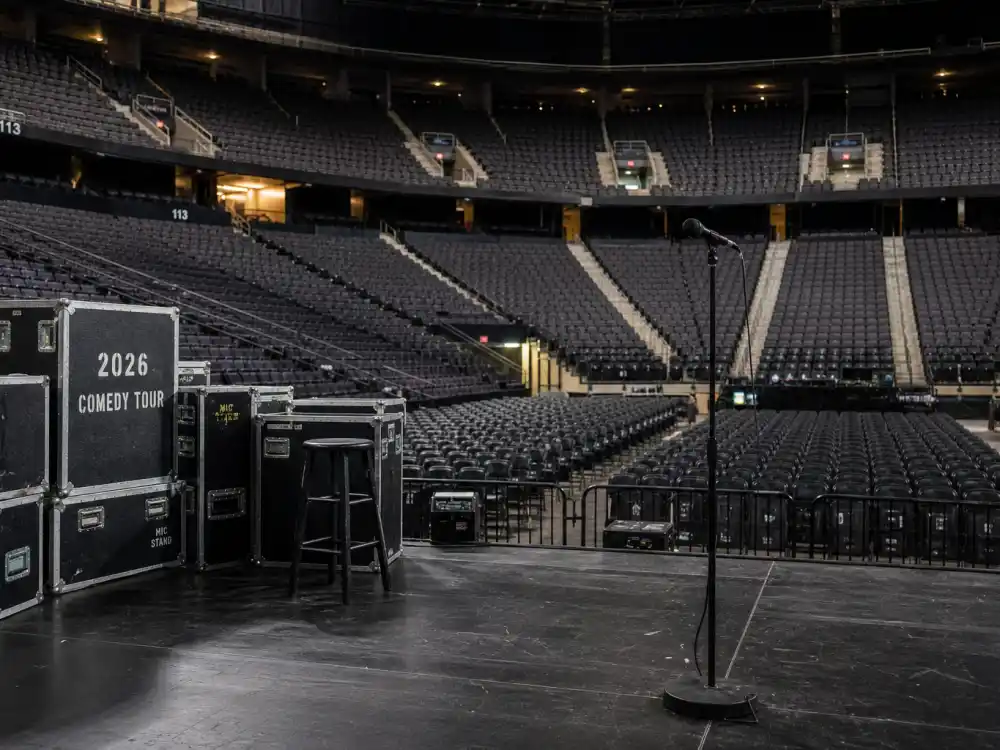
Legacy conversations have grown more nuanced. Younger comedians cite Cook’s MySpace mastery as ahead of its time. Historians of 2000s culture treat the arena-comedy boom as incomplete without him. Critics who dismissed his act still acknowledge the commercial footprint. What supporters want in 2026 is simple: a stable road career, maybe one well-received special that recontextualizes the arc, and space to be more than a nostalgia punchline.
Why “What Happened to Dane Cook?” Still Trends
Search interest clusters around four engines: 2000s nostalgia content on TikTok and YouTube, debates about joke theft and comedy ethics, curiosity about the embezzlement scandal, and genuine affection from fans who still quote his bits. Unlike comics who pivoted entirely to acting or podcasting empires, Cook remains identifiable first and foremost as a stand-up — which makes his fall from arena king to road comic a clean narrative Hollywood loves to retell.
The query also intersects with broader questions about fame in the social-media age. Cook was an early case study in direct-to-fan marketing, arena-scale comedy, and the speed with which a peer community can turn. Every time a comedian blows up online, someone asks what happened to Dane Cook as a reference point.
Legacy: Arena King, Punchline, and Pioneer
What happened to Dane Cook, ultimately, is a comedy-career story with three layers. The first is commercial: double-platinum albums, Madison Square Garden, and a Hollywood run few stand-ups replicate. The second is cultural: a style that defined bro-comedy for a generation and became unfashionable almost as fast as it dominated. The third is strategic: proof that a comic could build an empire without traditional gatekeepers — a lesson the industry absorbed even when it mocked the messenger.
If you still wonder what happened to Dane Cook, skip the one-word punchline and read the full arc: Boston kid, digital pioneer, arena superstar, movie lead, backlash target, betrayed brother’s victim, road warrior, and 2026 touring comic still carrying bits that millions memorized. The ending is quieter than 2006 — but it is not over.
Explore More
- Browse Celebrities for more what-happened-to and where-are-they-now profiles.
- Read what happened to Carlos Mencia for another 2000s stand-up star shaped by controversy.
- See what happened to Louis C.K. for the peer whose feud with Cook became comedy history.
- See what happened to Kevin Hart for the arena-comedy model that succeeded in the next generation.
For background, see Dane Cook’s Wikipedia profile and reporting from Rolling Stone, Variety, Forbes, and The Hollywood Reporter on his stand-up peak, Retaliation, Vicious Circle, and embezzlement trial.