

In this article8 sections
You can show the Carina Nebula and how it’s photographed with three kinds of pictures. Hubble, the James Webb Space Telescope, and a telescope in Chile each catch a different kind of light. The color in the famous shots is assigned later. Everything below is as of November 29, 2026.
The object is a real cloud of gas and dust. It sits in the southern constellation Carina, the Keel. NASA’s Hubble catalog lists it as Caldwell 92 and as NGC 3372. It is an emission nebula. Hot stars make the gas glow.
Show the Carina Nebula and How It’s Photographed at a Glance
| Question | What NASA reports |
|---|---|
| Catalog names | NGC 3372, Caldwell 92, also called the Eta Carinae Nebula |
| Distance | About 7,500 light-years on Hubble pages. About 8,500 on a 2024 NASA picture of the day |
| Size | About 300 light-years across, from a Hubble page dated December 14, 2022 |
| Brightness | About magnitude 4.8, bright enough for the naked eye in the south |
| Found | 1752, by Nicolas-Louis de Lacaille, from the Cape of Good Hope |
| Famous edge | Cosmic Cliffs, the rim of NGC 3324, not the whole cloud |
| Webb release | July 12, 2022, from frames taken June 3, 2022 |
A cloud you can see without a telescope
NASA’s Hubble page for Caldwell 92 puts the cloud about 7,500 light-years from Earth. A later Hubble write-up, dated December 14, 2022, says the cloud is about 300 light-years across. A NASA astronomy picture from February 5, 2024, gives a larger distance, about 8,500 light-years. Both numbers are NASA’s. They do not agree.
The glow is about magnitude 4.8. From Earth’s southern hemisphere you can see it with no telescope at all. Nicolas-Louis de Lacaille found it in 1752 while working at the Cape of Good Hope.
The cloud holds huge stars. NASA says at least a dozen of them are 50 to 100 times the mass of the Sun. Near the middle sits Eta Carinae. One Hubble page calls it a pair, about 90 and 30 times the Sun’s mass. The Caldwell page puts the larger star near 100 times the Sun’s mass, and about 5 million times as bright.
One wide picture is many shots stacked
Hubble’s camera sees a narrow patch. One exposure cannot cover a cloud 300 light-years wide. NASA released a short film on December 14, 2022. In it, Hubble operations project scientist Dr. Ken Carpenter says the wide view is hundreds of separate shots. Staff line the shots up. Then they stack them into one mosaic.
The film is Hubble’s Inside the Image, produced at NASA’s Goddard Space Flight Center. Carpenter stops on a peak called Mystic Mountain. He says that peak is only a small piece of the cloud. He also points to Eta Carinae. NASA’s written pages describe that star system as a massive, unstable pair, not as an ordinary aging star.
The orange wall is only one edge
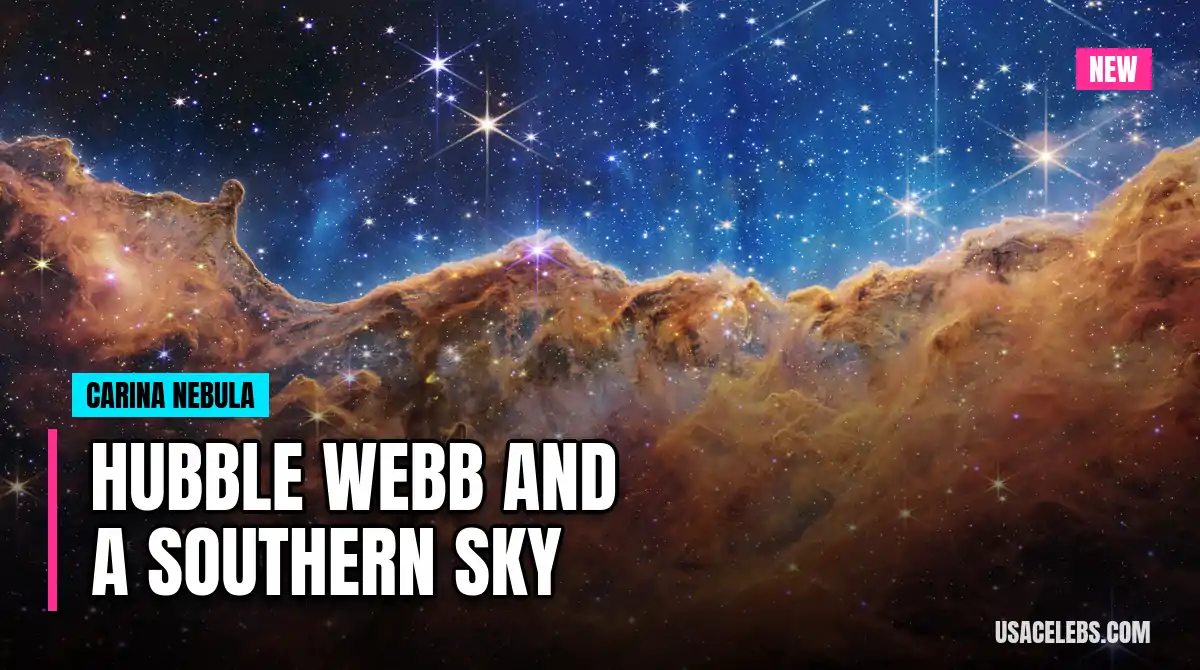
The orange ridge people pass around is not the entire nebula. NASA named that ridge the Cosmic Cliffs. It is the rim of a cavity in a region called NGC 3324. That region sits at the northwest corner of the larger cloud. James Dunlop entered NGC 3324 in a catalog in 1826.
Webb’s Near-Infrared Camera took those frames on June 3, 2022. NASA released the picture on July 12, 2022. The cliffs are about 7,600 light-years away. The tallest peaks in the frame are about 7 light-years high. The picture spans about 16 light-years.
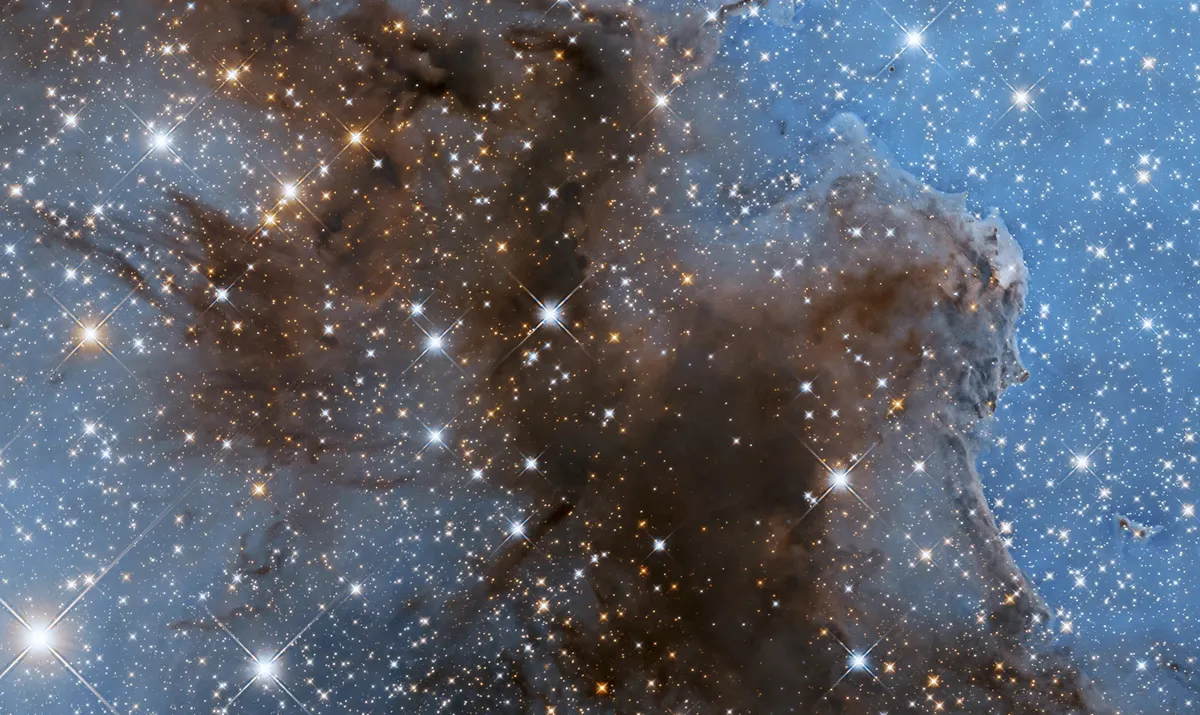
The photo above is a different view. Hubble released it on December 14, 2022. It shows a smaller patch near the center, where the gas is thinner. The team used infrared light. Dust scatters ordinary visible light. Longer infrared waves slip through. Credit goes to NASA, ESA, and A. Kraus, with processing by Gladys Kober.
Where the color comes from
A filter does not take a color photo. Each filter makes one gray frame. Editors map those frames onto red, green, and blue afterward.
The April 24, 2007 Hubble release mixed two telescopes. Hubble’s Advanced Camera for Surveys used a filter called F658N. That filter isolates hydrogen light, plus a little nitrogen. The 4-meter Blanco telescope at Cerro Tololo in Chile added three frames. One records oxygen at 501 nanometers. One records hydrogen at 658 nanometers. One records sulfur at 672 and 673 nanometers.
Webb looks at infrared light. Eyes cannot see it. NASA’s imaging team says a raw Webb file looks almost black. The detail sits in the darkest pixels. Specialists stretch the brightness so faint parts appear. They keep the bright parts from washing out. Then they assign color in wavelength order. Shorter infrared is painted blue. Longer infrared is painted red.
For the cliffs picture, NASA published the exact map. Red is filter F444W. Orange is F335M. Yellow is F470N. Green is F200W. Cyan is F187N. Blue is F090W. The credit line reads NASA, ESA, CSA, and STScI.
That is why two photos of one cloud can look unlike each other. Webb sees through dust and shows stars a visible-light shot would hide. A hydrogen filter lights the glowing gas and leaves the rest dark.
What a telescope on the ground adds
A spacecraft is not required. The Blanco telescope in Chile already supplied the oxygen and sulfur frames for the 2007 release.
A single click is still not enough. The cloud is faint, wide, and dusty. Observers collect many exposures through narrow filters. Software matches the stars from shot to shot and stacks the files. Stacking reduces noise.
NASA says the naked-eye view belongs to the southern hemisphere. The cliffs image is listed at a declination of -58 degrees 37 arcminutes. An object that far south stays under the horizon across much of the northern sky.
Sources
- NASA Hubble, Caldwell 92, the Carina Nebula
- NASA Hubble, December 14, 2022, infrared view
- NASA Hubble, April 24, 2007, filters and Eta Carinae
- NASA, February 5, 2024, picture of the day
- NASA Webb, July 12, 2022, Cosmic Cliffs
- NASA Webb image record, filters and size
- NASA, how Webb’s color pictures are made
- NASA Goddard, Hubble’s Inside the Image, December 14, 2022
Frequently Asked Questions
How do scientists show the Carina Nebula and how it’s photographed?
They take many gray frames through filters, line the frames up, and assign colors later. Hubble’s wide view is a mosaic of hundreds of shots. Webb’s cliffs picture uses infrared filters from June 3, 2022.
How far away is the Carina Nebula?
NASA’s Hubble pages say about 7,500 light-years. A NASA picture of the day from February 5, 2024, says about 8,500 light-years.
Are the Cosmic Cliffs the whole Carina Nebula?
No. NASA says the cliffs are the rim of NGC 3324, at the northwest corner of the larger cloud. The peaks in that Webb picture are about 7 light-years high.
Can you see the Carina Nebula without a telescope?
Yes, from the southern hemisphere. NASA lists the brightness at about magnitude 4.8. Nicolas-Louis de Lacaille recorded it in 1752.
Last updated: November 29, 2026.