

In this article8 sections
- Movies That Won the Most Oscars: The 11-Win Record
- Films With 10 and 9 Oscars: The Next Tier
- Most-Nominated Films vs. Most-Winning Films
- Biggest Sweeps and Biggest Shutouts
- Why Eleven Wins Became the Ceiling
- Honorary and Special Awards Do Not Count
- Quick Reference: Movies That Won the Most Oscars
- Explore More Awards Coverage
Movies that won the most Oscars do not merely collect trophies — they rewrite what Hollywood believes a single film can achieve in one awards season. Three epics share the all-time record with 11 competitive Academy Awards each: Ben-Hur (1959), Titanic (1997), and The Lord of the Rings: The Return of the King (2003). Only the latter converted every nomination it received, a perfect 11-for-11 sweep that remains unmatched among films at the summit of Oscar history.
This evergreen guide ranks the movies that won the most Oscars by competitive win total, explains how nomination counts differ from victory counts, and highlights the cruel inverse — films nominated 11 times that went home empty-handed. We cite official Academy records at Oscars.org, mark disputed trivia as “reportedly,” and cross-link related coverage: who has won the most Oscars ever across all categories, the Oscar winners 2026 full list, and most Oscars won by an actor all time for the performer side of the records book.

Movies That Won the Most Oscars: The 11-Win Record
When researchers ask which movies that won the most Oscars sit atop the leaderboard, the answer is a three-way tie at 11 competitive wins. No feature film has ever won 12 Academy Awards in categories voted by members in a single year — though category additions and rule changes over nine decades mean direct era-to-era comparisons require context.
The three record holders represent three distinct Hollywood eras: the widescreen biblical epic, the late-1990s blockbuster romance, and the fantasy franchise finale that capped a groundbreaking visual-effects trilogy. Together they define the ceiling for movies that won the most Oscars and set the benchmark every future Best Picture contender chases during awards season.
Ben-Hur (1959) — 11 Wins From 12 Nominations
William Wyler’s Ben-Hur dominated the 32nd Academy Awards on April 4, 1960, winning 11 of 12 nominations. Victories included Best Picture, Best Director, Best Actor (Charlton Heston), Best Supporting Actor (Hugh Griffith), and a sweep of technical categories — Art Direction, Cinematography (Color), Costume Design, Film Editing, Scoring, Sound, and Special Effects.
The lone miss was Best Adapted Screenplay; Karl Tunberg lost to Neil Paterson for Room at the Top. Still, Ben-Hur held the movies that won the most Oscars record alone for nearly four decades — from 1960 until James Cameron’s Titanic matched the total in 1998. Its chariot race and 70mm spectacle embodied the kind of grand theatrical experience voters rewarded before television ratings and streaming fragmentation reshaped the industry.

Titanic (1997) — 11 Wins From 14 Nominations
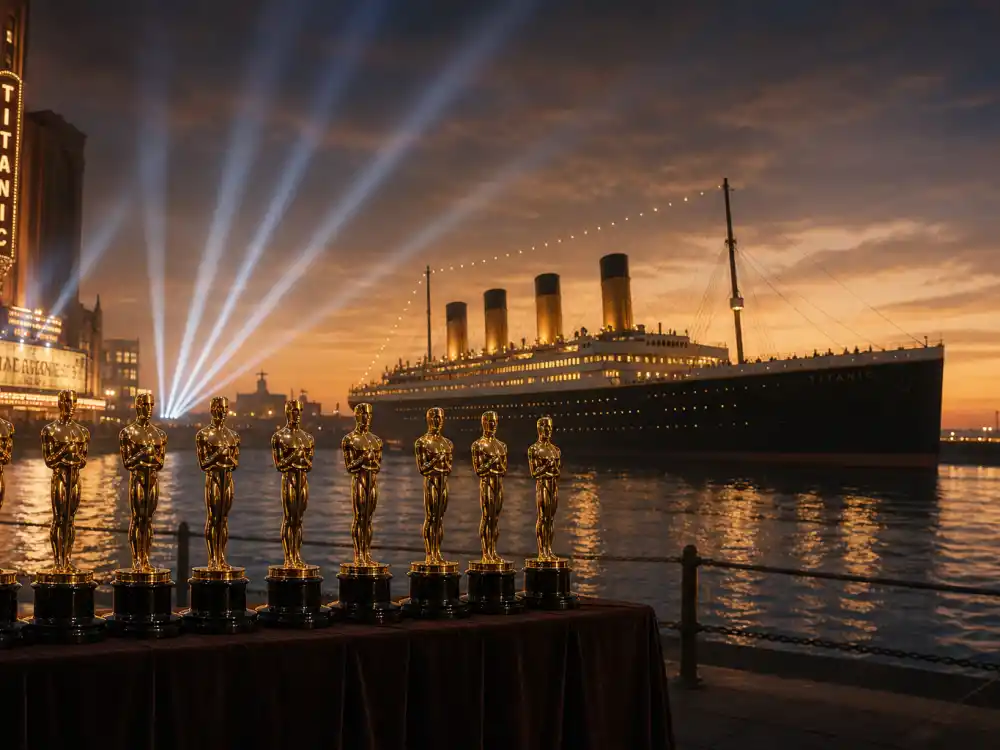
James Cameron’s Titanic arrived at the 70th Academy Awards on March 23, 1998, with 14 nominations — then tied for the most ever — and left with 11 wins. Cameron claimed Best Director and shared the Best Picture producing honor with Jon Landau. Kate Winslet lost Best Actress to Helen Hunt; Gloria Stuart lost Supporting Actress to Kim Basinger. The film still swept the crafts voters love for spectacle: Art Direction, Cinematography, Costume Design, Film Editing, Original Dramatic Score, Original Song (“My Heart Will Go On”), Sound, Sound Effects Editing, and Visual Effects.
Titanic proved that a romance-disaster hybrid could join the movies that won the most Oscars club alongside a sword-and-sandal epic. Its 14 nominations also placed it among the most-nominated films in history — a topic we explore below because nomination volume and win totals tell different stories.
The Lord of the Rings: The Return of the King (2003) — 11-for-11 Perfect Sweep
Peter Jackson’s The Return of the King stands apart among movies that won the most Oscars because it won every category in which the Academy nominated it. Eleven nominations, eleven victories — Best Picture, Director, Adapted Screenplay, Art Direction, Costume Design, Film Editing, Makeup, Original Score, Original Song (“Into the West”), Sound Mixing, and Visual Effects. No other eleven-win film has achieved a perfect conversion rate.
The sweep validated Jackson’s ambition to film J.R.R. Tolkien’s saga as one continuous production and rewarded the trilogy’s emotional payoff. For trivia fans, Return of the King is the answer when the question shifts from “movies that won the most Oscars” to “which film won every Oscar it was nominated for in a single year at the highest win total.” That distinction matters on quiz night and in film-history seminars alike.

Films With 10 and 9 Oscars: The Next Tier
Below the eleven-win ceiling, several classics approach the movies that won the most Oscars summit without quite reaching it.
West Side Story (1961) — 10 Wins
Robert Wise and Jerome Robbins’ West Side Story won 10 competitive Oscars from 11 nominations at the 34th Academy Awards in 1962 — including Best Picture, Director, Supporting Actor (George Chakiris), Supporting Actress (Rita Moreno), and major technical categories. It was the first musical to claim Best Picture since Gigi (1958) and demonstrated that staged dance numbers could dominate the crafts as thoroughly as any historical epic among movies that won the most Oscars runners-up.
Nine-Win Films: Gigi, The Last Emperor, The English Patient
Three films share nine competitive wins each:
- Gigi (1958) — won all nine categories in which it was nominated at the 31st Oscars, a clean sweep at a lower volume than Return of the King
- The Last Emperor (1987) — Bernardo Bertolucci’s biographical epic won nine from nine nominations at the 60th Academy Awards, including Picture, Director, and Adapted Screenplay
- The English Patient (1996) — won nine of 12 nominations at the 69th Oscars, losing Actress, Supporting Actress, and Costume Design while sweeping Picture, Director, Supporting Actress (Juliette Binoche), and crafts
These nine-win films illustrate that near-sweeps happen more often than eleven-trophy hauls. Voters occasionally spread wealth across multiple contenders in acting categories even when they crown a consensus Best Picture winner — a pattern that prevents more films from joining the movies that won the most Oscars elite trio.
Most-Nominated Films vs. Most-Winning Films
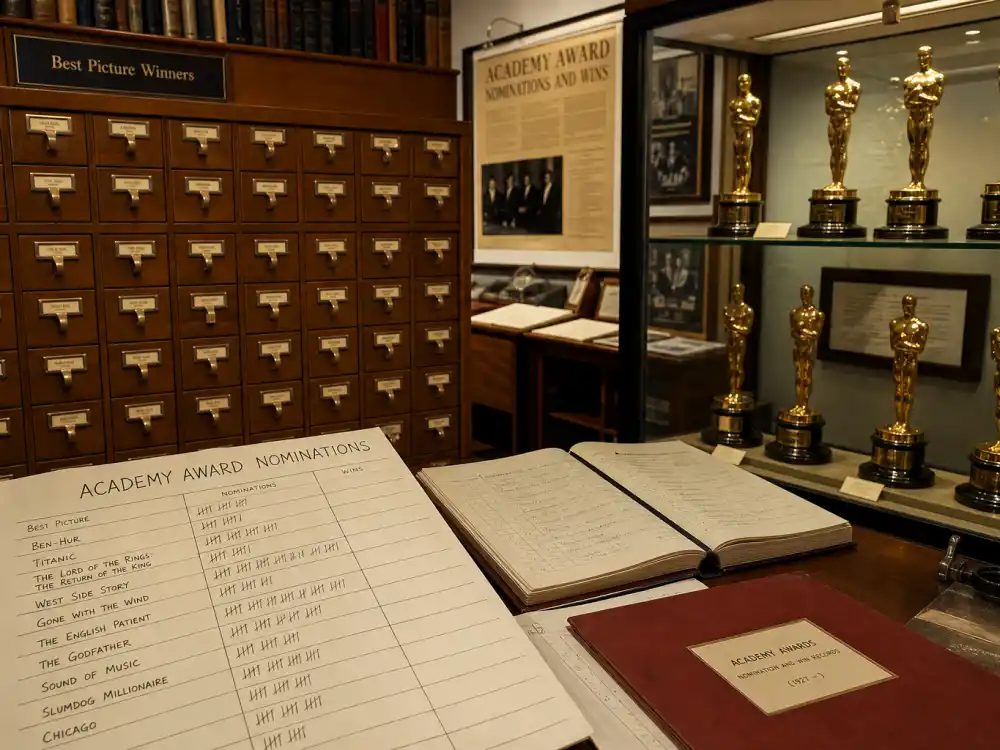
Movies that won the most Oscars is a win-total question, not a nomination question — yet the two metrics intertwine in awards-season lore. Three films share the record for most nominations in a single year: 14 each.
- All About Eve (1950) — 14 nominations, 6 wins at the 23rd Academy Awards
- Titanic (1997) — 14 nominations, 11 wins at the 70th Academy Awards
- La La Land (2016) — 14 nominations, 6 wins at the 89th Academy Awards
All About Eve and La La Land demonstrate that nomination dominance does not guarantee membership among movies that won the most Oscars. Joseph L. Mankiewicz’s backstage drama still won six trophies — including Picture and Director — but lost eight races. Damien Chazelle’s musical suffered the infamous Best Picture envelope mix-up against Moonlight and finished with six wins despite tying the nomination record.
Titanic remains the only film to combine 14 nominations with 11 victories — the most efficient high-volume conversion in Oscar history until Return of the King’s perfect 11-for-11 at a slightly lower nomination count.
Biggest Sweeps and Biggest Shutouts
The movies that won the most Oscars conversation has a painful mirror image: films nominated 11 times that won zero competitive statuettes.
The Turning Point (1977) — 0-for-11
Herbert Ross’s ballet drama The Turning Point received 11 nominations at the 50th Academy Awards in 1978 — including Picture, Actress (Anne Bancroft and Shirley MacLaine), Supporting Actor, Supporting Actress, Director, and crafts — and lost every single race. Annie Hall claimed Best Picture; Star Wars dominated technical categories. The Turning Point remains tied for the most nominations without a single win.
The Color Purple (1985) — 0-for-11
Steven Spielberg’s The Color Purple matched the shutout ignominy at the 58th Academy Awards in 1986: 11 nominations, zero wins. The film lost Picture to Out of Africa, and Spielberg was not nominated for Director — a snub that still fuels debate decades later. Whoopi Goldberg, Oprah Winfrey, and Margaret Avery all lost acting races despite widespread critical praise.
These shutouts prove that Oscar night is not arithmetic. A film can sit one nomination shy of the movies that won the most Oscars record in volume and still leave empty-handed — the cruelest outcome in Academy history.

Why Eleven Wins Became the Ceiling
Several structural forces explain why no film has surpassed the eleven-win mark among movies that won the most Oscars.
First, the Academy awards roughly 23 competitive categories today — but no single film contends in every category. Animated features, international films, and documentaries occupy separate lanes. Even a sprawling epic rarely lands nominations in shorts, animation, or documentary slots.
Second, voters spread wealth. Acting categories often split among multiple films even when one picture sweeps crafts. Titanic lost two acting races despite 11 wins. Ben-Hur lost screenplay. Consensus forms around a Best Picture frontrunner without handing that film every trophy.
Third, category splits and mergers changed the math over decades. Sound categories merged; technical fields multiplied. Films from the 1950s competed in fewer overall slots, arguably making eleven wins statistically more attainable than in today’s fragmented ballot — though that theory is debated among historians and should be marked as interpretive rather than official Academy doctrine.
Honorary and Special Awards Do Not Count
Purists ranking movies that won the most Oscars count only competitive category victories announced on ceremony night. Scientific and Technical Awards, Honorary Oscars, and special achievement citations fall outside the standard film leaderboard. This guide follows Oscars.org competitive databases so readers comparing Ben-Hur, Titanic, and Return of the King use the same definition trivia apps and film schools employ.
Quick Reference: Movies That Won the Most Oscars
- 11 wins (record tie): Ben-Hur (1959), Titanic (1997), The Lord of the Rings: The Return of the King (2003)
- Perfect sweep at 11: The Return of the King only — 11-for-11
- 10 wins: West Side Story (1961)
- 9 wins: Gigi (1958), The Last Emperor (1987), The English Patient (1996)
- 14 nominations (record tie): All About Eve, Titanic, La La Land
- 0-for-11 shutouts: The Turning Point (1977), The Color Purple (1985)
Explore More Awards Coverage
- Read who has won the most Oscars ever for individual and craft records beyond single films.
- See the Oscar winners 2026 full list for every category from the latest ceremony.
- Check most Oscars won by an actor all time for Hepburn, Day-Lewis, Streep, and the acting leaderboard.
- Browse our Awards archive for ceremony history, snubs, and records.