

In this article13 sections
- Marilyn Monroe White Dress History: The Lexington Avenue Night
- William Travilla and the Costume Construction
- The Subway Grate: Engineering an Iconic Moment
- 1950s New York and the Publicity Machine
- The Film Versus the Photograph
- Joe DiMaggio, Crowds, and the Marriage Subplot
- Copyright, Replicas, and Auction Culture
- Pop Art, Advertising, and Visual Repetition
- Styling Lessons Designers Still Cite
- Museum Legacy and Fashion Exhibition Culture
- Common Myths and Corrections
- Why the Dress Still Matters in 2026
- Explore More
Marilyn Monroe white dress history begins on a humid September night in 1954 when Twentieth Century Fox turned Lexington Avenue at 52nd Street into the most photographed sidewalk in America. Costume designer William Travilla dressed Monroe in an ivory-white halter cocktail gown with sunray pleats, a plunging neckline, and a skirt engineered to catch wind from a subway ventilation grate below. The setup was a publicity shoot for The Seven Year Itch, Billy Wilder’s 1955 comedy — not the final scene audiences would see in theaters, but the frame that outlived the film itself. Within hours the image crossed wire services. Within decades it became shorthand for mid-century glamour, pop-art repetition, and the moment Hollywood learned that a single dress could carry a career, a marriage, and an entire visual language.
This guide traces the full Marilyn Monroe white dress history from Travilla’s sketch to auction hammer — who designed the gown, why the subway grate mattered, what happened when thousands of fans and Joe DiMaggio watched the shoot, how the dress entered museum culture, and why stylists still cite the pleated halter when coaching red-carpet confidence. Whether you study celebrity fashion for journalism, film history, or pure nostalgia for golden-age Hollywood, you will leave with a complete timeline of the white dress that never needed a close-up of its wearer’s face to become immortal.
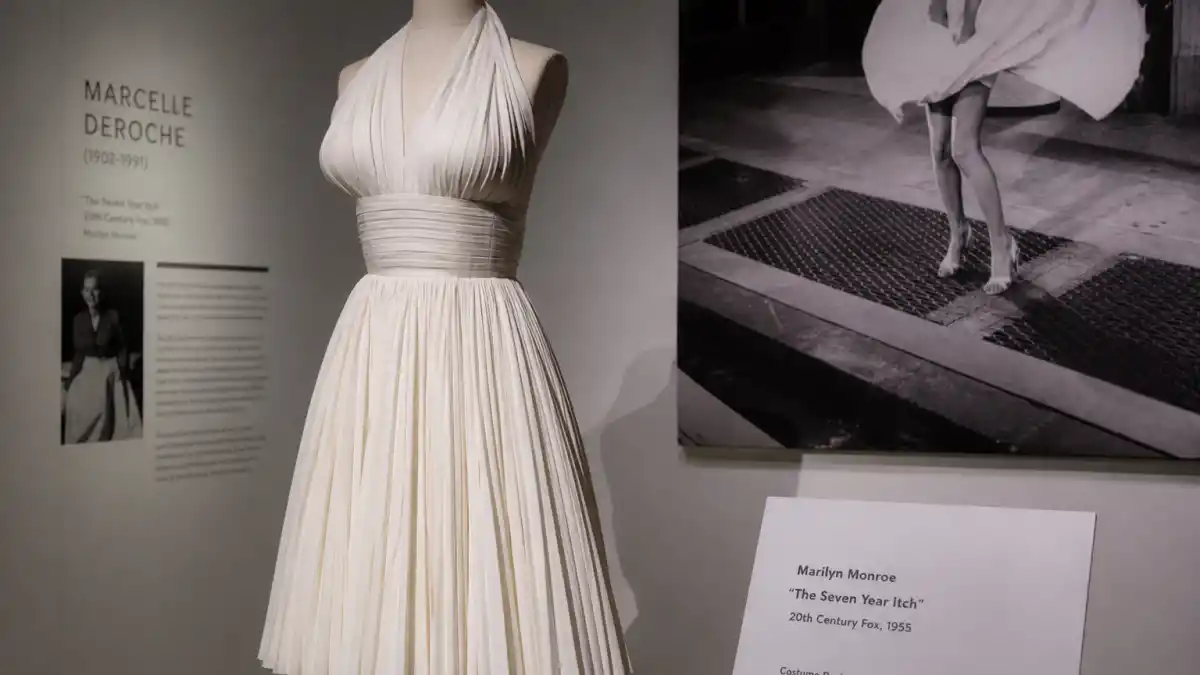
Marilyn Monroe White Dress History: The Lexington Avenue Night
On September 15, 1954, Fox staged the famous grate scene on location in Manhattan rather than on a closed soundstage — a decision that made Marilyn Monroe white dress history as much a story of crowd control as couture. Studio publicists invited press; fans gathered on fire escapes and sidewalks; flashbulbs popped from every angle. Monroe repeated the walk over the grate as cold air lifted the pleated skirt, creating the billowing circle that photographers still chase when they want instant recognition. The noise on Lexington Avenue reportedly reached levels that disturbed Monroe’s husband Joe DiMaggio, who was present that night and famously uncomfortable with the spectacle.
Context matters for accurate fashion journalism. The Seven Year Itch would not premiere until June 1955, nearly nine months after the outdoor shoot. The grate footage and stills were promotional assets — teasers for a summer comedy about fidelity and fantasy. Monroe was at peak visibility: fresh off Gentlemen Prefer Blondes and How to Marry a Millionaire, negotiating her Fox contract, and navigating a marriage under constant tabloid surveillance. The white dress gave photographers a clean graphic — monochrome silk against dark pavement — that required no dialogue to explain.
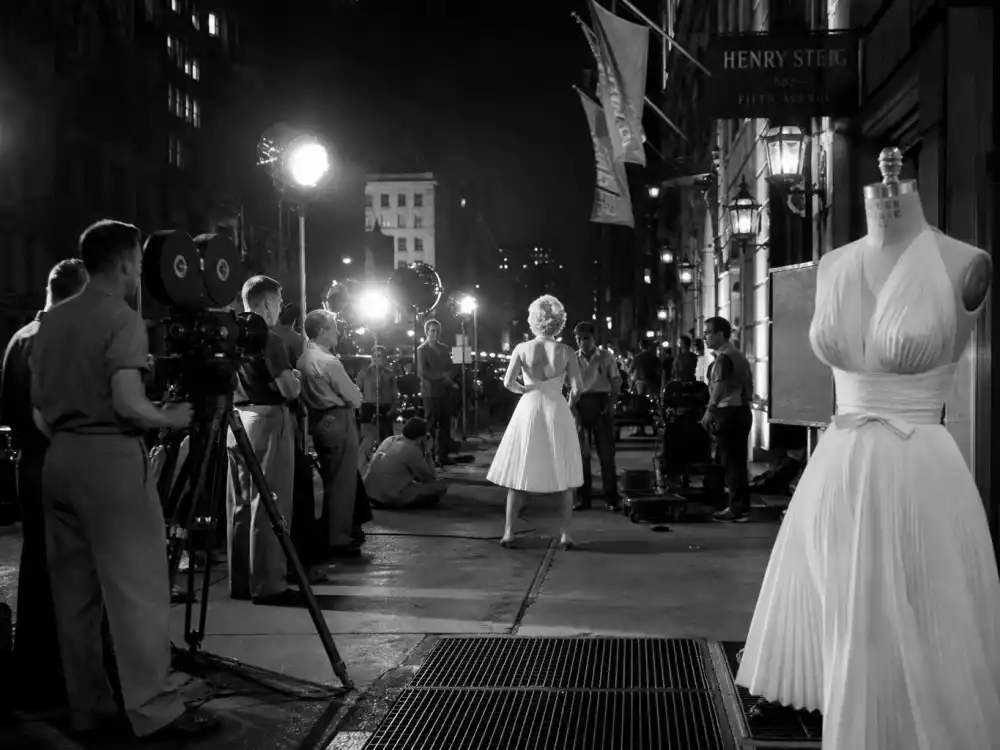
William Travilla and the Costume Construction
William Travilla designed costumes for Monroe across multiple Fox projects, and the white pleated halter belongs to his most cited collaboration. Travilla built the dress from lightweight fabric pleated in sunray formation so the skirt could expand dramatically when air rose from below while still draping cleanly when still. The halter neckline tied behind the neck, leaving shoulders bare and creating the plunging front that read both innocent and daring on 1950s moral scales. A fitted waistband anchored the pleats before the skirt flared to cocktail length — short enough to show legs and heels, long enough to survive repeated takes on a public street.
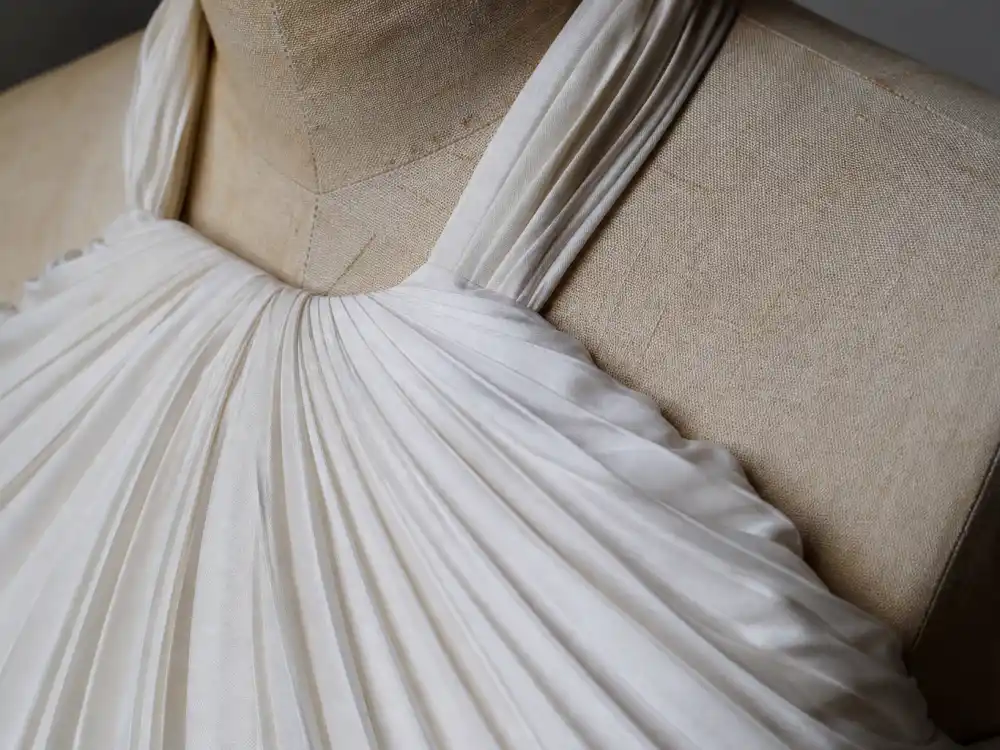
Travilla later described the dress as deceptively simple — a trap for amateur copyists who underestimated internal structure. Halter ties needed reinforcement so the bodice would not slip during movement. Pleats required alignment at the waist seam so the burst photograph would look symmetrical. Travilla’s archive notes and subsequent interviews position the gown inside his broader Monroe wardrobe: saturated colors for musicals, sculptural neutrals for publicity that had to compete with architecture and crowds. Fashion historians credit him as co-author of the image even when headlines name only the star.
The Subway Grate: Engineering an Iconic Moment
The ventilation grate was not accidental set dressing. Production arranged for air to rise through the sidewalk slats — mimicking the rush of a passing train — while fans and photographers documented each take. The physics are half the legend in Marilyn Monroe white dress history: pleated fabric catches updraft differently than smooth satin, which is why Travilla’s textile choice mattered as much as Monroe’s stance. Low camera angles emphasized the circle of white silk against the grid of dark metal. High angles captured the Manhattan canyon of shop signs and onlookers. Every frame reinforced the same readable silhouette.
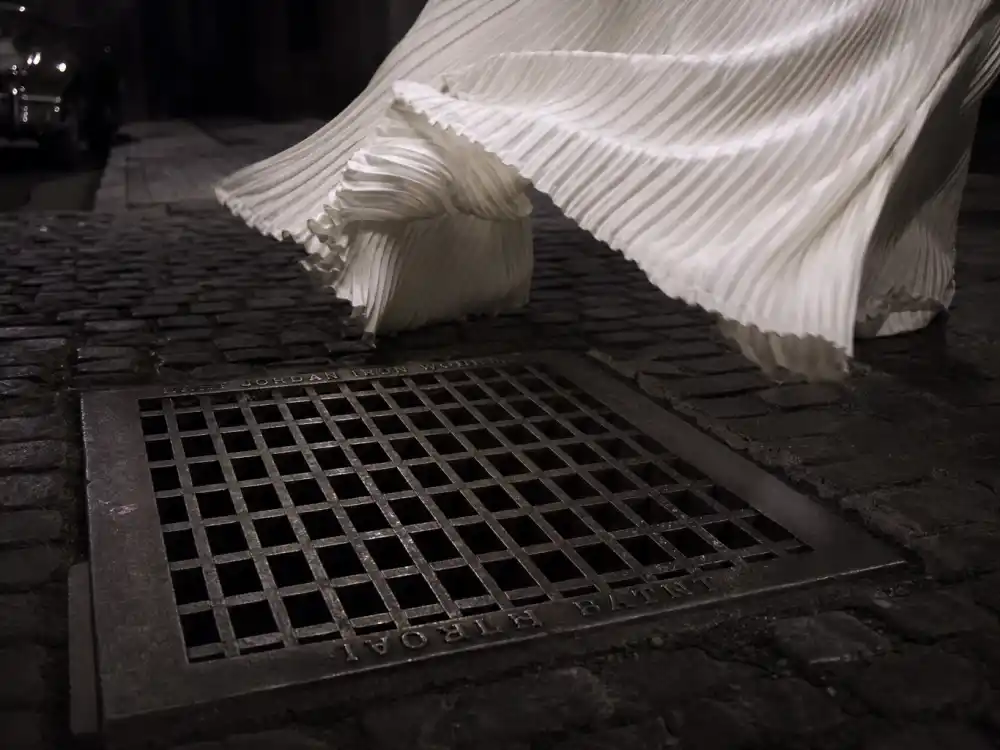
Urban legend sometimes claims the studio invented the subway breeze for effect; documentation confirms real vent airflow supplemented by production planning. The scene’s afterlife includes homages on runways, Halloween costumes, drag stages, and advertising campaigns that recreate the grate with fans and hidden floor vents. Each homage proves the dress functions as a logo — recognizable from hem and pleat alone.
1950s New York and the Publicity Machine
Mid-century studio publicity treated stars as movable landmarks. For Monroe, shooting on Lexington Avenue meant trading soundstage control for organic chaos — a trade Fox accepted because the chaos produced authenticity tabloids craved. Newspapers ran the white-dress stills before most readers could name the film’s plot. International editions cropped the frame for covers. The image traveled faster than review copy, establishing a pattern Hollywood still uses: release a single garment photograph early and let fashion media carry the marketing.
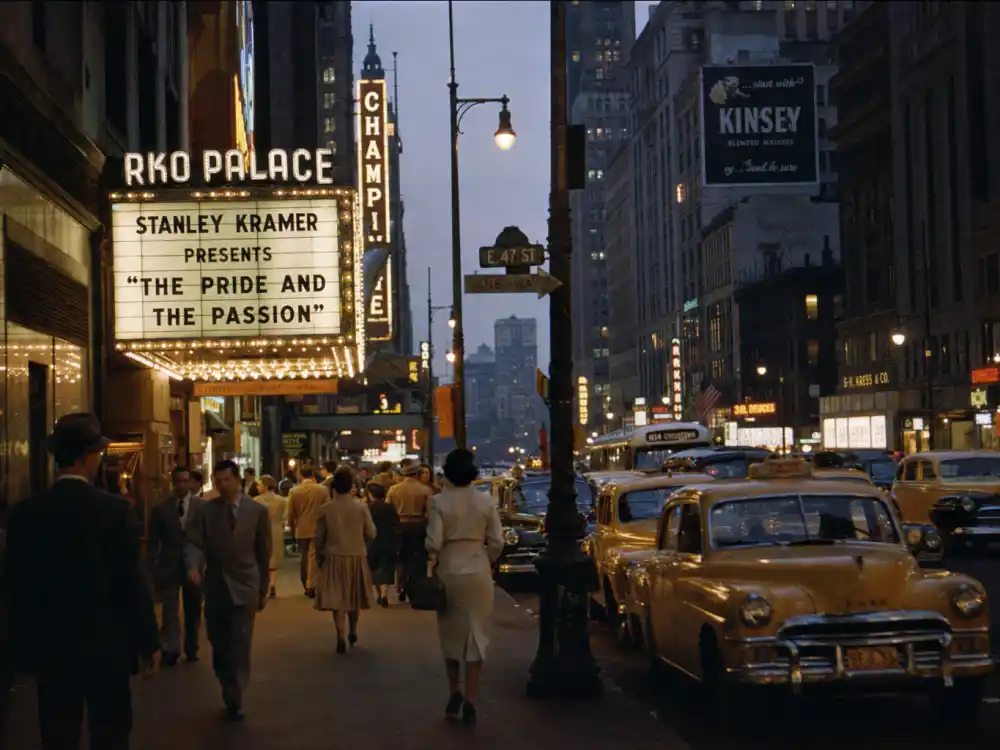
The publicity cycle intersected with Monroe’s personal narrative the same week. DiMaggio’s discomfort at the shoot fed divorce coverage within months — a reminder that Marilyn Monroe white dress history is never only costume history. The dress appeared while a marriage unraveled under flashbulbs, adding emotional weight to a comedy’s marketing still. Scholars of celebrity image-making cite the week as a case study in how fashion moments absorb biography whether the wearer intends it or not.
The Film Versus the Photograph
Audiences who watch The Seven Year Itch today often expect the grate scene to dominate the runtime. In the finished film the moment is brief — a fantasy sequence inside a larger story about temptation and summer heat. The promotional stills and posters, however, centered the white dress until it became the film’s visual brand. That split between motion-picture narrative and still-image mythology is common in classic Hollywood, but rarely as lopsided as here. The dress won the memory contest.
Color versus black-and-white adds another layer. Many iconic reproductions use high-contrast monochrome even when Travilla’s original was ivory-white silk. The tonal choice flattened the dress into graphic art — ideal for Warhol silkscreens and later pop-art licensing. Fashion students compare the phenomenon to Audrey Hepburn’s Givenchy black dress: a garment that functions in color on screen but lives forever in stylized reproduction.
Joe DiMaggio, Crowds, and the Marriage Subplot
Biographers document DiMaggio leaving the Lexington shoot early, disturbed by the crowd’s reaction and the repeated takes Monroe performed for cameras. Whether the white dress alone ended the marriage is oversimplified — the couple faced years of press intrusion — but contemporaneous reporters linked the grate night to their separation narrative. For fashion historians the subplot matters because it shows how a costume can become a flashpoint in private life. The dress was work; the crowd’s gaze made it spectacle. Monroe’s willingness to perform the take again and again demonstrated professional discipline that critics sometimes overlooked when they reduced her to image alone.
Copyright, Replicas, and Auction Culture
Original Travilla garments and studio-authorized pieces have surfaced at auction houses and celebrity memorabilia sales for decades. Collectors treat the white dress as grail-tier Hollywood costume — alongside ruby slippers and superhero capes. Debbie Reynolds famously championed film costume preservation before estate sales dispersed pieces to private buyers. When Monroe-related dresses cross the block, hammer prices make finance headlines, reinforcing that Marilyn Monroe white dress history now includes investment-asset status.
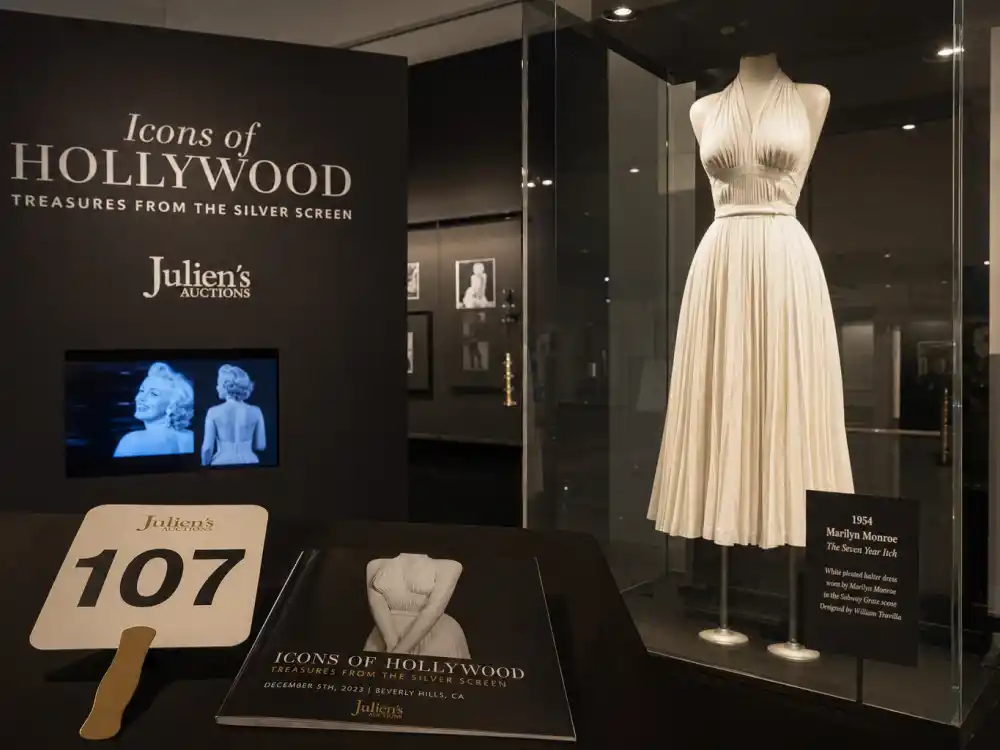
Replicas flood costume rental markets every October. High-fashion houses periodically reinterpret the halter pleat for runway shows, citing Monroe without naming her in look notes to avoid likeness disputes. The silhouette — bare shoulders, cinched waist, explosive skirt — remains a template for “classic American glamour” briefs stylists receive before award season.
Pop Art, Advertising, and Visual Repetition
Andy Warhol’s silkscreen culture absorbed Monroe’s face and wardrobe fragments into repeated panels that treated celebrity as industrial product. The white dress, often abstracted to pleats and heels, became a design element separable from portraiture. Advertising borrowed the grate gag for perfume, soda, and lingerie campaigns — always with legal clearance and usually with anonymous models shot from behind to echo the original without impersonation. That distance between homage and impersonation is now standard in fashion marketing law classrooms.
Social media revived the image for new generations. Pinterest boards, TikTok transitions, and Instagram carousel posts use the dress as instant 1950s code. The hashtag economy keeps search interest in Marilyn Monroe white dress history steady even when younger users have never watched the full film. Visual literacy travels faster than film literacy in the algorithm era.
Styling Lessons Designers Still Cite
Working stylists break the look into teachable elements: choose one hero garment with movement, anchor with simple heels, keep jewelry minimal so fabric stays protagonist, and match hair volume to skirt physics. Monroe’s stylists used soft curls that would not compete with halter straps. Makeup emphasized lips and brows because the camera angle often excluded detailed eye close-ups in the famous stills. The discipline is why modern recreations fail when they add statement necklaces or heavy belts — the original succeeded through subtraction.
Body-confidence coaching in media still references the grate walk as permission to occupy public space boldly. Feminist readings alternately celebrate the joy in Monroe’s performance and critique the male gaze the crowd embodied. Both readings keep the dress active in cultural debate rather than sealed in nostalgia.
Museum Legacy and Fashion Exhibition Culture
Costume institutes from Los Angeles to London have displayed Travilla’s Monroe-era work with placards explaining pleating technique and Fox archive numbers. Exhibition visitors who never watched The Seven Year Itch still recognize the mannequin from a thousand derivative images. Docents explain the subway grate; design students sketch waist seam placement. Institutional treatment elevates the piece from fan collectible to textile-history object alongside Dior’s New Look and Versace safety-pin gowns.
Digital archives now host high-resolution scans of publicity stills for licensing — a secondary economy that funds preservation. When museums borrow from private collectors, insurance valuations treat the white dress category as top tier. That financial reality confirms what fashion editors knew in 1954: this gown was never background filler.
Common Myths and Corrections
Myth one: the famous grate scene appears at length in the released film. Reality: the moment is short; promotional photography built the legend. Myth two: any white halter dress on a grate is an exact replica of Travilla’s construction. Reality: pleat count, halter width, and waistband placement vary across studio duplicates and touring costumes. Myth three: the shoot happened in 1955. Reality: Lexington Avenue filming occurred in September 1954; the film premiered in 1955. Accurate Marilyn Monroe white dress history requires holding all three corrections simultaneously.
Why the Dress Still Matters in 2026
Seventy years after Lexington Avenue, pleated white halters still appear on spring runways, celebrity Halloween lists, and fashion-magazine retrospectives. Documentaries on Monroe return to the grate frame as visual thesis statement. New audiences discover the story through costume exhibitions before streaming the comedy itself. For USA Celebs readers tracking celebrity fashion as cultural signal, Marilyn Monroe white dress history remains the benchmark case study: one gown, one sidewalk grate, infinite aftershocks across film, marriage, art, and commerce.
Explore More
- Browse our Fashion section for celebrity style history and red-carpet breakdowns.
- Read Jennifer Lopez green Versace dress history for another dress that rewrote search and media culture.
- See Princess Diana revenge dress story for protest dressing done with couture confidence.
- Compare Cher naked dress Bob Mackie history for red-carpet shock legacy.
- Check celebrity street style for how stars dress off the step-and-repeat.
For background, see coverage from Vogue, Harper’s Bazaar, and the Library of Congress on classic Hollywood costume archives, William Travilla’s Fox career, and mid-century publicity photography.