

In this article7 sections
- How much does Bill Gates make in a year the IRS actually scored
- Cascade sales, not a Microsoft paycheck
- Dividends on the leftover Microsoft stake
- Foundation grants are not personal income
- After the 2022 gifts, the Microsoft slice shrank
- Pretax ProPublica income versus take-home
- Why a 2026 Forbes tick is the wrong annual answer
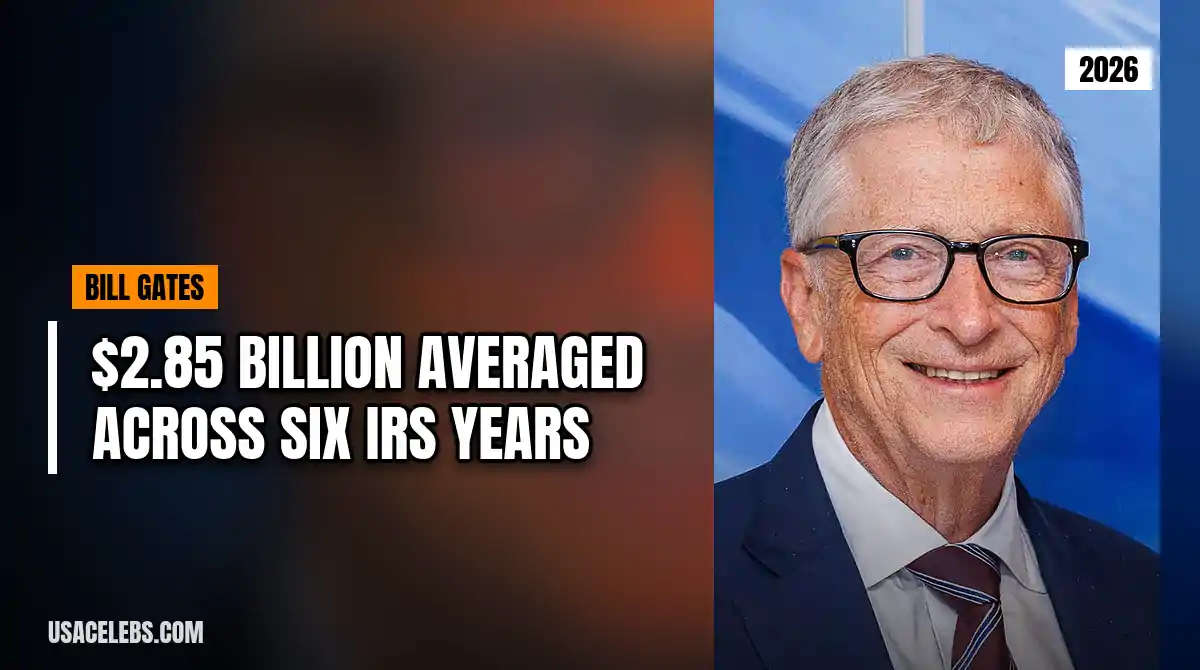
How much does Bill Gates make in a recent calendar is a question with a last IRS-backed answer, not a current Form 1040. ProPublica, working from tax files covering 2013 through 2018, reported an average yearly income of an estimated $2.85 billion — the most of any American in that window — and an effective federal income tax rate of 18.4 percent. No matching IRS release for 2026 sits in the public record this page relies on. Folding Forbes’ approximately $109.7 billion late-August fortune into “what he earned” freezes a wealth total and calls it a paycheck. Treating a quiet year as zero erases Cascade Investment sales that never hit a magazine pay list. The useful unit is the dated IRS window, not a live rich-list tick.
Yearly income is cash and realized gain. Net worth is whatever still sits in the personal column. Forbes still estimated the leftover fortune at approximately $109.7 billion as of August 28, 2026, 19th in the world. That wealth page is a different job. This one stays on dated IRS-backed prints, what Cascade sales and dividends look like, why Microsoft no longer writes a chief-executive check, and why take-home is smaller than the ProPublica line. For the mix of holdings that throw those realizations off, see how Bill Gates makes money. For the fortune those years left behind, see Bill Gates net worth 2026.
How much does Bill Gates make in a year the IRS actually scored
There is no typical W-2, and that absence is the point. The closest documented midpoint is not a salary and not a blank. It is ProPublica’s estimated $2.85 billion average yearly income for 2013 through 2018, a figure Bloomberg Law said ran about $800 million ahead of any other U.S. citizen in that study. One hundred percent of that income was taxed at the lower investment rate, according to the same top-15 table, and 22 percent of it was deducted. If someone wants a single responsible number, that dated average is it — plus a warning that 2026 has no matching IRS print.
A year Cascade closes a large sale is one species. A year of quiet coupons is another. An unscored calendar is a third. ProPublica could estimate a billionaire’s haul when it had the returns. It has not reprinted that estimate every January. The approximately $109.7 billion fortune is a store of remaining assets. Mixing 19th place on a rich list into an earnings answer is how the internet overstates 2026.
Anyone quoting a single annual figure without naming the years and the outlet is not answering the query. Anyone quoting a green day on Forbes’ real-time list as a paycheck is answering a wealth question with a pay noun.
Cascade sales, not a Microsoft paycheck
He left the Microsoft chief-executive role in 2000, left the chairmanship in 2014, and left the Microsoft and Berkshire Hathaway boards in March 2020, according to Forbes’ chronology. In a February 2023 Forbes interview he said he still spent about 10 percent of his time consulting with Microsoft teams, including those working with OpenAI. Consulting time is not a disclosed nine-figure salary, and no serious outlet has treated it as one. How much does Bill Gates make from Microsoft as a job, in cash, is therefore: he doesn’t, in any sourced wage sense.
The income ProPublica scored was investment income. Cascade Investment is the private vehicle most often named as the holder of his post-Microsoft assets. Michael Larson has long run that book. When Cascade sells a block of Republic Services, Deere, or another named holding, the gain is income in that tax year. When it does not sell, the paper gain is a Forbes mark, not a 1040 line. A scored year is closer to those realizations plus qualified dividends than to a chief-executive bonus.
Steve Ballmer is the control experiment from the same company. ProPublica put Ballmer’s average annual reported income at about $1.05 billion in the same 2013–2018 window, 10th on that list, with an effective federal rate of 14.1 percent. Ballmer kept a concentrated Microsoft stake. Gates spent those years moving shares into a foundation. Both men cleared 10-figure IRS income without drawing a pop-star paycheck. Ballmer’s average still sat far below Gates’s estimated $2.85 billion, because realizations are lumpy and because Cascade’s book was already diversified.

Dividends on the leftover Microsoft stake
Some of the cash is quieter than a block sale. Microsoft pays a dividend. Amazon, by contrast, still does not. Forbes estimates Gates’ remaining personal Microsoft stake at less than 1 percent after 2022 share gifts. In the 2021 Forbes 400 snapshot, nearly a quarter of his fortune was still an estimated 1.3 percent stake worth approximately $31 billion as of September 3, 2021. The 2023 Forbes asset breakdown marked Microsoft at an estimated $33.8 billion even after the stub had shrunk as a percentage. A stub can throw off a nine-figure coupon when the company is huge. A stub is still a stub. It is not a CEO wage.
The rest of the coupon stack sits in Cascade’s named public lines. Forbes’ September 8, 2023, split, when it marked him at approximately $111 billion, priced Republic Services at an estimated $16.1 billion, Deere at an estimated $7.9 billion, Ecolab at an estimated $5.7 billion, and smaller lines in Givaudan, AutoNation, Canadian National Railway, and others. Those companies pay dividends. Income from Republic Services is not a concert fee. It is an equity coupon on a waste-and-recycling company. The same logic applies to Deere and Ecolab. The office does not publish the personal 1099 total. Inventing one from yield math would be worse than leaving the coupon unpriced.
Four Seasons, farmland, and other private marks throw off cash the way a hotel night or a rent check does, not the way a tour gross does. Forbes marked Four Seasons at an estimated $6.6 billion and landholdings at an estimated $1.2 billion in that 2023 split. Acreage headlines are not the same as a 12-figure paycheck. They are part of a normal year. They will not, on any sourced figure, look like ProPublica’s estimated $2.85 billion average by themselves.
Foundation grants are not personal income
A foundation gift is a discrete event. A market is not. When Cascade’s public holdings rally, Forbes’ real-time net worth ticks up. When they sell off, it ticks down. That is not Gates booking an estimated nine-figure sum in a day as income, even when the mark moves by that size. It is a revaluation of assets still in the personal column. Cash the IRS would see is realizations, dividends, and partnership distributions. A daily wealth tick is an appraisal.
The Gates Foundation’s approximately $9 billion annual payout, according to its January 2026 release, is a different unit. That is grant spending from charitable capital under board governance, plus an additional approximately $200 billion the foundation said it would invest before a 2045 close. Those figures describe where gifted money is going. They are not a personal paycheck, and they are not this year’s earned income. Confusing the payout with Cascade’s return stream inflates his wage and misunderstands the charity.
The foundation trust’s 13F is not a salary either. Recaps of the first-quarter 2026 filing described a full Microsoft exit from that charitable portfolio, a block various write-ups valued at about $3.2 billion to $3.7 billion. That sale is charitable-portfolio management under a spend-down. It is not Gates cashing a personal bonus, and it is not Cascade publishing a full book.
After the 2022 gifts, the Microsoft slice shrank
The ProPublica window closed in 2018. The holdings kept moving. Forbes recorded a July 2022 transfer of approximately $20 billion to the foundation, a donation of Canadian National stock it valued at approximately $5.2 billion, and Microsoft-share gifts that cut the personal stub to less than 1 percent. Divorce-era transfers of at least $5.6 billion in public-company shares to Melinda French Gates, according to Forbes, were a split of the personal column, not a bonus. Income after those events is not a reprint of 2013–2018. The Microsoft dividend slice is smaller. Cascade is still large. The IRS print is off.
That absence is data. Coupons and realizations in 2026 cannot be stated as a certified salary. They can be bounded: still investment income, still not a Microsoft wage, likely smaller on the Microsoft dividend line than in the ProPublica years, and unlisted by any 2026 dump used here. Inventing an estimated $3 billion 2026 paycheck to fill the gap would be worse than leaving the year blank.
Laurene Powell Jobs, fifth on ProPublica’s top 15 at an average about $1.57 billion, and Michael Bloomberg, second at about $2.05 billion, are the other named investment-income peers from that study. Gates led them. He also paid a higher effective federal rate than Bloomberg’s 4.1 percent, at 18.4 percent, according to the same table. Leading a secret IRS ranking is not the same as drawing a Microsoft salary. It is the same as realizing a lot of capital in a six-year window.

Pretax ProPublica income versus take-home
Every ProPublica number has to pass through a filter before it becomes spending money. The estimated $2.85 billion average was reported income, already after whatever the returns classified, and still before the 18.4 percent effective federal rate the study printed. Deductions ate 22 percent of income in that table. State tax, if any, sits somewhere after that. An estimated $2.85 billion year is not $2.85 billion of checking-account cash.
What Bill Gates actually kept after that ProPublica IRS window is the paycheck this earnings query is after, and no public 2026 return still prints that keep. A responsible translation of the 2013–2018 print is: investment income ProPublica averaged at an estimated $2.85 billion a year, taxed mostly at capital-gains and qualified-dividend rates, minus the effective federal bite the study put at 18.4 percent, minus state tax, plus or minus the timing of when Cascade actually closed a sale. How much does Bill Gates make from a quiet coupon year is a fraction of a realization year. Averaging only the IRS peak window will overstate a decade.
Older Forbes 400-style wealth prints did not measure this at all. The 2021 estimated $134 billion American list and the 2026 estimated $108 billion global list are wealth snapshots. Keep, asked as spendable cash, is a fraction of ProPublica’s pretax average and a rounding error next to the leftover fortune.
Why a 2026 Forbes tick is the wrong annual answer
The search query invites a salary. He does not have one. He has scored IRS years, unscored years, and a 2026 calendar that looks rich at the wealth layer and unpublished at the pay layer. Until a named outlet scores that year, the usable answer to how much does Bill Gates make remains: an estimated $2.85 billion a year on average from 2013 through 2018, according to ProPublica; unknown at that print in 2026; never the approximately $109.7 billion fortune; and never the foundation’s approximately $9 billion payout.
Compare that with a musician’s mix and the mismatch is obvious. Beyonce’s last Forbes musicians print, about $148 million before taxes for 2025, is labor plus catalog. Gates’ scored years were capital. Mixing those two into a “highest-paid people” graphic without labeling the unit is how a 1040 becomes a myth.
For the rank that leftover book now buys, see how much is Bill Gates worth next to Ballmer and Musk. For the decades that produced the book, see Bill Gates net worth over the years. For how the pipes are named, stay on how Bill Gates makes money after Microsoft stopped being the whole story.