

In this article14 sections
- Celebrity Wedding Dress Designers Guide: Why Designer Names Matter
- Haute Couture Ateliers Behind Star Nuptials
- Handcraft: Lace, Embroidery, and Construction Codes
- Givenchy and the Minimal Royal Turn
- Alexander McQueen and Sarah Burton's Lace Revolution
- Vera Wang and the Modern Celebrity Bridal Mainstream
- Oscar de la Renta, Marchesa, and Romantic American Couture
- Off-White, Stella McCartney, and Rule-Breaking Labels
- How Celebrities Choose Their Wedding Dress Designer
- Translating Celebrity Designer Choices to Real Budgets
- Designer Timeline: From Helen Rose to 2026
- Common Myths About Celebrity Wedding Dress Designers
- Why This Keyword Still Dominates Search in 2026
- Explore More
Celebrity wedding dress designers guide — that is the search phrase brides, fashion historians, and pop-culture obsessives type when they want more than a pretty photo: they want the atelier names, the construction codes, and the business logic behind gowns that rewired bridal fashion from Grace Kelly’s Helen Rose lace to Meghan Markle’s Givenchy boat neck and Hailey Bieber’s Off-White rebellion. Celebrity weddings are not just ceremonies; they are live couture debuts broadcast to billions. The designer attached to the dress becomes searchable shorthand for an entire silhouette era. This guide maps the houses, creative directors, and signature techniques that define modern star nuptials — so you can decode any red-carpet bride, plan your own look with accurate references, and understand why certain names (McQueen, Givenchy, Vera Wang, Oscar de la Renta) dominate Pinterest boards a decade after the vows.
Whether you are comparing Kate Middleton’s Sarah Burton McQueen lace to Amal Clooney’s Peter Copping Oscar de la Renta embroidery, or tracing how Vera Wang democratized celebrity bridal taste for civilians, our celebrity wedding dress designers guide delivers designer histories, silhouette breakdowns, fabric science, budget translation tips, and the FAQ-level facts stylists expect you to know. You will leave with a working canon — not every famous wedding, but the design relationships that permanently moved bridal markets.
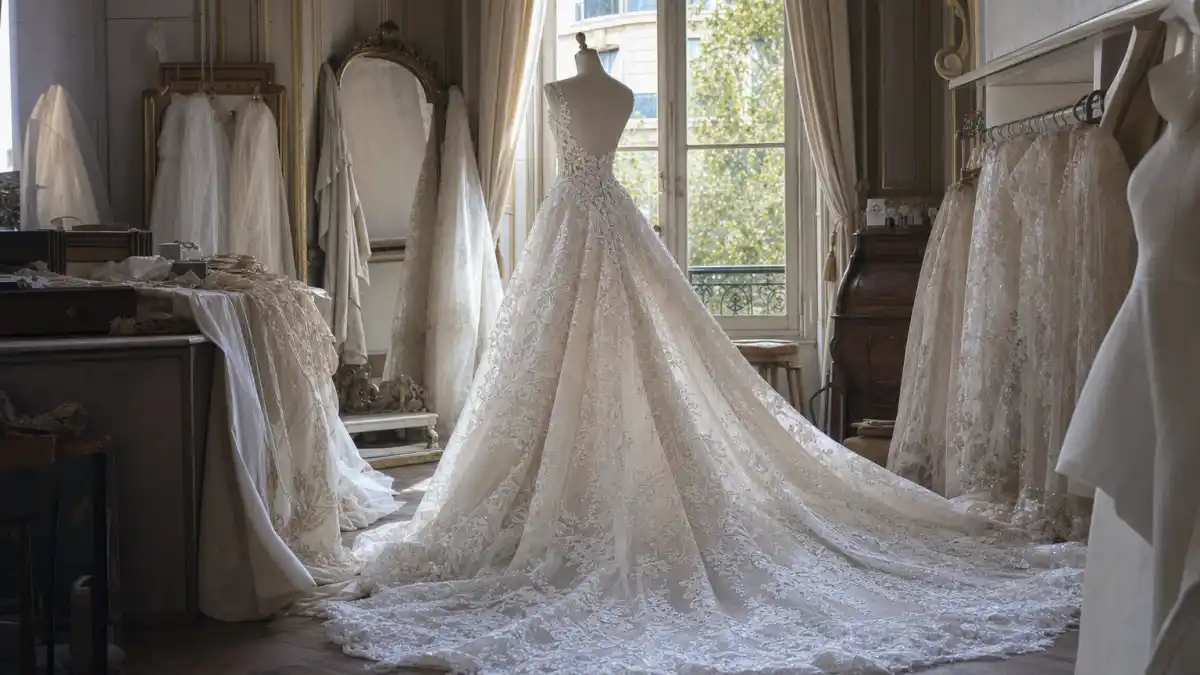
Celebrity Wedding Dress Designers Guide: Why Designer Names Matter
Searchers typing celebrity wedding dress designers guide usually want a definitive list, house histories, or inspiration for their own ceremony. The answer requires separating fame from craft. A celebrity can wear any white gown and trend for forty-eight hours; an iconic designer pairing rewires salons — copycat silhouettes appear at every price point, museums request loans, and fashion textbooks cite the commission decades later. When Kate Middleton chose Alexander McQueen by Sarah Burton, long-sleeve lace did not just suit Westminster Abbey; it ended fifteen years of strapless bridal dominance. When Meghan Markle chose Givenchy by Clare Waight Keller, boat-neck minimalism became the royal alternative to McQueen volume.
Accurate coverage of any celebrity wedding dress designers guide must name the creative director, not just the label; describe silhouette and fabric; cite the ceremony context; and explain the measurable trend that followed. “She looked beautiful” applies to thousands of weddings. “Sarah Burton engineered fifty-eight organza gussets and Carrickmacross lace appliqué” is the detail brides and editors still search twelve years later.
Haute Couture Ateliers Behind Star Nuptials
Most headline celebrity wedding gowns are not off-the-rack samples — they are bespoke commissions built in secured ateliers over months of fittings. Secrecy is part of the product: locked showroom doors, NDAs, decoy fabric shipments, and zero social leaks until the aisle moment. The labor is invisible in the final photograph but defines whether lace lies flat under HD broadcast cameras or collapses by the reception’s second course.
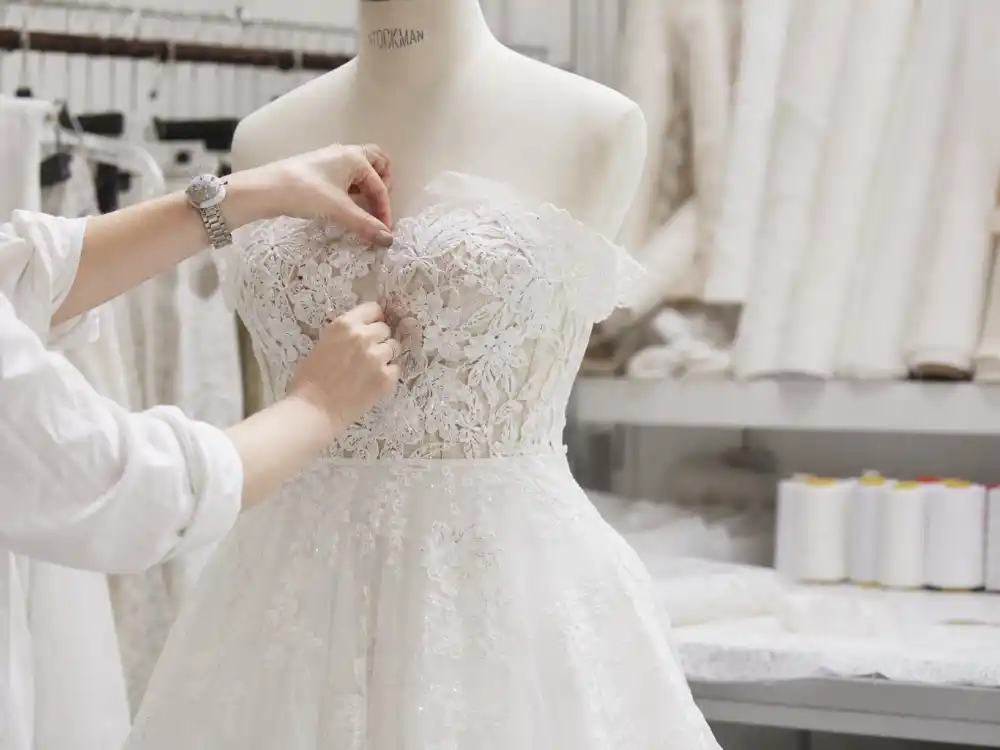
Couture bridal teams map internal corsetry, graduate organza layer weights, and hand-embroider motifs that catch candlelight and smartphone flash alike. Stylists advising modern brides use these ateliers as quality benchmarks: if your local seamstress cannot replicate graduated lace appliqué or proper boning distribution, you are copying the silhouette without the engineering — a common pitfall this celebrity wedding dress designers guide warns against.
Handcraft: Lace, Embroidery, and Construction Codes
The defining material across decades of celebrity bridal fashion remains lace — French Chantilly, Carrickmacross, guipure — layered over silk organza or gazar with hand-sewn pearl and crystal accents. Construction separates couture from costume: fitted bodices with internal boning support embroidery weight; cathedral trains are hemmed for specific venue aisle widths; veils are proportioned so necklines remain the focal point in wide shots.
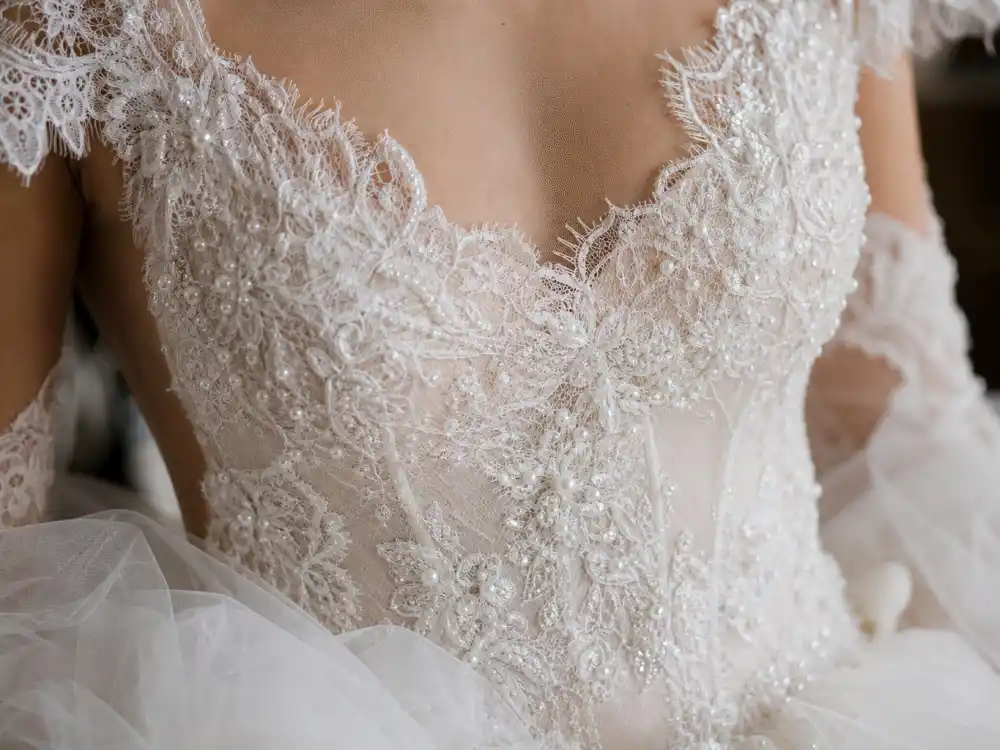
Bridal educators cite celebrity commissions in fashion courses because they combine romantic volume with structural discipline — gowns that must survive humid garden air, stone cathedral floors, and hours of celebration without losing shape. Understanding those codes enriches any study of the celebrity wedding dress designers guide canon: you are learning how houses translate red-carpet muscle into matrimonial permanence.
Givenchy and the Minimal Royal Turn
Givenchy Haute Couture under Clare Waight Keller delivered one of the most analyzed designer relationships of the 2010s when Meghan Markle married Prince Harry in May 2018. The boat-neck, three-quarter-sleeve silk organza gown with a sixteen-foot veil embroidered with Commonwealth flora represented deliberate minimalism — a counterpoint to Kate Middleton’s McQueen lace volume just seven years earlier. Waight Keller was the first female artistic director at Givenchy; Meghan’s choice signaled both fashion literacy and institutional respect.
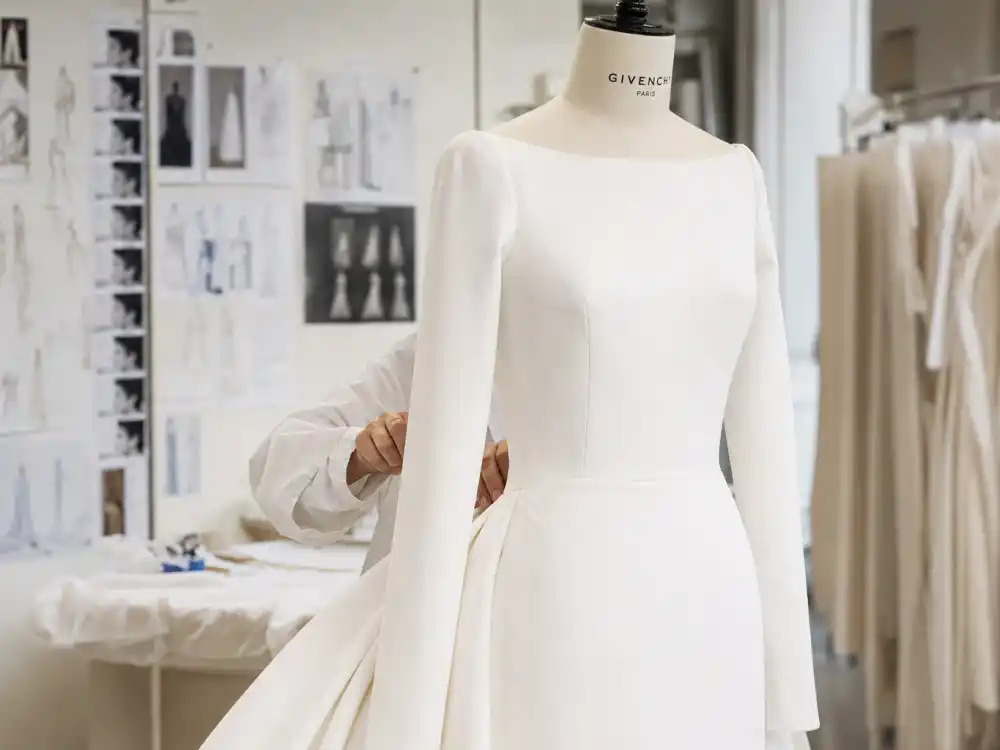
For searchers building a celebrity wedding dress designers guide mental map, Givenchy occupies the “clean line” quadrant: Audrey Hepburn’s LBD legacy extended into bridal via Waight Keller’s precise seaming and absence of excess ornament. Brides who want Meghan’s effect without a couture budget prioritize boat necklines, structured crepe bodices, and long veils with subtle embroidery rather than all-over lace — the commercial ripple of one designer decision through mass bridal.
Alexander McQueen and Sarah Burton’s Lace Revolution
Alexander McQueen — specifically creative director Sarah Burton after Lee McQueen’s passing — owns the 2011 inflection point in celebrity bridal history. Kate Middleton’s Westminster Abbey gown featured long lace sleeves, a V-neck bodice, padded hips referencing Victorian corsetry, and a nine-foot train built from fifty-eight gussets of organza. Burton’s team used Carrickmacross lace appliqué techniques developed in the McQueen atelier for red-carpet fantasy, scaled to constitutional pageantry.
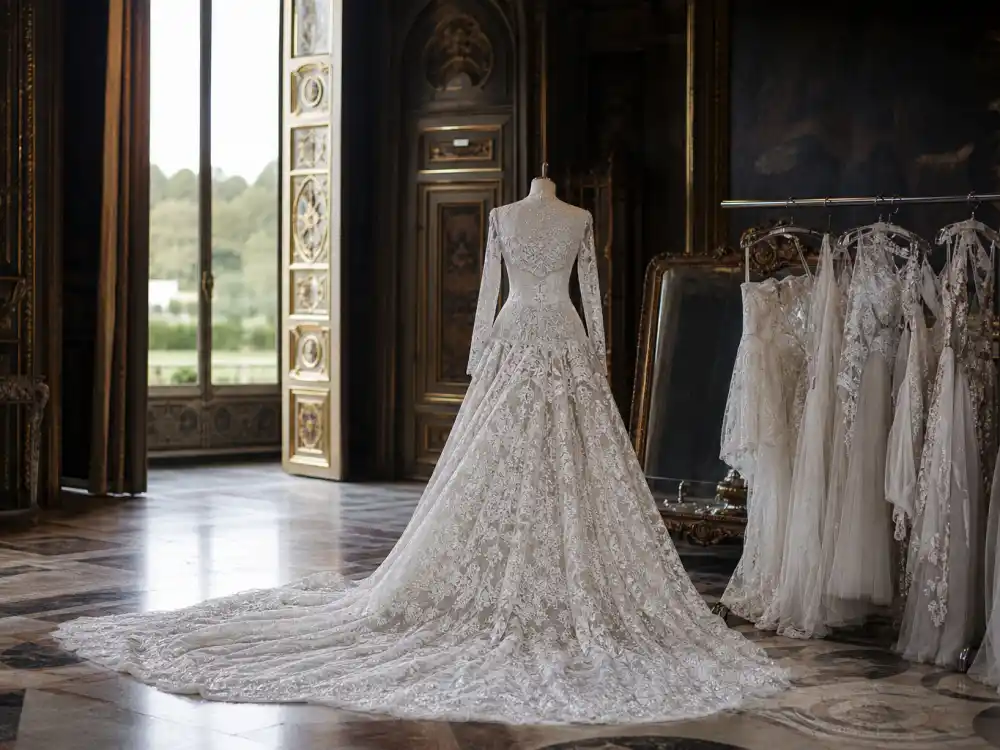
Any credible celebrity wedding dress designers guide treats Burton’s McQueen commission as the bridge between Diana’s 1980s volume and Meghan’s 2018 minimalism: sleeves returned, lace became non-negotiable, and “royal” no longer automatically meant tiara-and-taffeta cliché. Salon data from 2011–2014 confirmed long-sleeve lace inquiries surging at every price tier — proof that designer identity drives markets faster than celebrity fame alone.
Vera Wang and the Modern Celebrity Bridal Mainstream
Vera Wang occupies a distinct lane in the celebrity wedding dress designers guide: she is both couture-adjacent name and commercial powerhouse brides can actually access. Victoria Beckham wore lavender Vera Wang; Alicia Keys chose a purple-accent Vera Wang; countless Real Housewives and athletes selected Vera Wang silhouettes that photograph cleanly and ship on realistic timelines. Wang pioneered the idea that a celebrity bridal designer could scale — diffusion lines, flagship salons, and red-carpet credibility without mandatory six-figure couture invoices.
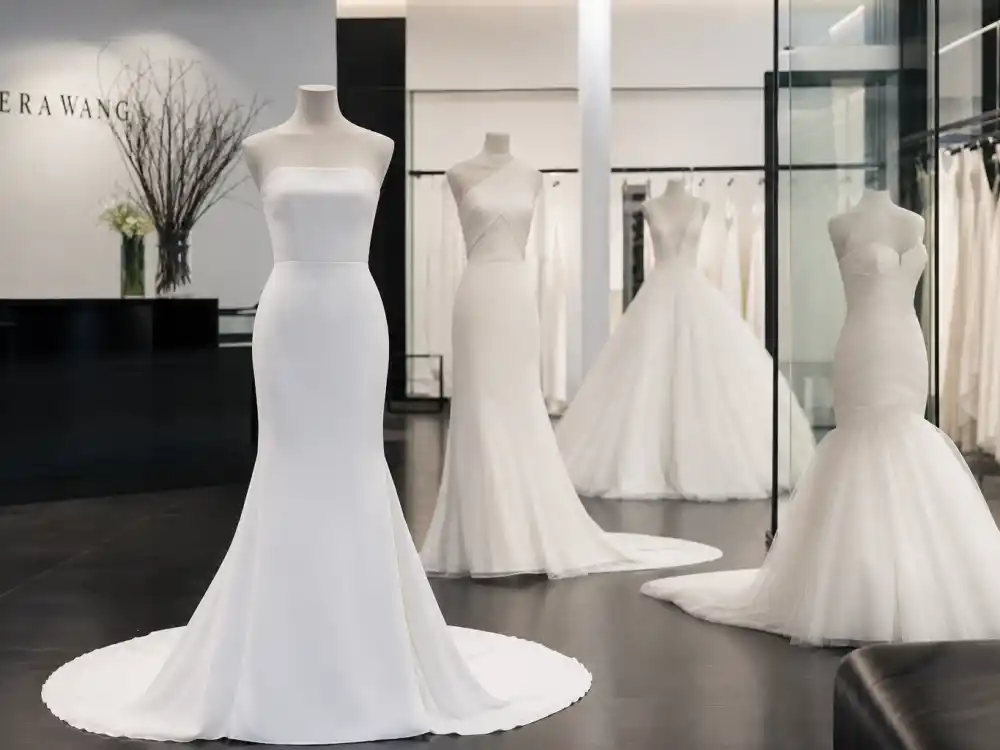
Wang’s design vocabulary — dropped waists, architectural tulle, unexpected color (blush, champagne, lavender) — gave celebrities permission to break white-only rules while staying “designer.” For civilians mapping celebrity wedding dress designers guide inspiration to real budgets, Vera Wang is often the first house where sample sizes, alteration networks, and financing options align with non-Hollywood timelines.
Oscar de la Renta, Marchesa, and Romantic American Couture
American romantic houses fill the off-shoulder lace and floral embroidery quadrant of celebrity nuptials. Oscar de la Renta dressed Amal Clooney for her Venice celebration (Peter Copping era) with French Chantilly, pearl beading, and A-line organza that proved heritage New York couture could own European destination ceremonies. Marchesa — Georgina Chapman and Keren Craig — defined Blake Lively’s 2012 blush-pink tulle ball gown at Boone Hall Plantation, launching rose-gold floral embroidery as a Pinterest-era bridal obsession.
These designers matter in a celebrity wedding dress designers guide because they translate red-carpet relationships into bridal accessibility faster than Paris houses: Oscar de la Renta bridal salons, Marchesa’s presence in luxury department stores, and editorial coverage that names the house in headlines. When searchers ask “who designs celebrity wedding dresses,” Oscar de la Renta and Marchesa appear alongside Givenchy and McQueen as the romance-and-embroidery answer.
Off-White, Stella McCartney, and Rule-Breaking Labels
Not every celebrity bridal moment comes from traditional couture. Hailey Bieber’s Virgil Abloh Off-White gown — backless lace with “Till Death Do Us Part” embroidery — proved streetwear-luxury could enter the matrimonial canon. Stella McCartney dressed Amal Clooney for her London civil ceremony in minimalist white tailoring, contrasting with Oscar de la Renta romance in Venice. These choices expand the celebrity wedding dress designers guide beyond lace princess fantasies into dual-look strategies: legal ceremony minimalism, celebration couture spectacle.
Rule-breaking labels matter for 2026 brides who identify with fashion-forward celebrity personas more than royal protocol. The designer name signals tribe: Off-White for hype-luxury couples, McCartney for sustainability-conscious minimalists, Narciso Rodriguez for city-hall slip purists (Carolyn Bessette-Kennedy’s 1996 benchmark). Tracking those codes prevents generic “celebrity inspiration” posts that ignore why a specific house fit a specific star.
How Celebrities Choose Their Wedding Dress Designer
Selection logic blends personal history, venue scale, brand relationships, and media strategy. Stars with existing red-carpet contracts (Givenchy, Dior, Valentino) often extend those relationships to matrimony — Meghan and Waight Keller had met through fashion circles before the royal engagement. Royal brides weigh protocol consultants alongside creative directors. Hollywood couples prioritize photographic performance: Blake Lively’s Marchesa blush read perfectly against South Carolina oaks; Kim Kardashian’s Givenchy by Riccardo Tisci lace matched Florence’s Forte di Belvedere stone at golden hour.
Secrecy contracts and exclusive fittings are standard for A-list commissions cataloged in any serious celebrity wedding dress designers guide. The designer gains global brand lift; the celebrity gains a garment engineered for their body and venue. When the pairing fails — ill-fitting samples, leaked sketches — the fashion press documents it as aggressively as success because bridal debuts are rare one-time inventory for houses that live on repeat red-carpet placements.
Translating Celebrity Designer Choices to Real Budgets
Exact celebrity couture is unavailable commercially, but elements copy efficiently at every price tier. From the celebrity wedding dress designers guide playbook:
- McQueen-inspired: Prioritize lace sleeve quality and bodice boning over train length — local seamstresses can adapt long-sleeve lace overlays to simpler skirts.
- Givenchy-inspired: Boat necklines and clean crepe lines require fewer embroidery hours; invest in fabric weight and tailoring.
- Oscar de la Renta-inspired: Off-shoulder lace and pearl accents scale through appliqué panels rather than full-gown beading.
- Vera Wang-inspired: Shop sample sales and prior-season trunk shows for architectural tulle at fraction of couture cost.
- Marchesa-inspired: Rose-gold floral embroidery transfers to belts, bodice panels, or detachable overskirts.
- Off-White-inspired: Custom embroidery on accessible lace sheaths delivers the statement without Abloh couture pricing.
Stylists recommend naming your reference designer in salon consultations — “McQueen lace sleeve, not generic lace” — because the celebrity wedding dress designers guide vocabulary saves fitting rounds and prevents off-the-rack mismatches.
Designer Timeline: From Helen Rose to 2026
Grace Kelly’s 1956 Helen Rose gown established Hollywood-to-royalty designer bridging. Diana’s David and Elizabeth Emanuel 1981 volume defined 1980s princess fantasy. Carolyn Bessette-Kennedy’s 1996 Narciso Rodriguez slip proved minimalist designer credibility. Kate Middleton’s 2011 McQueen reset lace sleeves. Meghan’s 2018 Givenchy pushed boat-neck restraint. Hailey Bieber’s 2019 Off-White merged streetwear and matrimony. Each entry in the celebrity wedding dress designers guide timeline reflects its media environment — newsreels, color tabloids, HD broadcast, Instagram Stories — and the designer who translated that moment into silk.
Common Myths About Celebrity Wedding Dress Designers
Myth one: celebrities always wear the designer they are paid to promote. Reality: many choose houses outside endorsement contracts for personal authenticity — Amal’s Oscar de la Renta was relationship-driven, not a paid placement. Myth two: any white lace gown counts as “McQueen inspired.” Reality: Burton’s Carrickmacross appliqué and gusset engineering are specific construction codes. Myth three: couture designers only dress royals. Reality: Vera Wang, Monique Lhuillier, and Galia Lahav dress athletes, musicians, and influencers globally. Myth four: the designer name guarantees icon status. Reality: the gown must photograph, trend, and copycat successfully — fame alone does not qualify for the celebrity wedding dress designers guide canon. Myth five: men do not matter in bridal designer history. Reality: Riccardo Tisci’s Givenchy lace for Kim Kardashian and Virgil Abloh’s Off-White rebellion expanded gender and aesthetic boundaries in celebrity bridal fashion.
Why This Keyword Still Dominates Search in 2026
Interest in celebrity wedding dress designers guide persists because weddings remain universally understood fashion spectacles — visual, emotional, algorithm-friendly, and cyclical every spring and fall bridal season. Every new celebrity union reopens designer debates: Does this house join the canon? Which historical commission does it reference? What will salons copy by December? Fashion students write theses on Sarah Burton and Clare Waight Keller; brides pin Amal’s Oscar de la Renta lace alongside Meghan’s Givenchy veil.
For USA Celebs readers, mastering designer names is mastering cultural power expressed through thread — who gets remembered, what silhouette wins the decade, and how a single atelier relationship can outlast albums and box office. The celebrity wedding dress designers guide is not a static list; it is a living map of houses, creative directors, and construction codes that brides, editors, and historians reinterpret every season.
Explore More
- Browse our Fashion section for celebrity style history and red-carpet breakdowns.
- Read celebrity wedding dresses most iconic for the full gown canon this guide references.
- See Meghan Markle wedding dress designer for deep Givenchy couture analysis.
- Compare Kate Middleton wedding dress Alexander McQueen for Sarah Burton lace construction.
- Check Amal Clooney wedding dress Oscar de la Renta for American romantic couture at scale.
For background, see coverage from Vogue, Harper’s Bazaar, Business of Fashion, and house archives at Givenchy and Alexander McQueen on couture bridal and celebrity fashion.