

In this article11 sections
- Cher Naked Dress Bob Mackie History: The 1974 Oscars Night
- Bob Mackie: The Designer Behind the Illusion
- How the Nude Illusion Gown Was Constructed
- Press Reaction and the Invention of "Naked Dress"
- The Mackie-Cher Partnership Beyond One Night
- Television, Censorship, and the Sonny & Cher Era
- Fashion Legacy: Every Modern Naked Dress Descends From 1974
- Museum Culture, Auctions, and Costume Preservation
- Common Myths and Corrections
- Why the Naked Dress Still Matters in 2026
- Explore More
Cher naked dress Bob Mackie history begins on April 2, 1974, when Cher walked the Academy Awards red carpet in a sheer, crystal-beaded nude-illusion gown that made television audiences gasp and fashion editors rewrite their rulebooks overnight. Costume designer Bob Mackie engineered the dress as wearable architecture — thousands of hand-sewn beads tracing the body while leaving expanses of transparent fabric that read, from a distance, like bare skin. Cher was not trying to disappear into Hollywood propriety; she was announcing that a pop star could own the Oscars rope line the way a couture house owns Paris. Fifty years later stylists still invoke that night when coaching clients through sheer-gown risks, and every modern “naked dress” on a carpet carries DNA from Mackie’s needle.
This guide traces the full Cher naked dress Bob Mackie history from Mackie’s early TV sketches to museum cases and Met Gala homages — who built the gown, why 1974 mattered, how bead placement created the illusion, what the press and Academy guests said in real time, and why the Mackie-Cher partnership remains fashion’s longest-running creative marriage. Whether you study celebrity costume design for journalism, red-carpet strategy, or pure love of 1970s glamour, you will leave with a complete timeline of the gown that invented the naked dress as a headline genre.
Cher Naked Dress Bob Mackie History: The 1974 Oscars Night
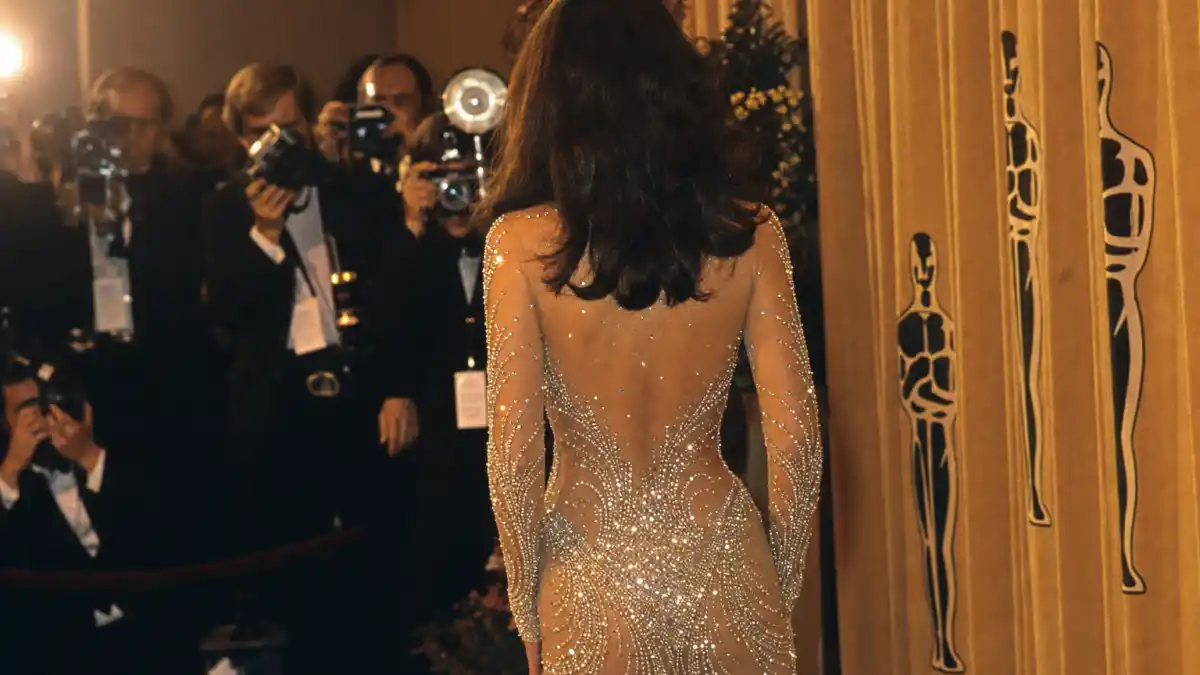
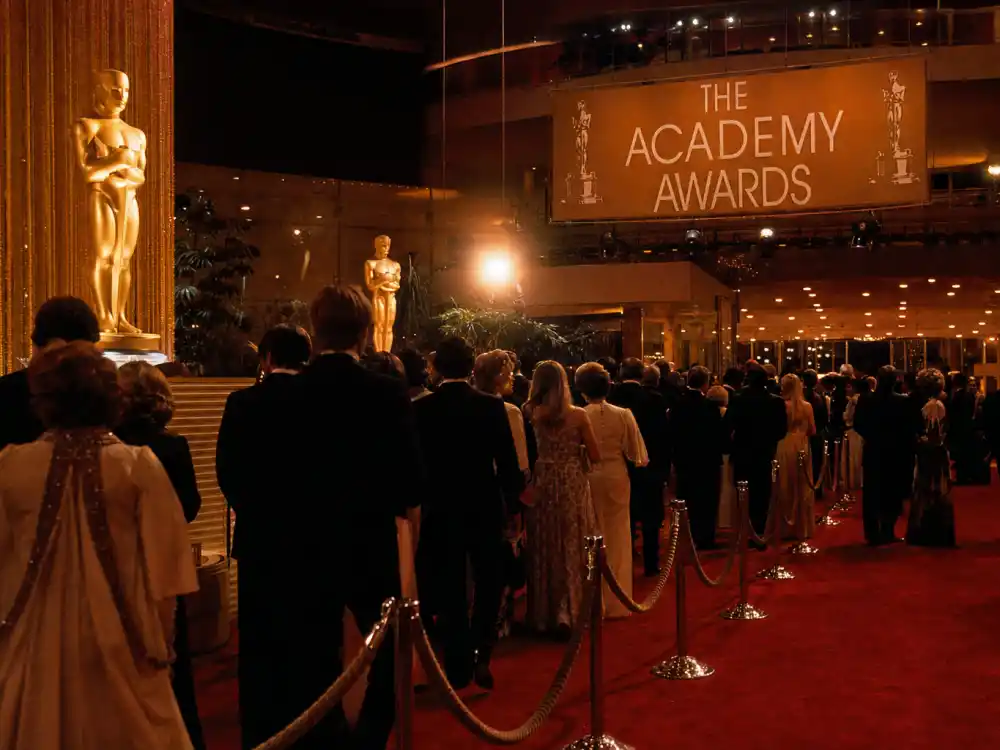
The 46th Academy Awards convened at the Dorothy Chandler Pavilion in Los Angeles — a formal evening of tuxedos, column gowns, and network television beaming Hollywood’s self-image into living rooms nationwide. Cher arrived with Sonny Bono, whom she would divorce two years later, wearing a Bob Mackie creation that reframed the entire broadcast’s fashion segment. The dress was floor-length, long-sleeved, and constructed from nude-toned sheer fabric. Mackie and his workroom mapped the torso, hips, and limbs with bugle beads and sequins in feathered, swirling motifs so dense they functioned as coverage while the negative space between them suggested nakedness.
Photographers on the rope line had never trained lenses on a major star dressed this way at the Oscars. The Cher naked dress Bob Mackie history is inseparable from that shock — not because the gown lacked fabric, but because it made fabric behave like skin. Cher’s posture on the carpet was unbothered: chin lifted, hair loose, movement confident. She understood Mackie’s engineering and trusted the beads to hold their story under flash. That partnership confidence is the emotional engine historians still cite when they call 1974 the birth of red-carpet provocation.
Bob Mackie: The Designer Behind the Illusion
Robert Gordon Mackie built his reputation sketching costumes for variety television before he became synonymous with Cher’s silhouette. Born in Monterey Park, California, he trained in the studio system of mid-century Hollywood costuming — learning drape, sparkle, and the mathematics of movement under stage lights. By the early 1970s he was designing Cher’s wardrobe for The Sonny & Cher Comedy Hour, translating pop stardom into sequined camp, Apache headpieces, and feathered capes that television censors barely tolerated.
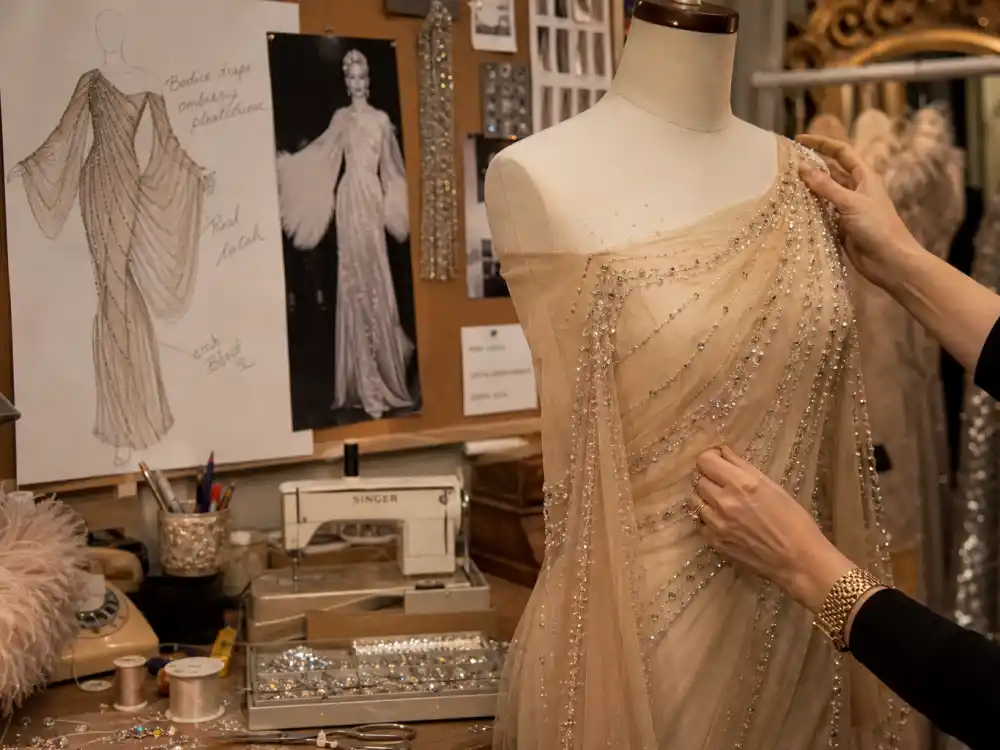
The 1974 Oscars gown was not Mackie’s first sheer experiment — he had been testing nude illusion on stage for years — but it was his first deployment of that vocabulary on the Academy’s most conservative carpet. Fashion historians note that Mackie treated Cher’s body as a canvas for narrative: each bead line directed the eye, each sheer panel invited debate. He later told interviewers the dress required hundreds of hours of handwork and that Cher never wavered when advisers suggested a safer alternative. That resolve defines the Cher naked dress Bob Mackie history as much as the stitching does.
How the Nude Illusion Gown Was Constructed
Mackie’s team began with a nude mesh base fitted to Cher’s measurements, then built coverage through strategic embellishment rather than opaque lining. Bugle beads and sequins were sewn in dense organic patterns across the bust, hips, and sleeves while leaving intervals of bare mesh that television cameras read as skin tone. Internal structure at the shoulders and waist prevented collapse during hours of standing and walking. The long sleeves extended the illusion to the wrists — a detail that made the gown feel complete rather than like a truncated stunt.
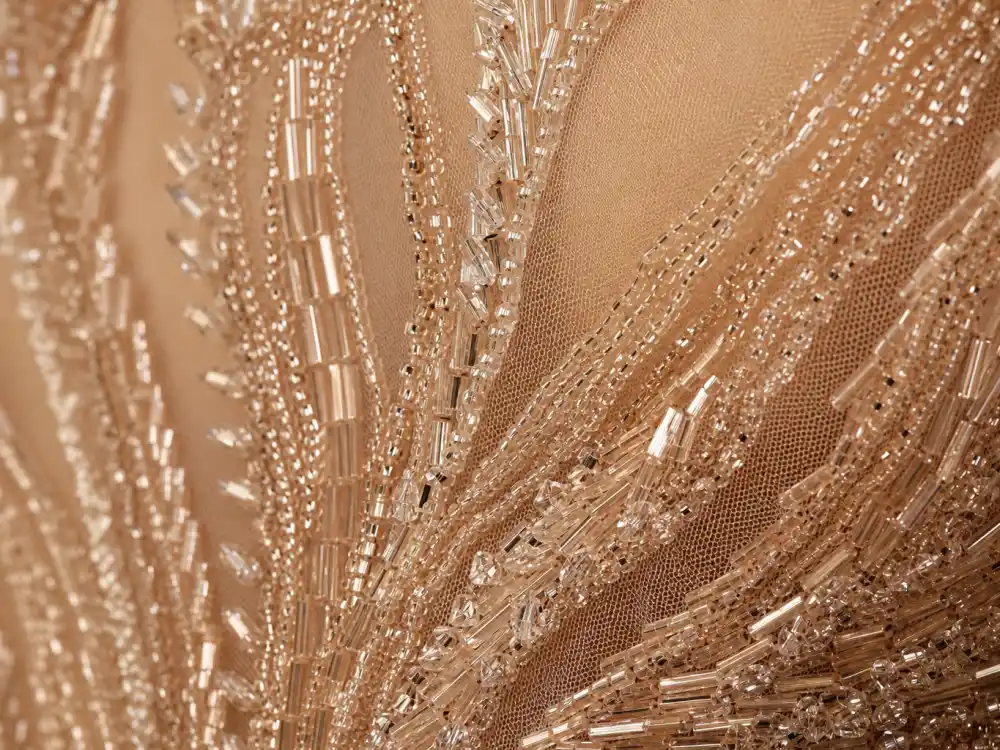
Costume archivists comparing Mackie’s 1974 gown to later naked dresses by designers from Alexander McQueen to Balmain note a consistent principle: the beads must tell a visual story so compelling that audiences forget they are looking at mesh. Mackie’s feather-and-scroll motifs accomplished that by feeling ornamental first and anatomical second. Copycat gowns that place beads only along bikini lines often fail on carpets because they read as lingerie rather than couture. The Cher naked dress Bob Mackie history lesson for designers is pattern density, not mere transparency.
Press Reaction and the Invention of “Naked Dress”
Morning papers and fashion trade magazines needed vocabulary for what they had witnessed. “Naked dress” became the shorthand — not literally accurate, but emotionally precise. Columnists debated whether Cher had insulted the Academy, empowered women, or simply executed brilliant publicity. Women’s Wear Daily covered the construction; mainstream tabloids cropped photographs for front pages that parents hid from children. The gown appeared on television recap shows alongside winners like The Sting, proving that fashion could compete with film for water-cooler dominance.
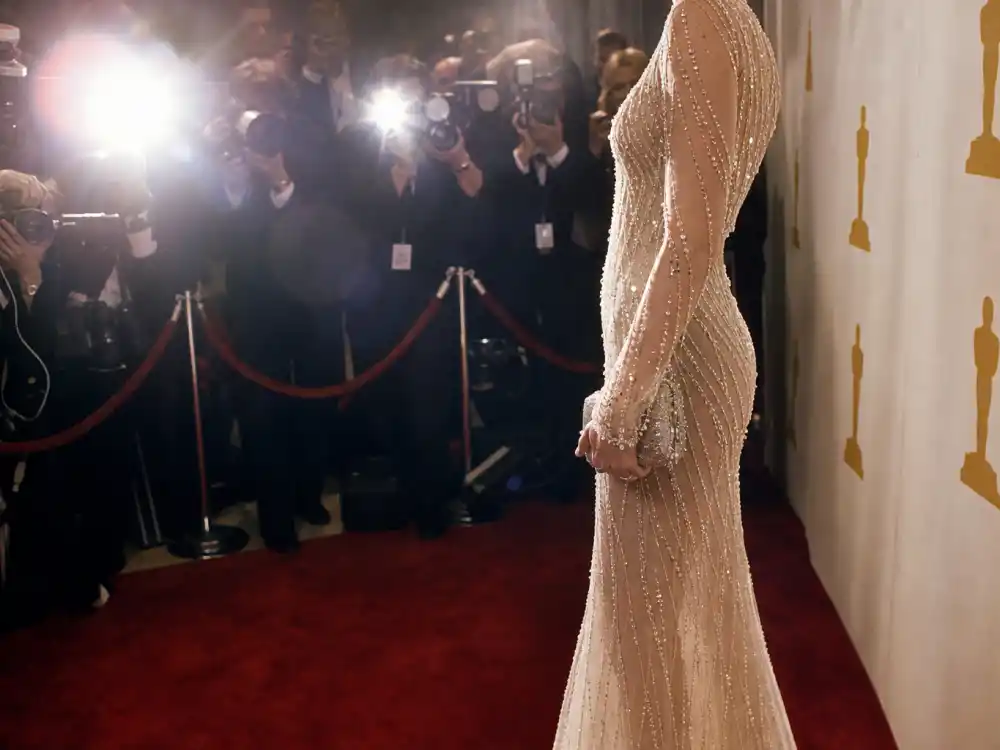
Critics who called the look vulgar missed the craft. Supporters, including a generation of young designers watching at home, saw permission to treat the body as a design problem rather than a liability. Within a decade, sheer panels appeared on runways from Paris to New York; within four decades, nearly every awards season featured a descendant gown credited, explicitly or not, to Mackie’s 1974 blueprint. The phrase “naked dress” entered stylist briefs as a category the way “little black dress” already functioned — and Cher plus Mackie owned the origin story.
The Mackie-Cher Partnership Beyond One Night
One gown does not sustain a fifty-year creative partnership. After 1974, Mackie continued dressing Cher for tours, television specials, magazine covers, and later Met Gala appearances that referenced their shared vocabulary of feathers, fringe, and fearless exposure. The 1986 Met Gala “Bob Mackie for Hurrell” theme found Cher in a towering feathered headdress; the 2017 Met Gala “Rei Kawakubo” year paired her with a sheer embroidered column that quoted the 1974 ethos in contemporary proportion. Each appearance reinforced that Mackie understood Cher’s appetite for transformation better than any house designer.
Television audiences who grew up on Sonny & Cher already associated the duo’s fashion with rebellion — bell-bottoms, midriff, Apache braids — but the Oscars gown escalated that rebellion into black-tie territory. For Cher, who would later win an Academy Award herself for Moonstruck in 1988 wearing a comparatively restrained black Mackie column, the 1974 dress established that her relationship with Hollywood’s biggest night was dialogic, not deferential. The Cher naked dress Bob Mackie history therefore spans one shocking entrance and decades of intentional callbacks.
Television, Censorship, and the Sonny & Cher Era
Context matters: Cher and Mackie honed shock value on broadcast television before they imported it to the Oscars. The Sonny & Cher Comedy Hour pushed CBS censors with belly-baring costumes, sheer inserts, and quick-change reveals that made fashion part of the comedy rhythm. Mackie sketched fast, sewers executed faster, and Cher performed the garments with comic timing. That training ground taught both collaborators how sheer fabric behaved under studio lights versus flash photography — knowledge Mackie deployed when engineering the 1974 mesh.
When historians argue whether the naked dress was calculated provocation or authentic self-expression, they often overlook this TV apprenticeship. Cher had been displaying Mackie’s body-conscious designs to millions weekly; the Oscars carpet was a larger stage, not a different personality. Network standards of the 1970s created a push-pull dynamic that made every successful sheer costume a small victory against prudishness. The gown that scandalized Academy traditionalists was, from Cher’s perspective, a logical next step in a wardrobe she had been wearing on air for years.
Fashion Legacy: Every Modern Naked Dress Descends From 1974
Runway and red-carpet archives document the lineage clearly. Halle Berry’s 2002 Oscars sheer embroidered gown, Kate Moss’s vintage slip dresses revived for galas, Rihanna’s Swarovski Adam Selman dress at the 2014 CFDA Awards, and countless Met Gala entries trading on strategic transparency all participate in a conversation Mackie started. Designers cite “nude illusion” in technical notes the way tailors cite canvas interfacing — a standard tool whose celebrity origin story points to Cher.
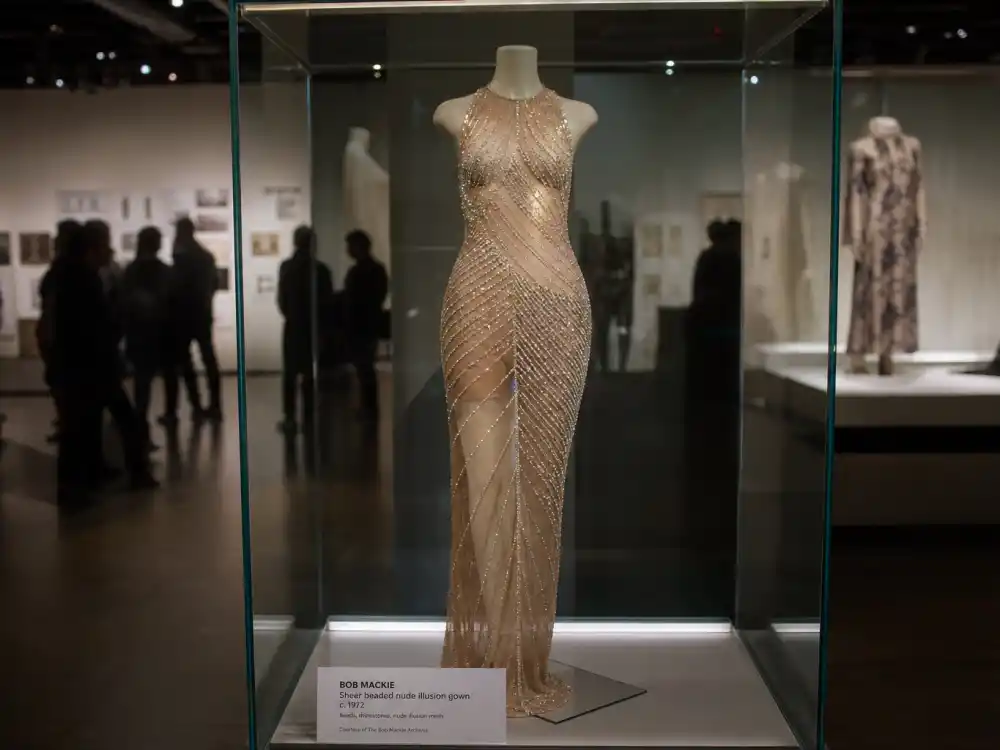
Social media accelerated the trend — a single sheer gown can trend worldwide before the star reaches her seat — but the stakes Mackie navigated were arguably higher. There was no Instagram to contextualize the look; there was only network television, newsprint, and word of mouth. Surviving that attention economy with craftsmanship rather than apology is why the Cher naked dress Bob Mackie history remains the reference case in fashion schools. Professors screen side-by-side comparisons of 1974 bead density versus 2010s laser-cut mesh to teach how illusion evolves while provocation stays constant.
Museum Culture, Auctions, and Costume Preservation
Original Mackie-Cher costumes periodically surface in exhibitions and charity auctions, though the exact 1974 Oscars gown’s whereabouts have been the subject of collector speculation for decades. Costume collections at institutions studying Hollywood dress use Mackie’s sketches and duplicate constructions to teach students about hand-beading labor — a single gown could require a workroom weeks. When pieces appear in retrospectives titled “Rock Style” or “Hollywood Costume,” the naked dress photograph leads marketing materials even if the physical garment is too fragile to travel.
Preservation challenges are unique: sheer mesh yellows, beads loosen, and mannequin display must respect ethical questions about exhibiting garments that simulate nudity. Curators solve this with dim lighting, strategic angles, and contextual panels explaining Mackie’s intent. Documentary series on Cher’s life inevitably include the 1974 carpet clip in opening montages, reintroducing the Cher naked dress Bob Mackie history to viewers born decades after the broadcast. Each revival keeps search interest alive and trains new stylists in the vocabulary of acceptable risk.
Common Myths and Corrections
Myth one: Cher was literally naked under the dress. Reality: nude illusion mesh and dense beadwork provided coverage; the “naked” effect was optical, not factual nudity. Myth two: Mackie designed the dress as a one-off stunt without Cher’s input. Reality: both collaborators have described the gown as a shared decision after years of TV costume partnership. Myth three: the Academy banned Cher afterward. Reality: no documented ban occurred; Cher continued attending and eventually won her own Oscar. Myth four: the 1974 dress was Cher’s only Mackie naked illusion. Reality: Mackie returned to sheer beaded silhouettes across decades, refining proportion for each era’s cameras.
Accurate Cher naked dress Bob Mackie history reporting holds all four truths: illusion not exposure, collaboration not sabotage, institutional tolerance not exile, and an ongoing design language not a single headline.
Why the Naked Dress Still Matters in 2026
Fifty-two years after Dorothy Chandler Pavilion flash bulbs, sheer beaded gowns still headline every awards season recap. Designers from young LA ateliers to Paris couture houses pitch “nude illusion” in collection notes; celebrity stylists maintain running lists of seamstresses who can bead on deadline. Cher herself, now in her seventies, continues to wear Mackie-adjacent glamour that quotes the 1974 silhouette with updated tailoring — proof that the partnership outlasted trends, divorces, and entire media ecosystems.
For USA Celebs readers tracking celebrity fashion as cultural signal, the Cher naked dress Bob Mackie history is the benchmark case study for designer-star symbiosis: one costume designer, one fearless client, one awards night, infinite aftershocks across television, film, music, and design education. No replica captures the original electricity of live 1974 television, but every sheer gown that stops a scroll participates in the legacy Bob Mackie stitched bead by bead.
Explore More
- Browse our Fashion section for celebrity style history and red-carpet breakdowns.
- Read Jennifer Lopez green Versace dress history for another gown that rewrote awards-show search traffic.
- See Lady Gaga meat dress explained for protest dressing with a different kind of public symbolism.
- Compare Princess Diana revenge dress story for 1990s royal fashion as headline warfare.
- Check Rihanna yellow Met Gala cape dress for modern red-carpet confidence dressing.
For background, see coverage from Vogue, Harper’s Bazaar, and the Academy of Motion Picture Arts and Sciences on 1970s red-carpet fashion, Bob Mackie’s costume archive, and Cher’s awards-show style evolution.