

In this article7 sections
- BAFTA vs Oscar Difference Explained: Voting Membership
- Categories: British Fields vs Academy Branch Map
- Timing: February BAFTAs vs March Oscars
- British Focus vs American Ceremony Culture
- Predictive Value: BAFTA as Oscar Crystal Ball
- Side-by-Side Quick Reference
- Explore More BAFTA and Oscar Pillar G Coverage
BAFTA vs Oscar difference explained in one sentence: the British Academy of Film and Television Arts crowns what its London-based membership values in February, while the Academy of Motion Picture Arts and Sciences crowns what a global but Hollywood-centric electorate validates in March — same art form, different ballots, calendars, and cultural gravity. BAFTA voters are BAFTA members — roughly 6,500 industry professionals with documented credits — casting ballots in category rounds that emphasize British cinema and international prestige. Oscar voters are Academy members — more than 10,000 artists, craftspeople, executives, and international invitees — using preferential ranked-choice balloting on Best Picture and branch-specific expertise on craft categories. Categories overlap on the surface — Best Film, lead acting, supporting acting — yet BAFTA maintains distinct British fields such as Outstanding British Film and the Rising Star Award that the Oscars do not replicate. Timing places BAFTA two to four weeks ahead of the Academy ceremony in most years, making EE BAFTA Film Awards night one of the last major precursors before Oscar envelopes open. Below we compare voting pools, category maps, February-versus-March scheduling, British-versus-American focus, and predictive handicapping value — with cross-links to our BAFTA Awards 2026 winners list (#136) and Oscar Pillar G coverage. We do not break down red-carpet outfits; that is Pillar F territory.
If you need the latest British ceremony results first, start with BAFTA Awards 2026 winners list (#136). For Academy mechanics, pair this with how are Oscar winners chosen voting explained (#18721), Oscar nominees 2026 (#18269), and Oscar winners 2026 full list (#18391). This piece is the dual-ceremony explainer: who votes, what each trophy means, and when to trust BAFTA night over other Oscar precursors.

BAFTA vs Oscar Difference Explained: Voting Membership
The sharpest BAFTA vs Oscar difference explained lesson is who votes. BAFTA membership includes actors, directors, producers, craftspeople, and other film and television professionals who meet eligibility criteria tied to credited work — with a substantial London and UK industry core even as international membership has expanded. Members vote in rounds: longlists and nominations often reflect specialist chapter input before all eligible voters weigh in on winners. The Academy of Motion Picture Arts and Sciences uses a different architecture: members belong to branches — actors, directors, editors, sound designers, and dozens more — and typically vote in nomination rounds within their branch expertise before the full membership ranks Best Picture through preferential balloting.
That structural split produces predictable divergences. A British indie adored by BAFTA voters may earn Best Film or Outstanding British Film while missing Oscar Best Picture shortlists built around global campaign spend. Conversely, a Hollywood studio tentpole can dominate Oscar craft categories while BAFTA voters reward a smaller UK co-production. Neither outcome is wrong — they reflect different electorates on different calendars. For full Academy ballot mechanics, see how are Oscar winners chosen voting explained (#18721). For guild overlap — often stronger than BAFTA for acting — bookmark SAG Awards vs Oscars predictor explained (#20801).
International Expansion vs Hollywood Gravity
Both institutions have internationalized in the twenty-first century. The Academy invited hundreds of new members from outside the United States after 2016 diversity initiatives, diversifying Best Picture taste beyond traditional studio consensus. BAFTA similarly broadened membership and reformed voting rules — including requiring voters to watch more contenders — to reduce home-country bias. Yet cultural gravity still diverges: BAFTA night leans toward British talent, UK co-productions, and European festival pedigree; Oscar night still orbits Hollywood marketing muscle and Academy branch craft expertise. The BAFTA vs Oscar difference explained frame is not “British awards versus American awards” in a crude nationalist sense — both honor global cinema — but handicappers still weight BAFTA as the strongest London peer signal and Oscars as the global industry coronation.
Categories: British Fields vs Academy Branch Map
Category design is the second major BAFTA vs Oscar difference explained axis. The Oscars maintain roughly twenty-three competitive categories on the main telecast — Best Picture through International Feature, Documentary, Animated Feature, and granular craft prizes for editing, sound, costume, and visual effects. BAFTA’s film ceremony uses a parallel but not identical map: Best Film, Outstanding British Film, lead and supporting acting in film, documentary, animated film, and craft categories — plus signature prizes the Academy does not offer on Oscar night.
Outstanding British Film is the clearest BAFTA-only headline category — celebrating UK qualifying productions regardless of whether they also compete for Best Film. The EE Rising Star Award — voted by the public and a jury — has no Oscar equivalent; track its lineage in our upcoming BAFTA Rising Star Award winners list. Oscar Best International Feature (formerly Foreign Language) maps loosely to BAFTA’s international categories but with different eligibility rules and campaign dynamics. Craft overlap is high — both honor editing, cinematography, costume, and production design — yet branch voting depth at the Academy produces more hyper-specific Oscar craft fields. Browse current Academy shortlists via Oscar nominees 2026 (#18269) and results via Oscar winners 2026 full list (#18391).

Timing: February BAFTAs vs March Oscars
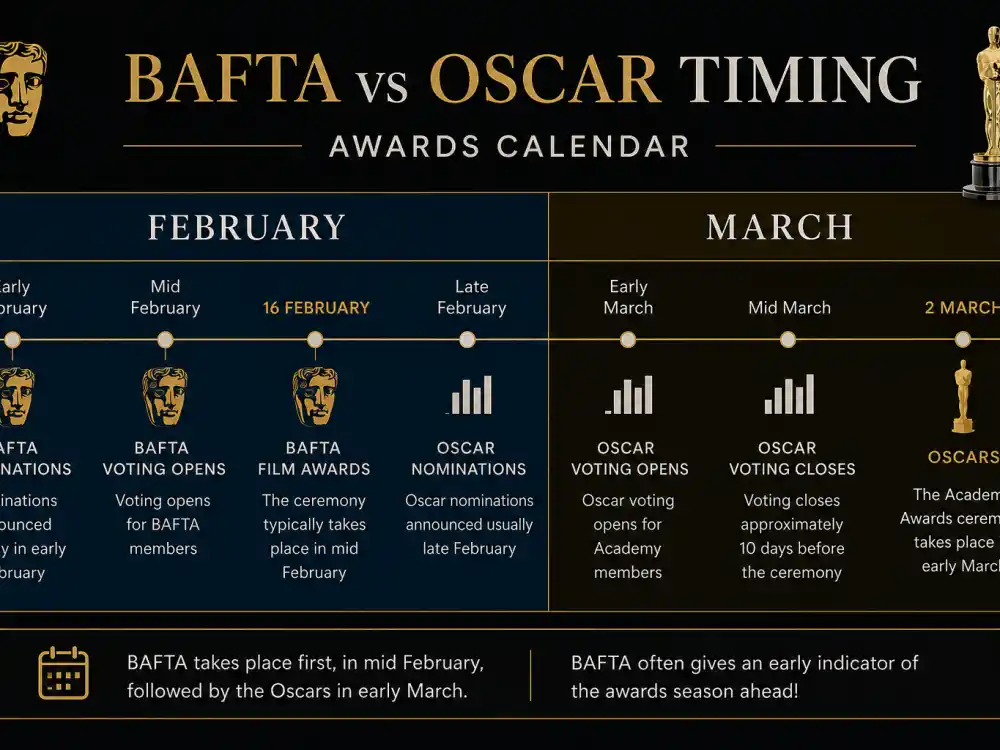
Calendar placement matters for narrative and handicapping. EE BAFTA Film Awards traditionally land in February — often the second or third Sunday of the month at the Royal Festival Hall or Royal Opera House in London — while the Academy Awards telecast airs in March, typically the first or second Sunday, at the Dolby Theatre in Hollywood. That two-to-four-week gap places BAFTA among the final major precursors before Oscar voting closes. Critics Choice and Golden Globes arrive earlier in January; SAG Actor Awards usually sit between Globes and BAFTA in late February or early March depending on the cycle.
Practical BAFTA vs Oscar difference explained guidance for fans tracking one season: watch BAFTA for how London peers rank contenders entering the Oscar homestretch; watch Oscars for the global industry stamp. When the same film wins BAFTA Best Film and Oscar Best Picture, pundits treat it as consensus — see whether that alignment held in who won best picture at Oscars 2026 (#18292) after BAFTA crowned its own victor in BAFTA Awards 2026 winners list (#136). Split years — BAFTA favorite loses Oscar Best Picture — remain common enough that no single London night should be treated as destiny.
British Focus vs American Ceremony Culture
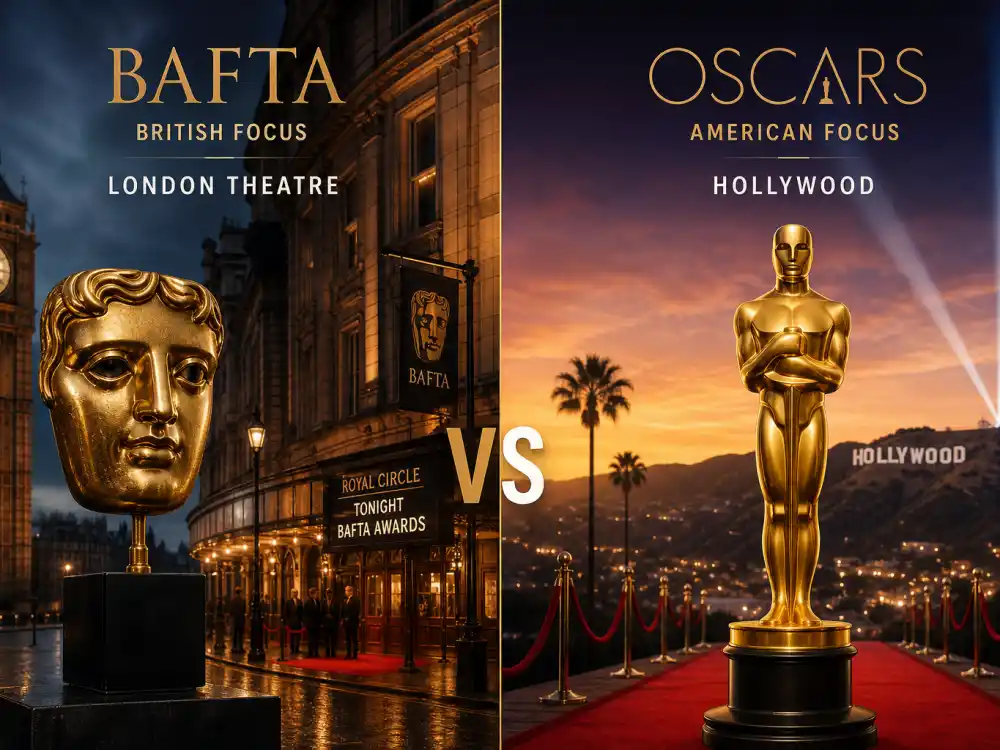
Geography and production culture sharpen BAFTA vs Oscar difference explained beyond ballots. BAFTA — founded in 1947 as the British Film Academy — stages a London ceremony with British hosts, Royal patronage traditions, and a guest list weighted toward UK talent even as Hollywood stars fly in for campaigning. The Oscars — born in 1929 at the Hollywood Roosevelt Hotel — remain the American industry’s flagship telecast, with ABC broadcast reach, studio after-parties, and decades of ceremony mythology from streakers to surprise upsets.
That cultural split influences which films get momentum. UK qualifying rules can elevate British co-productions on BAFTA night that Oscar voters evaluate purely on artistic merit without a homeland boost. American studio franchises may dominate Oscar craft categories through branch expertise while BAFTA voters reward smaller UK indies in Outstanding British Film. Neither show is provincial — both honor international cinema — but the BAFTA vs Oscar difference explained lens helps readers understand why a film can “win everywhere in London” and still lose Hollywood’s top prize. For ceremony-history context on the American side, explore our Oscar Pillar G archive from most Oscars won by an actor all time (#18414) through best actor Oscar winners list by year (#18529).
Predictive Value: BAFTA as Oscar Crystal Ball
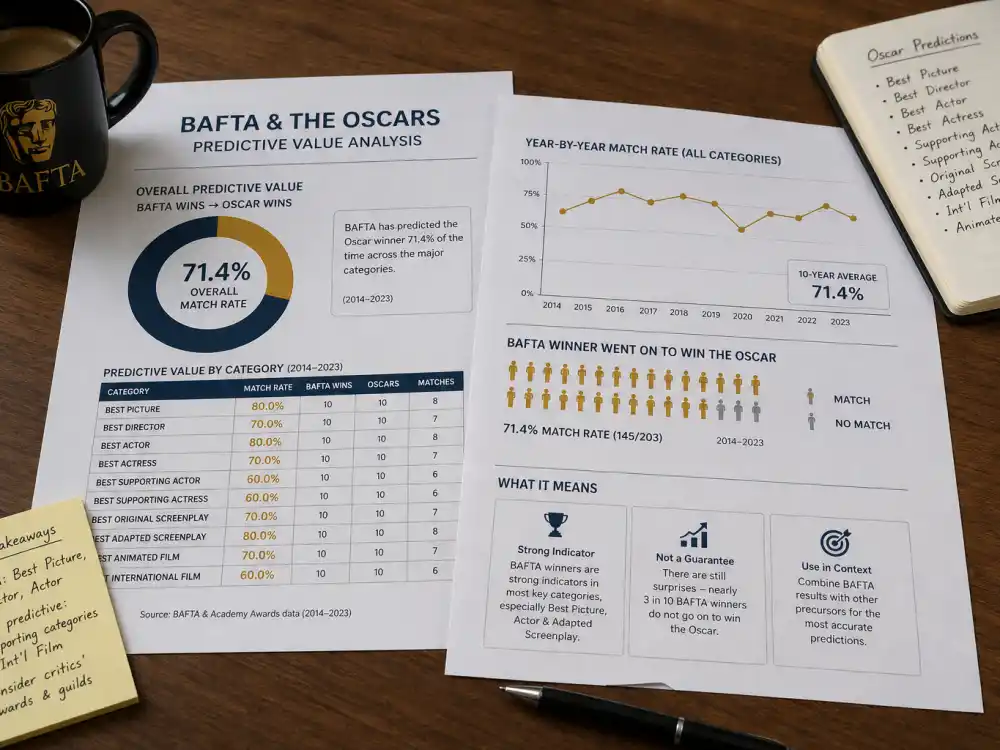
Handicappers treat BAFTA as a significant Oscar precursor — especially in acting races and Best Film — but not an infallible one. Historical overlap since the modern BAFTA-Oscar calendar alignment often shows strong correlation when the same English-language drama sweeps both ceremonies; mismatch years remind analysts that London taste diverges from Los Angeles branch consensus. BAFTA typically outperforms Golden Globes in predictive models because BAFTA voters are industry peers screening contenders, not journalists at the HFPA — yet SAG ensemble results often beat BAFTA for Best Picture signal per our SAG Awards vs Oscars predictor explained (#20801) analysis.
Use BAFTA night to update Oscar models two to four weeks before envelopes open: if BAFTA Best Actor and Oscar lead actor align, correlation is high; if BAFTA crowns a British indie for Best Film while Oscar front-runners remain split, expect variance. Rising Star and Outstanding British Film wins rarely predict Oscar outcomes because those categories have no Academy mirror. The BAFTA vs Oscar difference explained handicapping rule: weight BAFTA heavily for acting and Best Film, discount BAFTA-only categories, and never ignore SAG and Critics Choice signals from the same window.
Side-by-Side Quick Reference
- Voting: BAFTAs — BAFTA membership (~6,500+ industry professionals); Oscars — Academy branches with full membership Best Picture ballot.
- Categories: BAFTAs — Best Film, Outstanding British Film, Rising Star; Oscars — twenty-three main telecast categories including International Feature.
- Timing: BAFTAs — February in London; Oscars — March in Hollywood.
- Cultural focus: BAFTAs — UK industry gravity with global honorees; Oscars — global industry with Hollywood campaign center.
- Predictive value: Strong for acting and Best Film; weaker for BAFTA-only categories; compare with SAG for ensemble signal.
- Founded: BAFTA — 1947 (British Film Academy); Oscars — 1929 (Academy of Motion Picture Arts and Sciences).
Explore More BAFTA and Oscar Pillar G Coverage
- 2026 BAFTAs: BAFTA Awards 2026 winners list (#136).
- 2026 Oscars: Oscar nominees 2026 (#18269), Oscar winners 2026 full list (#18391), who won best picture at Oscars 2026 (#18292).
- Voting & predictors: how are Oscar winners chosen voting explained (#18721), SAG Awards vs Oscars predictor explained (#20801).
- Records & history: most Oscars won by an actor all time (#18414), who has won the most Oscars ever (#18437), best actor Oscar winners list by year (#18529).
- BAFTA siblings: BAFTA Rising Star Award winners list, most BAFTAs won by an actor.
- Archive: Awards category on USA Celebs.