

In this article15 sections
- Meghan Markle Wedding Dress Designer: Who Is Clare Waight Keller?
- Why Givenchy Won the Royal Bridal Commission
- The Dress: Boat Neck, Sleeves, and Triple Silk Organza
- Behind the Atelier: Fittings, Secrecy, and Construction
- The Veil: Commonwealth Flora and Diplomatic Stitch
- St George's Chapel: The Dress in Context
- Comparison With Kate Middleton's Alexander McQueen Gown
- Givenchy Heritage: From Audrey Hepburn to Windsor
- Evening Reception Dress: Stella McCartney Second Look
- Bridal Industry Impact After May 2018
- Common Questions and Myths
- Where the Dress Lives Now
- What Brides Can Borrow in 2026
- Clare Waight Keller After Windsor
- Explore More
Meghan Markle wedding dress designer Clare Waight Keller made history twice on May 19, 2018 — as the first female artistic director of Givenchy Haute Couture and as the woman who dressed a modern American actress-turned-royal for her marriage to Prince Harry at St George’s Chapel, Windsor. The gown was not the fairy-tale volume of Princess Diana’s 1981 Emanuel ball gown or the lace cathedral drama of Kate Middleton’s 2011 Alexander McQueen commission; it was deliberate minimalism — boat neckline, three-quarter sleeves, clean A-line silhouette in triple silk organza, and a sixteen-foot veil embroidered with flora representing all fifty-three Commonwealth nations. Searchers typing meghan markle wedding dress designer want the name behind the dress, the atelier process, and why Givenchy — not British houses like McQueen or Erdem — won the most scrutinized bridal commission of the decade.
This guide answers every layer of that question: who Clare Waight Keller is, how Givenchy’s Hubert de Givenchy heritage shaped the design, what construction details separated couture from off-the-rack imitation, how the veil carried diplomatic symbolism, and how the dress rewired bridal trends toward boat necks and restrained elegance. Whether you are a bride researching silhouette inspiration, a fashion student tracing royal couture history, or a royal watcher revisiting Windsor 2018, our breakdown of the meghan markle wedding dress designer story delivers designer biography, fabric science, timeline secrecy, and the measurable salon impact that followed the broadcast.
Meghan Markle Wedding Dress Designer: Who Is Clare Waight Keller?
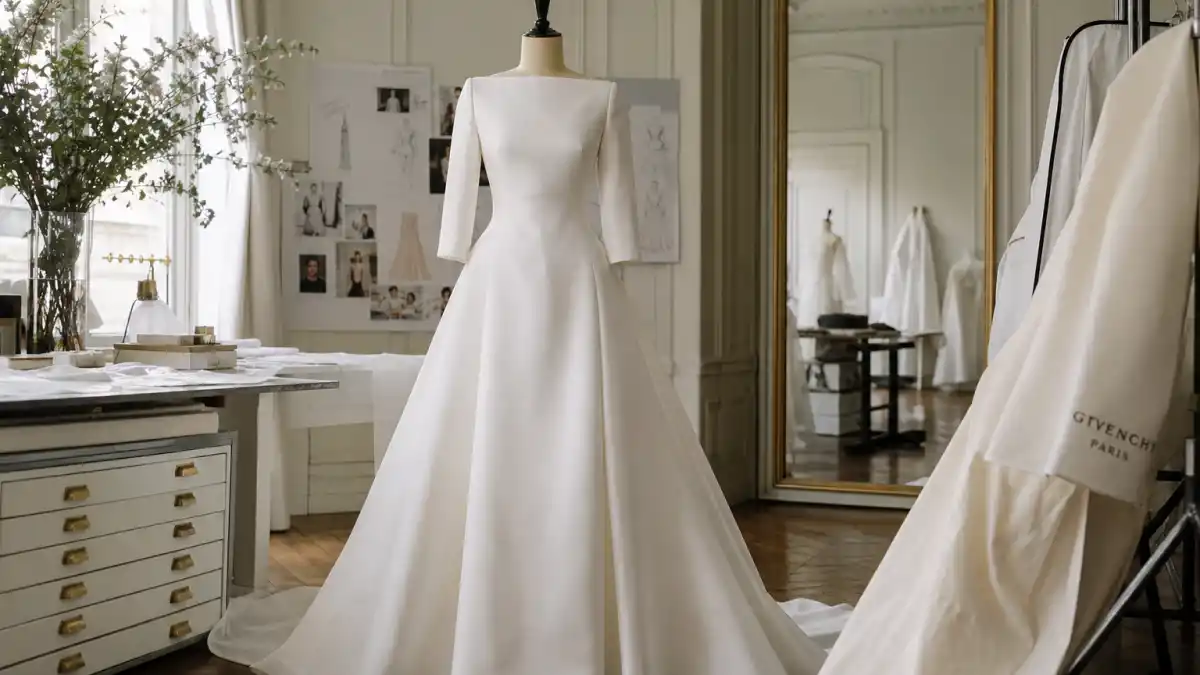
Clare Waight Keller is the British designer who served as artistic director of Givenchy from 2017 to 2020 — and the definitive answer to who is the meghan markle wedding dress designer. Born in Birmingham, educated at Kingston University and the Royal College of Art, she built her reputation at Pringle of Scotland and Chloe before Bernard Arnault appointed her to succeed Riccardo Tisci at Givenchy, making her the first woman to lead the house’s creative direction since Hubert de Givenchy founded the label in 1952. That milestone mattered symbolically for a bride who had spent years advocating for women’s empowerment: Markle reportedly chose Waight Keller partly because she wanted to support a female creative director on a global stage.
Waight Keller’s aesthetic before the royal wedding balanced sharp tailoring with romantic volume — structured shoulders, clean lines, occasional floral embroidery, never costume excess. She had dressed Markle for public appearances before the engagement, building trust that Givenchy could deliver modern royal restraint rather than Hollywood sparkle. When Kensington Palace confirmed the marriage date, fashion insiders speculated among British houses; the meghan markle wedding dress designer reveal on wedding morning stunned analysts who expected Erdem, Ralph & Russo, or Stella McCartney. Givenchy’s selection reframed the commission as a French couture statement filtered through British creative leadership — transatlantic, feminist, and historically literate.
Why Givenchy Won the Royal Bridal Commission
Givenchy’s relationship with royal-adjacent glamour predates Meghan Markle by sixty years. Hubert de Givenchy dressed Audrey Hepburn for Sabrina, Funny Face, and decades of off-screen friendship — the little black dress, the ball gowns, the cigarette pants that redefined mid-century elegance. That cinema-royalty crossover DNA made Givenchy a credible house for a televised Windsor ceremony even though the brand is Parisian, not London-based. Markle’s team understood that meghan markle wedding dress designer selection would be parsed as cultural diplomacy: British designer, French maison, American bride, global broadcast.
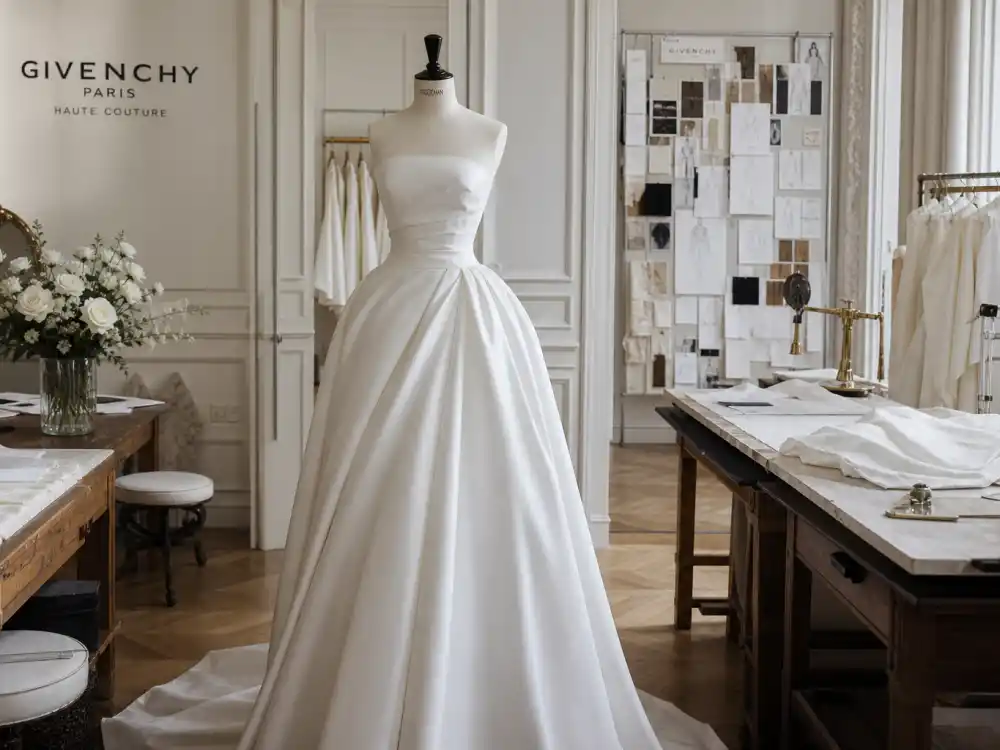
Practical factors also favored Givenchy. Waight Keller could schedule discrete fittings in Paris away from London paparazzi corridors. The house’s haute couture infrastructure — petites mains embroiderers, organza specialists, veil engineers — could deliver museum-grade construction under extreme deadline pressure. Competing houses like Alexander McQueen (Sarah Burton) had already defined the previous royal wedding; choosing a different creative lineage avoided direct comparison while still invoking couture legitimacy. The meghan markle wedding dress designer decision was strategic branding as much as personal taste.
The Dress: Boat Neck, Sleeves, and Triple Silk Organza
The gown’s silhouette was intentionally simple on paper, complex in execution. Boat neckline grazing the collarbones — a Givenchy signature revived from Hepburn-era archives — framed Markle’s face without veiling her identity in lace. Three-quarter sleeves offered modesty for a chapel ceremony while avoiding the full long-sleeve lace armor of Middleton’s dress; critics called Meghan’s sleeves “fresh” and brides called them copy-worthy within weeks. The skirt used triple silk organza layered for opacity without weight, holding an A-line that moved cleanly down St George’s nave without crinolines or bustles.
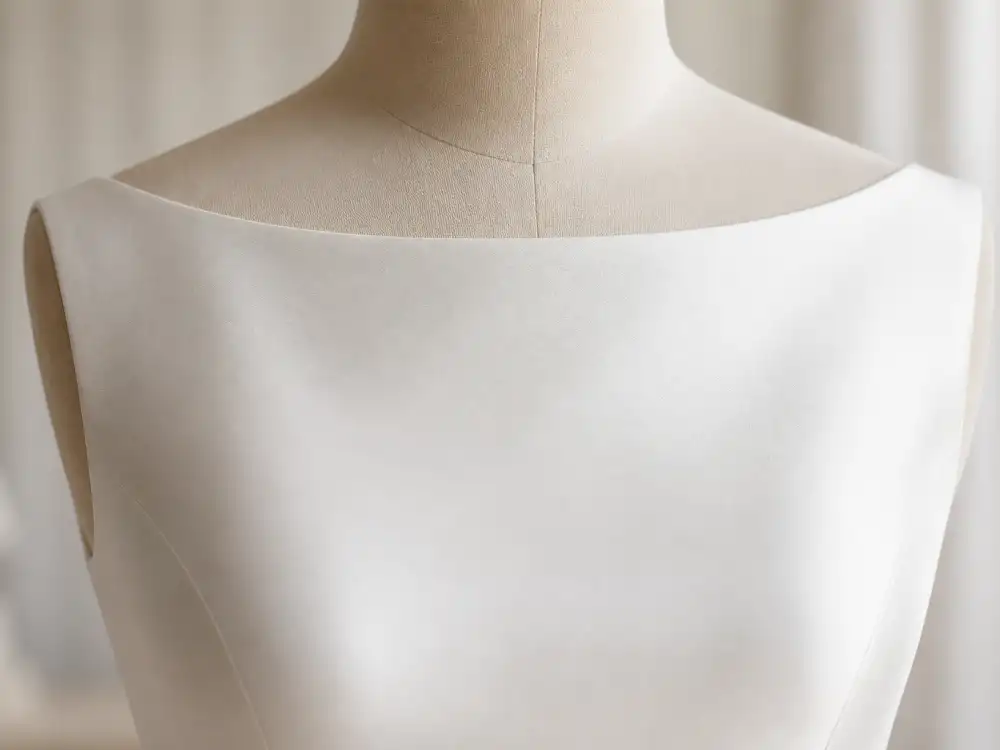
Waight Keller described the design as “refined modernity” — no lace appliqué dominating the bodice, no pearl encrustation, no structural cage exaggerating the waist. The absence of embellishment on the gown itself pushed attention to proportion, press, and the veil’s narrative embroidery. Fashion historians note that this minimalism risked reading as “plain” on a two-billion-viewer live stream; instead it photographed as confident, adult, and contemporary — the opposite of princess fantasy. That tension — simplicity under maximum scrutiny — is why the meghan markle wedding dress designer story still generates search volume every wedding season.
Behind the Atelier: Fittings, Secrecy, and Construction
Royal wedding dresses are among fashion’s most classified projects. Waight Keller and a tiny Givenchy team conducted fittings with Markle in private, reportedly starting months before the public announcement. Seamstresses washed their hands before touching organza to avoid oil marks; each layer was hand-finished so stitches would not shadow under broadcast cameras. The meghan markle wedding dress designer atelier operated under code names and non-disclosure agreements — standard for celebrity couture, extreme for a Windsor ceremony where a leaked sketch would become front-page news worldwide.
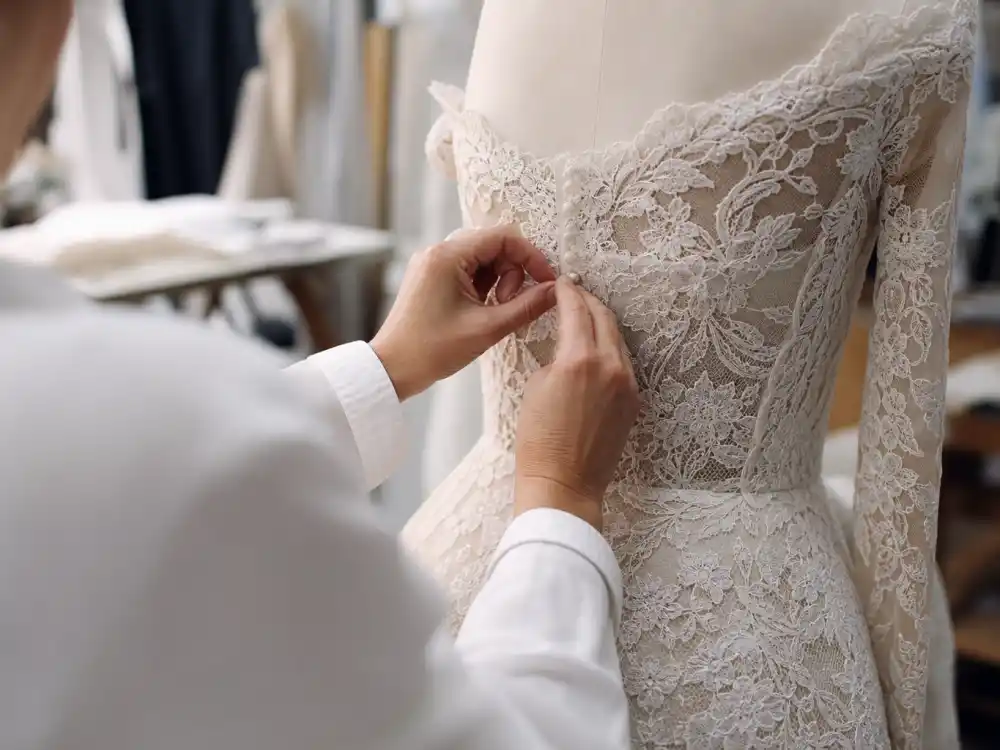
Construction details confirmed after the wedding:
- Bodice: Structured internally for posture through a two-hour ceremony without visible boning lines.
- Skirt layers: Triple silk organza cut on the bias for gentle movement without puff volume.
- Sleeves: Set-in three-quarter length, clean hem, no lace overlay — a deliberate break from 2011 royal lace codes.
- Closure: Hidden at back to preserve uninterrupted front lines for aisle photography.
- Train: Modest compared to Diana or Middleton — five meters, prioritizing chapel scale over spectacle.
Bridal manufacturers studied those specifications within days, producing “Meghan-inspired” boat-neck organza gowns at every price tier by autumn 2018 — the fastest proof that a meghan markle wedding dress designer commission had moved the mass market.
The Veil: Commonwealth Flora and Diplomatic Stitch
If the dress was restraint, the veil was narrative. Sixteen feet of silk tulle — five meters visible behind the gown, additional length for chapel perspective — carried hand-embroidered flora from all fifty-three Commonwealth countries. California poppy for Markle’s home state sat among English rose, Scottish thistle, Welsh daffodil, and dozens of international blossoms researched for botanical accuracy. Waight Keller treated the veil as the emotional and diplomatic canvas; the gown stayed quiet so the embroidery could speak.
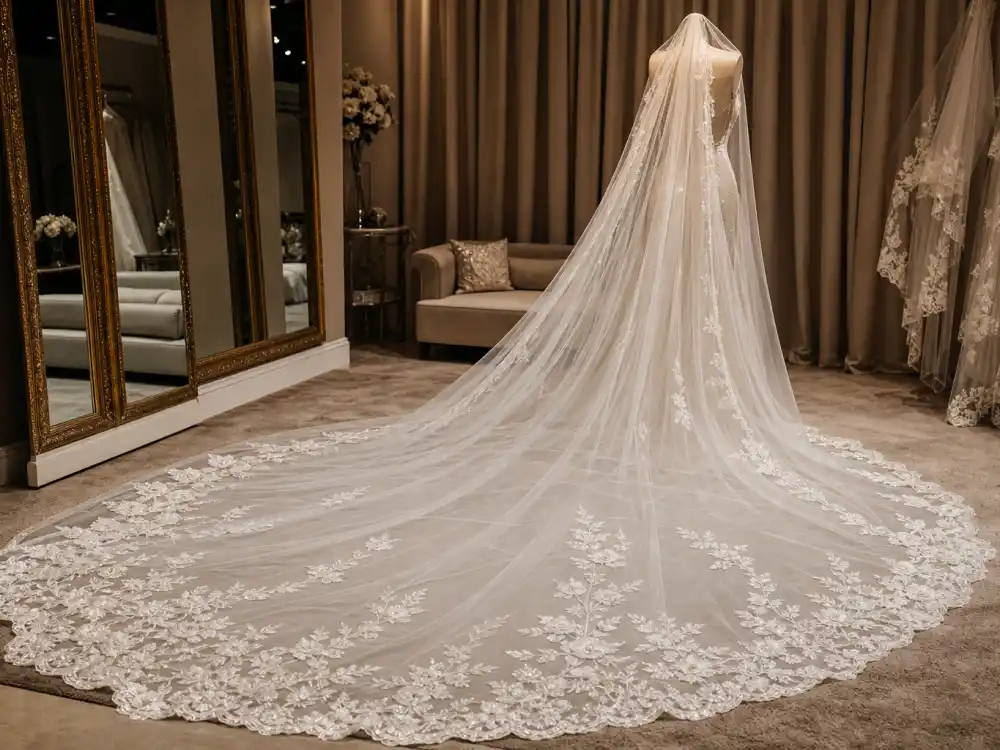
The veil also incorporated crops of wheat and Wintersweet — flowers that bloom in January at Kensington Palace — linking personal memory to institutional symbolism. Embroiderers at Givenchy’s Paris ateliers spent hundreds of hours on the veil alone, far more labor than the unadorned gown required. For searchers studying meghan markle wedding dress designer craft, the veil is the hidden couture marathon: the dress telegraphs silhouette trends; the veil preserves the diplomatic footnote historians cite in royal fashion archives.
St George’s Chapel: The Dress in Context
St George’s Chapel at Windsor Castle is gothic, intimate compared to Westminster Abbey, and lined with warm stone that absorbs white organza differently than Abbey grey light. Waight Keller and Markle reportedly considered how boat-neck clean lines would read against stained glass and marching soldiers — no lace competing with uniform detail, no sparkle fighting ceremonial swords. The meghan markle wedding dress designer team visited the chapel to study aisle length, train proportion, and camera angles for the BBC/U.S. network pool feed.
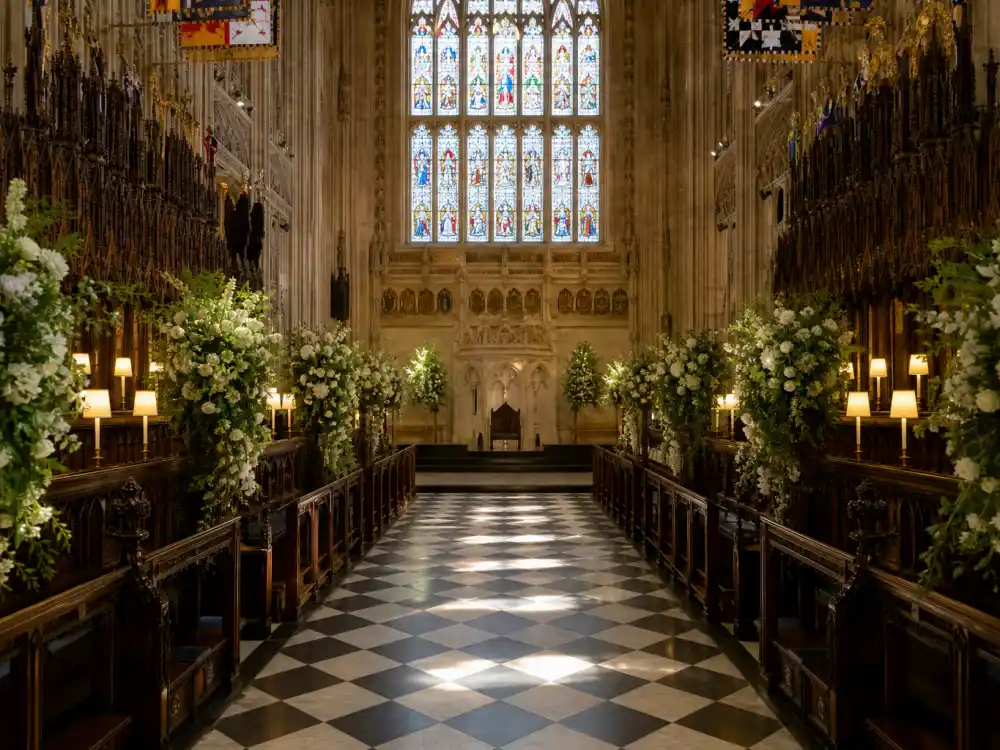
Markle entered without a veil over her face — another modern break from tradition — so the boat neckline registered immediately on first camera cut. Prince Harry reportedly gasped; social media split between “underwhelmed” and “breathless.” Within hours, Givenchy’s website traffic spiked; bridal Pinterest boards tagged “Meghan boat neck” surged. Context mattered: a simpler dress in a smaller chapel still reached an estimated two billion viewers — proving meghan markle wedding dress designer impact is measured in attention economics, not skirt volume.
Comparison With Kate Middleton’s Alexander McQueen Gown
Every meghan markle wedding dress designer article invites comparison to Kate Middleton’s 2011 Sarah Burton for Alexander McQueen dress — lace long sleeves, V-neck bodice, nine-foot train, 58 gussets of organza, national floral motifs in lacework. Middleton’s dress revived fairy-tale bridal romance after years of strapless dominance. Markle’s Givenchy pushed minimalism and boat-neck modernity — almost a generational correction within the same family institution. Neither is objectively superior; they reflect different royal briefs, different creative directors, different 2010s fashion moments.
Key contrasts for brides researching both:
- Designer nationality: Burton (British house, British designer) vs. Waight Keller (British designer, French house).
- Surface treatment: All-over lace vs. plain organza.
- Sleeve story: Full lace sleeve vs. clean three-quarter organza.
- Neckline: Plunging V vs. horizontal boat.
- Symbolism placement: Lace motifs on bodice/skirt vs. veil-only Commonwealth flora.
- Train scale: Nine feet vs. five meters — both substantial, Middleton’s read more voluminous on camera.
Bridal salons reported clients requesting “Kate lace” through 2015 and “Meghan boat neck” from 2018 onward — parallel legacies from two meghan markle wedding dress designer era-defining royal commissions.
Givenchy Heritage: From Audrey Hepburn to Windsor
Hubert de Givenchy founded the house in 1952 and built it on aristocratic simplicity — clothes that let the woman lead, not the ornament. His relationship with Audrey Hepburn produced the Sabrina necklines, the little black dress in Breakfast at Tiffany’s, and a template for “effortless” couture that was anything but casual in construction. Waight Keller channeled that DNA for Markle: boat neck echoes Hepburn bridal lines; organza discipline recalls mid-century gala gowns stripped of excess.
When Waight Keller joined Givenchy in 2017, she inherited a house balancing streetwear hype (Tisci’s era) with archival elegance. The royal wedding restored Givenchy’s couture credibility to mainstream audiences who knew the brand from red carpets but not from petites mains tables. After the ceremony, LVMH highlighted the commission in investor-facing materials; fashion students cited the dress in thesis papers on modern monarchy. The meghan markle wedding dress designer narrative permanently linked Givenchy to Windsor 2018 alongside Hepburn and Jackie Kennedy’s early Givenchy purchases.
Evening Reception Dress: Stella McCartney Second Look
Markle changed into a Stella McCartney halter-neck white gown for the evening reception at Frogmore House — sleek, bias-cut, high neck, open back. That second look confuses casual searchers who ask only “who designed Meghan’s wedding dress?” The ceremony answer remains Clare Waight Keller at Givenchy; the party answer is McCartney. Both choices reinforced Markle’s minimal-modern brand: couture restraint for the church, sensual simplicity for the private party. Complete meghan markle wedding dress designer coverage must separate the two — only the Givenchy gown carries the diplomatic veil and historic house appointment story.
Bridal Industry Impact After May 2018
Quantifying a royal dress effect is imperfect but directional. Google Trends data showed spikes for “boat neck wedding dress,” “Givenchy bridal,” and “three-quarter sleeve wedding dress” within seventy-two hours of Windsor. Retailers including H&M’s higher lines and specialty bridal chains issued press releases citing Meghan-inspired silhouettes for 2019 collections. The meghan markle wedding dress designer effect paralleled Middleton’s lace surge but pushed minimalism — clean necklines, plain crepe and organza, statement veils instead of statement bodices.
Couture houses also noticed: more brides requested discreet embroidery with personal meaning (state flowers, heritage motifs) rather than all-over bling. Waight Keller’s veil blueprint — private symbolism on public tulle — became a consultation talking point in upscale salons worldwide. Even brides who never watched the royal wedding absorbed the aesthetic through Instagram reposts and evening-news montages.
Common Questions and Myths
Myth: Meghan designed the dress herself. Reality: Markle collaborated on brief and fittings, but Clare Waight Keller and Givenchy ateliers executed couture construction — standard for celebrity bridal, absolute for royal protocol. Myth: the dress was inexpensive because it looked simple. Reality: haute couture organza commissions run into six figures before embroidery; simplicity requires premium fabric because flaws have nowhere to hide. Myth: Givenchy was a random choice. Reality: months of relationship-building between Markle and Waight Keller preceded the commission. Myth: the dress disappointed fashion critics universally. Reality: reviews split, but salon copycat data proves enduring influence — the practical verdict on any meghan markle wedding dress designer analysis.
Where the Dress Lives Now
Unlike Diana’s dress, which toured museums, Markle’s Givenchy gown has not been on public exhibition as of 2026 — royal and personal archiving choices keep many Windsor 2018 garments private. Fashion historians rely on broadcast footage, official portraits by Alexi Lubomirski, and Givenchy’s approved press imagery for study. The meghan markle wedding dress designer legacy therefore lives primarily in digital memory and bridal trend genealogy rather than climate-controlled display cases — though speculation about future museum loans persists whenever royal fashion retrospectives open in London or Paris.
What Brides Can Borrow in 2026
Contemporary brides mining meghan markle wedding dress designer inspiration typically borrow:
- Boat or portrait necklines for ceremony portraits.
- Three-quarter sleeves without lace overload.
- Plain organza or crepe skirts with minimal seaming.
- Statement veils carrying personal embroidery (heritage flowers, family symbols).
- Separated ceremony and reception dresses — couture for church, slip for party.
Stylists caution: the Givenchy veil’s sixteen-foot scale requires venue proportion; a courthouse ceremony needs edited embroidery on a fingertip veil, not cathedral tulle. The Meghan lesson is intentionality — every choice read on camera because the meghan markle wedding dress designer team edited ruthlessly.
Clare Waight Keller After Windsor
Waight Keller departed Givenchy in April 2020 amid broader LVMH creative restructuring during the pandemic. Her royal wedding commission remains the most visible project of her tenure — referenced in every profile, overshadowing ready-to-wear collections that fashion week regulars studied more closely. She later launched UNIFORM, a direct-to-consumer line, and consulted on luxury projects; the meghan markle wedding dress designer credit follows her résumé permanently, the way Sarah Burton’s Middleton dress anchors McQueen bridal lore.
For fashion students, the case study lessons are clear: couture survival in the Instagram era requires broadcast moments; female creative director appointments carry symbolic weight in institutional clients; minimalism under magnification demands flawless execution. Waight Keller delivered all three on May 19, 2018.
Explore More
- Browse our Fashion section for royal style history and red-carpet breakdowns.
- Read celebrity wedding dresses most iconic for the full royal bridal canon including Meghan and Kate.
- See Kate Middleton wedding dress Alexander McQueen for Sarah Burton lace construction.
- Compare Audrey Hepburn little black dress Givenchy for the house’s earlier Hollywood legacy.
- Check how to dress like Meghan Markle royal style for her engagement-era wardrobe formula.
For background, see coverage from Vogue, Harper’s Bazaar, Givenchy, and the Royal Family on the Windsor wedding, Clare Waight Keller, and haute couture bridal history.